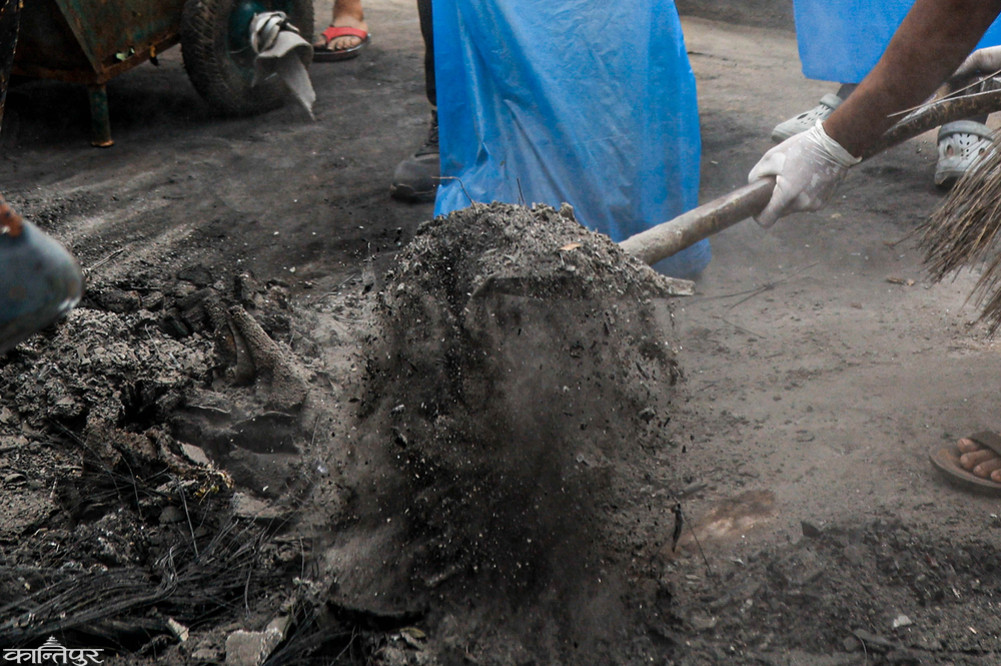
The Gauri Bahadur Karki-led commission of inquiry did not mention the forensic test report conducted in India in its report, citing the delay in its delivery.
We use Google Cloud Translation Services. Google requires we provide the following disclaimer relating to use of this service:
This service may contain translations powered by Google. Google disclaims all warranties related to the translations, expressed or implied, including any warranties of accuracy, reliability, and any implied warranties of merchantability, fitness for a particular purpose, and noninfringement.
Forensic tests have shown that petroleum products were used in the arson attacks on key structures in the country the day after the Gen-G movement on 23 Bhadra. A report has reached Kathmandu that petroleum hydrocarbon residues were found in samples sent to India during testing.
Although that report arrived a week ago, it was not included in the report of the Gauri Bahadur Karki-led Commission of Inquiry into the incidents of Bhadra 23 and 24.
‘Initially, we sent it to the police forensic science laboratory, and after the results were not available in Nepal, there was talk of sending it to other countries.’ Later, the government sent it to India,’ said a member of the committee, ‘However, we were not able to include its report as it did not arrive even by the last minute.’
The Commission of Inquiry had shown interest in it after the American newspaper ‘The New York Times’ wrote a news story suspecting the use of chemicals during the arson attacks on 24 Bhadra. Therefore, the police started collecting samples about a month and a half after the incident. For forensic testing, the police collected ashes from the main administrative center, Singha Durbar, the Supreme Court, the Parliament Building, the President's Office, and the private sector, including Kantipur Publications and Bhatbhateni Supermarket. Samples were collected from different places even at the same arson site. An investigation committee was formed under the leadership of the then SP of the Valley Crime Investigation Office, Kazi Kumar Acharya, to investigate the matter. After that, both the police committee and the inquiry commission showed interest in its test report.
However, the samples could not be tested in Nepal. After that, the process of testing the samples was taken forward through the police forensic laboratory with the support of the Ministry of Home Affairs, the Ministry of Foreign Affairs, and the Nepali Embassy in India.
A Home Ministry official says, ‘A DSP Saab himself had reached Delhi from the Forensic Science Laboratory in Kathmandu for this test.’
The laboratory source also confirmed that he had sent nearly 3 kg of samples to India. ‘He coordinated with the Nepali Embassy in Delhi for the test and the samples were sent to the laboratory for testing,’ the source said, ‘That report was prepared 18 days ago and sent to Nepal.’
Even then, police sources say, the report had reached the police headquarters and laboratory from the Foreign Ministry via the Home Ministry. The officials of the investigation committee say that they have not received any response till the final stage of their study. ‘We had kept the details we received there, and had mentioned that further investigation is needed for the missing ones,’ said another member of the committee.
Discussions on the topic of making bombs with chemicals and petrol
including sodium were held on the servers named ‘Youth Against Corruption’ and ‘Youth Hub’ of the platform ‘Discord’, where youth unite for the Gen-G movement.
The word ‘Molotov cocktail’ alone was found to have been used 356 times in the discussion on ‘Discord’. The commission’s report states that attempts were made to examine these issues together, but it could not be confirmed based on the evidence available at the time that the arson was organized and planned. The Karki Commission has also recommended an investigation and action against the then Prime Minister KP Sharma Oli, Home Minister Ramesh Lekhak and high-ranking officials in the incidents of 23 and 24 Bhadra. The commission had also mentioned that an investigation should be conducted against the then Inspector General of Nepal Police (IGP) Chandrakuber Khapung and the then Chief District Officer of Kathmandu, Chhabi Rijal. 76 people were killed during the government crackdown on the Gen-G movement on 23 Bhadra and the protests on 24 Bhadra.