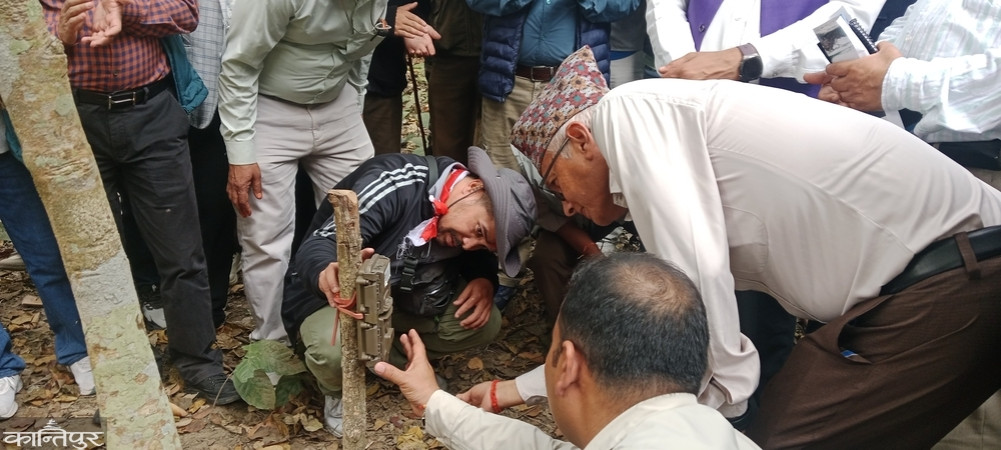
A study of tiger numbers, habitats, and prey species has been initiated in Shuklaphanta with the help of automated cameras and a technical team.
We use Google Cloud Translation Services. Google requires we provide the following disclaimer relating to use of this service:
This service may contain translations powered by Google. Google disclaims all warranties related to the translations, expressed or implied, including any warranties of accuracy, reliability, and any implied warranties of merchantability, fitness for a particular purpose, and noninfringement.
The national tiger census has begun in Shuklaphanta National Park and surrounding areas. The tiger census began in the Shukla-Laljhadi-Jogbuda complex through camera trapping method from Tuesday.
The census has started in Shuklaphanta after three months of starting from the Chitwan-Parsa Complex. On Tuesday, Durga Dutta Bohara, the head of the District Coordination Committee, Kanchanpur, started the tiger census by turning on the automatic cameras.
‘The work of installing the cameras and training the technicians has started from today (Tuesday),’ said Manoj Air, Monitoring and Evaluation Officer of the National Parks and Wildlife Conservation Department. ‘The cameras will be kept in the field for at least 15 days at a time.’ According to him, the field work will be done for about 20 days, including the days of installing and removing the cameras.
260 grids of 2 x 2 kilometers have been constructed in the Shukla-Laljhadi-Jogbuda Complex. The grids have been constructed by identifying the areas where tigers roam. A pair of automatic cameras will be installed in each grid. The cameras will be kept for at least 15 days. The number of tigers will be identified by analyzing the images captured by those cameras.
The automatic cameras will be installed at a height of 20 centimeters on both sides of the road. The camera will take pictures of any animal that moves in between. Each camera will be monitored for 2/3 days. The images captured by the camera will also be collected.
‘Along with the number of tigers, their habitat and range will also be identified now,’ said Air, who is also a data analyst for the National Tiger Survey Program. ‘This will help in reducing human-tiger conflict with tiger habitat management.’ According to him, the study to be conducted in this way is called an occupancy survey.
For this, 15 by 15 kilometer grids are constructed. Technicians will walk and install automatic cameras in each grid to study and monitor. According to him, 24 grids have been constructed for the occupancy survey. ‘If we can study the tiger’s range and the condition of prey species, it will help in reducing potential conflicts,’ said Air. ‘It shows whether the census is showing the same tiger every year or whether there are no tigers in the past or how the tiger is changing its habitat, everything.’
Along with the tiger census and occupancy survey, prey species will also be studied. According to a previous study, the density of prey species per square kilometer in Shuklaphanta is around 146. Which is the highest in Nepal's protected areas.
Tiger census has been started in Shuklaphanta since 2009 through camera trapping method. Although a national tiger census is conducted every 4/4 years, tiger census has been conducted regularly in Shuklaphanta as per the plan to conduct a census every year in areas with low numbers and at risk. In the 2022 national census, the number of tigers here reached 36. According to the census conducted by the National Park Office last year, the number has increased to 43.
When the first tiger census was started using the camera trapping method in 2009, the number of tigers here was 8. Now it has increased by almost 5 times. It is suspected that human-wildlife conflict will also increase with the increase in the number of tigers. In the past few years, incidents of tigers entering settlements have also created fear among the locals. Stakeholders say that work should also be done to reduce conflict along with the increase in the number of tigers.
‘As the number of tigers increases, special emphasis should be placed on habitat management and increasing food species,’ said Bed Kumar Dhakal, Deputy Director General of the Department of National Parks and Wildlife Conservation. ‘The department is currently revising policies in line with the times, and preparations are underway to revise laws and regulations.’ He said that all concerned bodies should work to ensure the coexistence of both humans and wildlife.