Two-thirds, or 40 MPs, will also be required in the National Assembly to pass bills related to constitutional amendments and treaties that will have a long-term impact on the nation.
We use Google Cloud Translation Services. Google requires we provide the following disclaimer relating to use of this service:
This service may contain translations powered by Google. Google disclaims all warranties related to the translations, expressed or implied, including any warranties of accuracy, reliability, and any implied warranties of merchantability, fitness for a particular purpose, and noninfringement.
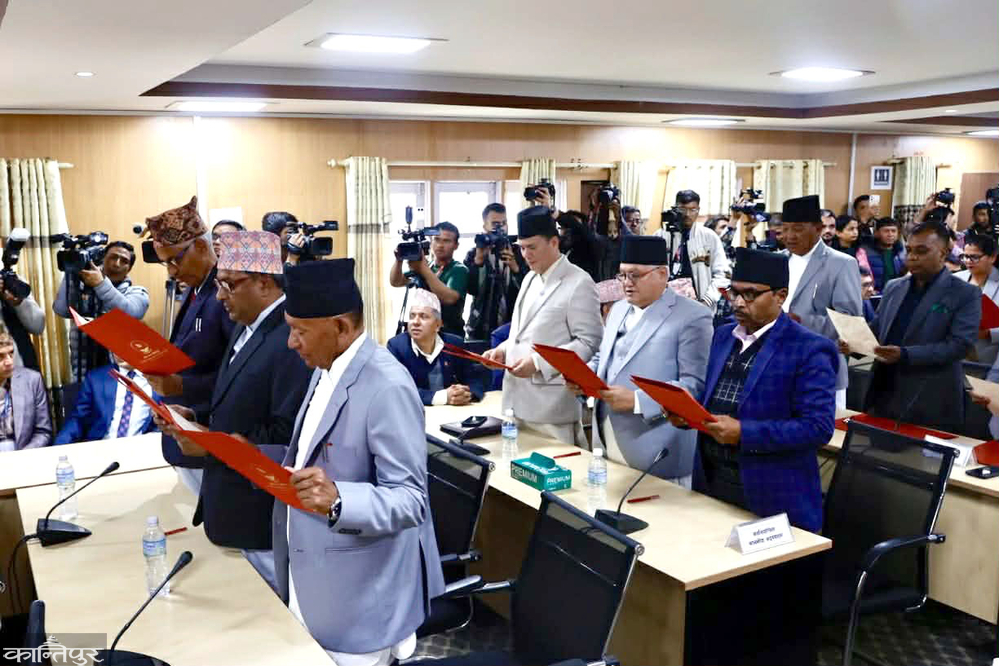
The equation of the upper house of the federal parliament has changed with the new members elected to the National Assembly taking oath on Monday. After 18 posts fell vacant, 17 members elected on 11 Magh took the oath. One member post, which should have been nominated by the President on the recommendation of the Council of Ministers, is still vacant. Experts on parliamentary practice and constitutional experts have commented that the role of the National Assembly will be important when the Rashtriya Swayamsevak Sangh (RSS) wins about a two-thirds majority in the House of Representatives.
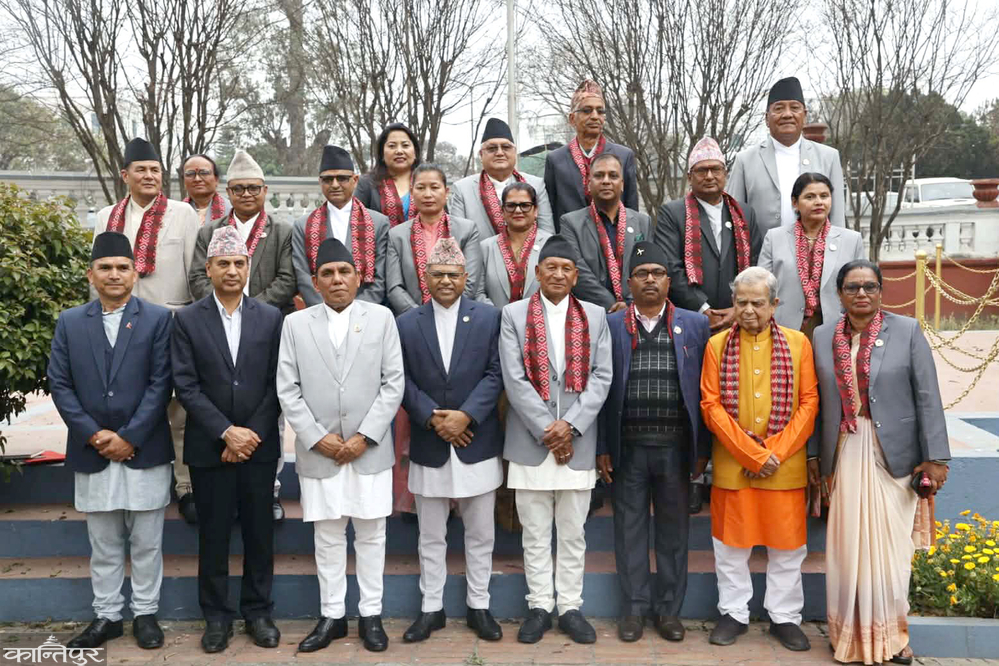
Among the members sworn in by National Assembly Speaker Narayan Prasad Dahal on Monday are 9 from the Congress, 8 from the UML, and 1 from the JSP. In the election held on 11 Magh for the National Assembly members, an alliance was formed between the Congress and the UML. 17 members were elected from the alliance and one was elected unopposed. Sunil Bahadur Thapa of the Congress was elected unopposed from Koshi. Along with Thapa, Ranjit Karna, Dharmendra Paswan, Geeta Devkota, Jagat Timilsina, Basudev Ghimire, Chandra Bahadur KC, Lalit Jung Shahi, and Khamma Bahadur Khati of the Congress took the oath.
UML's Roshni Meche, Somnath Portel, Rekha Jha, Prem Prasad Dangal, Samjhana Devkota, Ram Kumari Jhankri and Leela Kumari Bhandari are among those taking the oath. Meena Singh Rakhal, who was elected from UML, was absent from the oath-taking. Mahantha Thakur of JSP Nepal has also taken the oath as a member of the National Assembly.
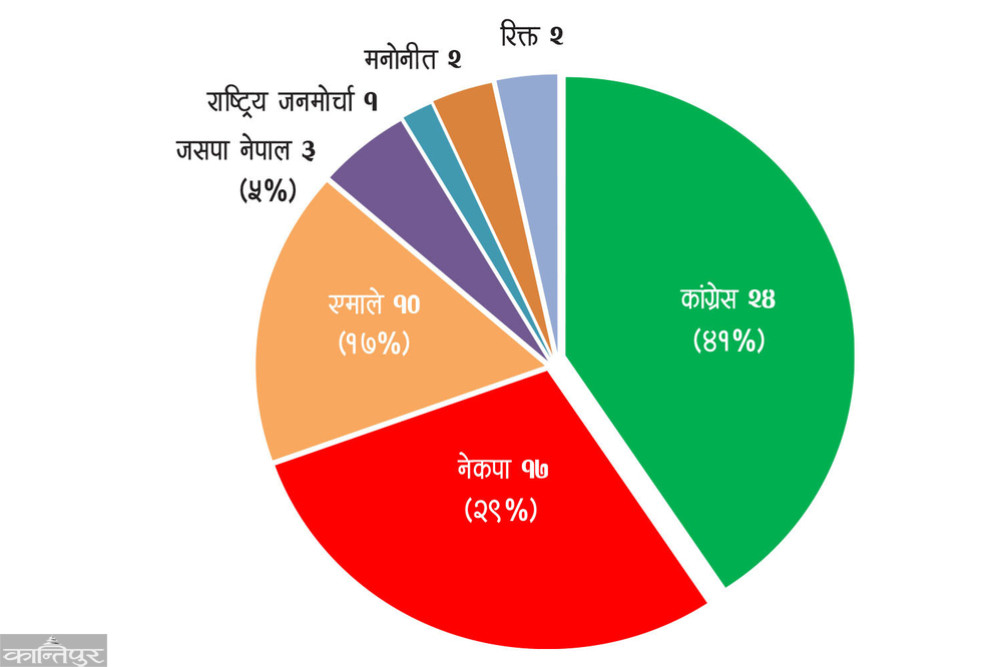
With the entry of MPs elected from the Congress and UML alliance, the 'size and power' equation of the parties in the National Assembly has changed. Earlier, the NCP was the largest party in the National Assembly. With the unity between the Maoists and the Unified Socialists, this party became the largest party with 24 MPs. Now the Congress has become the largest party with 24 MPs. One seat is vacant due to the death of Congress MP Baldev Bohara in the National Assembly on Poush 30. The NCP has become the second party with 17 MPs, while the UML has become the third party with 10 MPs. JSP Nepal, which was formed by the unity between JSP and LOSPA Nepal, has 3 members, Rastriya Janamorcha 1 and nominees (including the National Assembly Speaker). If one MP is yet to be nominated, one MP will have to be elected. There is a constitutional provision that elections are held every 2 years for one-third of the members of the 59-member National Assembly.
The RSVP has won 125 seats in the House of Representatives directly and is also leading with a large number of votes in the proportional representation. It is likely to win about two-thirds (184) seats in the House of Representatives. Although it seems that it will easily reach two-thirds in the House of Representatives, the RSVP will have to seek national consensus on issues such as constitutional amendment, as the Congress, CPN and UML have a large number of seats in the National Assembly. The RSVP is not present in the National Assembly. It is not yet clear who the government will send as a nominated MP. It is expected that the RSVP will be able to express its presence through nominated MPs.
Two-thirds, or 40 MPs, will also be required in the National Assembly to pass bills related to constitutional amendment and treaties that will have a long-term impact on the nation. The balance of power in the National Assembly will affect issues such as lawmaking by the House of Representatives.
The National Assembly is also known as the House of Experts and the House of the Mature. Although a member of the House of Representatives must have completed 25 years of age, there is a constitutional provision that a member of the National Assembly must have completed 35 years of age. The National Assembly is also considered a house that corrects the shortcomings made by the House of Representatives during the process of lawmaking. The National Assembly played an important role in the passport bill and the land ordinance brought by the then KP Sharma Oli-led government.
The National Assembly also amended the Federal Civil Service Bill that was cheated by high-ranking employees in the House of Representatives.
Even though the Rashtriya Swayamsevak Sangh (RSS) is the largest party leading the country, it is necessary to maintain a national consensus with the old parties to pass constitutional amendments and treaties that will have a long-term impact on the nation, says former Secretary of the National Assembly Rajendra Phuyal. 'The role of the National Assembly is advisory in budget formulation, stakeholder in lawmaking, and decisive in constitutional amendments,' he said.
‘After the formation of a two-thirds government including the Congress under the leadership of UML Chairman KP Oli, there was no majority in the National Assembly, due to which some ordinances, including land, which the JSP had expressed disagreement with, were stuck,’ Phuyal said, ‘In the current situation, the next government will have to maintain consensus with the old parties on issues such as amending the constitution, ratifying treaties and agreements of long-term importance. Not only that, but since the consent of the provincial assembly is also required when changing the boundaries of the provinces and amending the provisions of the constitution related to the jurisdiction of the provinces, such issues do not seem possible for the next government without consensus with the old parties.’
Even though the status of the old parties (Congress, UML and NCP) has decreased at the federal level in the House of Representatives elections, they have remained at the provincial and local levels and have the experience of bringing the country to this point, constitutional expert Bipin Adhikari says that it would be better for the RSP to cooperate. ‘The full support of the National Assembly is required to amend the constitution. The status of the House of Representatives with 275 members and the National Assembly with 59 members is equal for amending the constitution,’ he said.
Stating that the local level and the provinces are under the control of the Congress, UML and NCP, the official said, "The old parties have a long experience in running the country. Despite political shortcomings, they have protected the country, sovereignty and democracy. In today's situation, the federal leadership is with the old parties. Even though the new government has the capacity of two-thirds, caution is needed in running the government."
Newly elected Congress MP Sunil Thapa said that the government will be supported to end corruption and ensure good governance. "We will work to advance the bill and provide a solution to the nation and strengthen the current federalism and inclusiveness," he said, "There are issues of anti-corruption and good governance. This is what the Gen-G movement was for. The bill will be brought to end it. The main thing is to make the parliament active, that is what we do.'
Similarly, UML MP Ram Kumari Jhankri said that the National Assembly should be the government's support in all kinds of initiatives in favor of the nation and the people, and that it will play the role of a supporter. 'We will fully support them in their work, there are many public expectations, and we hope they are successful in fulfilling these public expectations and promises, and we will play the role of a supporter,' she said, 'We will also do the work of a warning.'
NCP MP Renu Chand said that the issue of making the parliament effective in lawmaking is serious. 'In the changed situation, the role of the National Assembly has increased further, we should take important issues like constitutional amendments and the issue of making new laws and laws seriously,' she said.