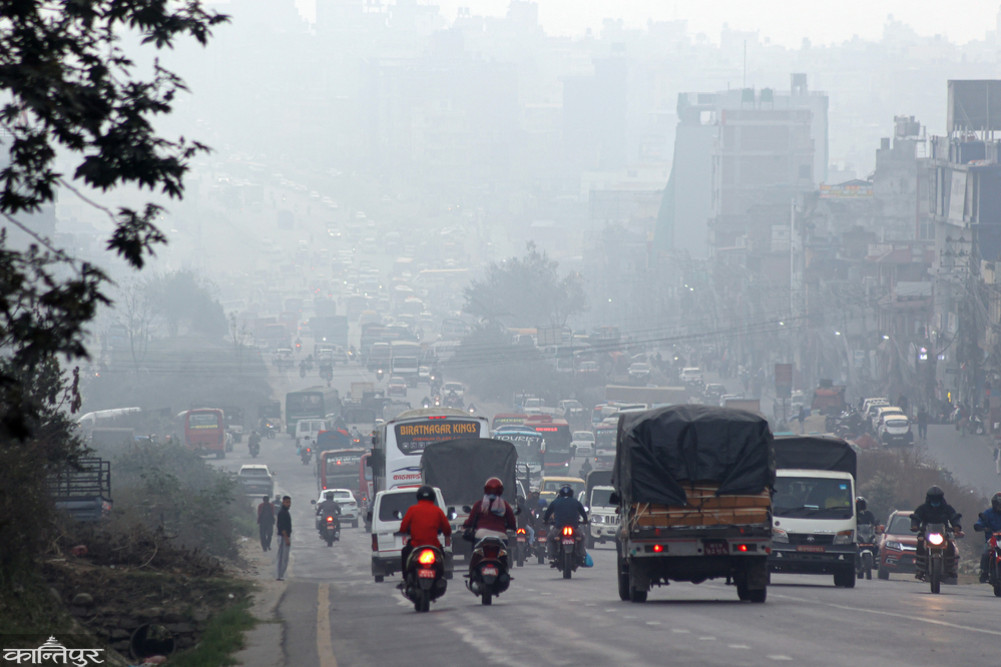
The Ministry of Health and Population has urged people to avoid going out in the morning and evening and to wear masks if they have to go out.
We use Google Cloud Translation Services. Google requires we provide the following disclaimer relating to use of this service:
This service may contain translations powered by Google. Google disclaims all warranties related to the translations, expressed or implied, including any warranties of accuracy, reliability, and any implied warranties of merchantability, fitness for a particular purpose, and noninfringement.
The level of environmental pollution has increased in the Kathmandu Valley in the last week. The sky of the Kathmandu Valley has also become cloudy due to pollution. The Air Quality Index (AQI) measuring air pollution has shown that Kathmandu's air is harmful to human health.
According to IQ Air, which measures air quality, the level of such an index of air is high in Kathmandu's air. On Tuesday morning, Kathmandu's AQI was measured at 198. Generally, an AQI of zero to 50 is considered satisfactory. Above 150 is considered unhealthy. Experts say that AQI of 150 to 200 affects sensitive people. AQI of 201 to 300 increases the health risk of people of all age groups. 301 to 500 indicates an emergency.
According to the standards of the World Health Organization (WHO), the amount of PM 2.5 in the air should be 5 micrograms per cubic meter or less. But the amount of PM 2.5 in Kathmandu's air is 96 per cubic meter. PM 2.5 is the smallest particle in the air with a diameter of less than 2.5 microns.
These particles contain sulfate, nitrates, black carbon, ammonium, and dust particles. These particles are harmful to health because they easily reach the lungs. Such particles are released when vehicles, industries, agriculture, construction, grass, and firewood are burned. The AQI value is calculated based on this PM 2.5.
According to meteorologists, the pollution has increased due to the lack of rain for a long time. Senior meteorologist at the Department of Water and Meteorology, Bibhuti Pokharel, says that the sky will remain like this for a few more days. She told Kantipur, "The sky in Kathmandu may remain foggy for another 2/3 days. There has not been much rain. Water vapor-containing particles have come to the lower atmosphere, but they are not capable of causing heavy rain." She said that dust particles are in the sky.
Meanwhile, the Ministry of Health and Population issued a statement on Monday stating that pollution has reached high levels in the Kathmandu Valley. Ministry spokesperson Dr. Prakash Budhathoki has mentioned that the pollution has increased due to old vehicles, forest fires, industrial activities and dust from various construction materials. The ministry has stated that the pollution will continue in Kathmandu for another week.
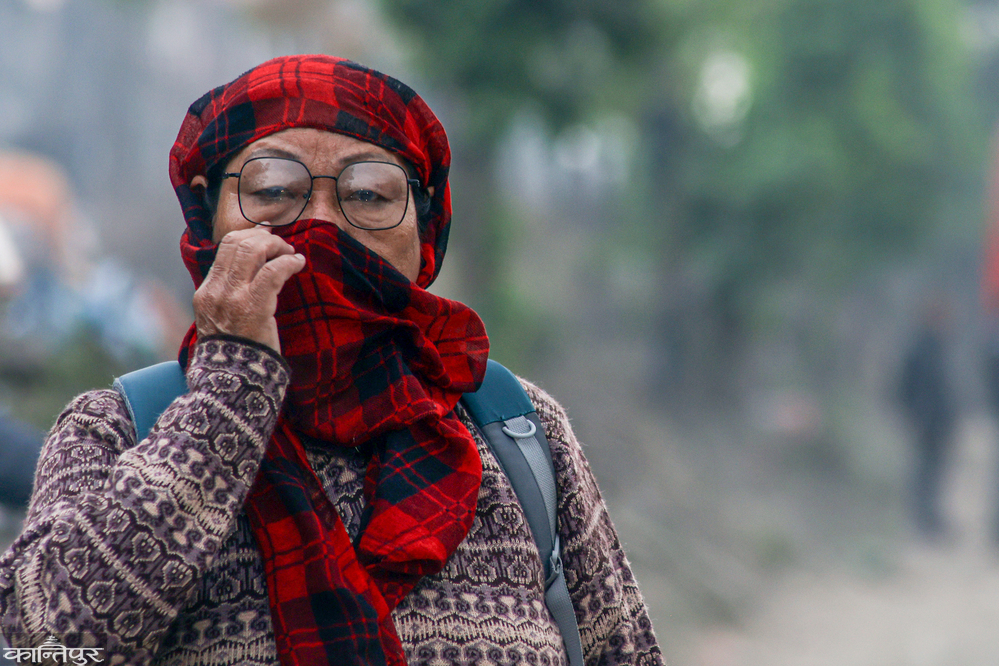
Due to high pollution, ordinary people walking on the road are complaining of burning eyes, sore throat and difficulty breathing. According to doctors, such air has a serious impact on children, the elderly and respiratory patients such as asthma and pneumonia.
Meanwhile, the Ministry of Health has also urged people to be aware of air pollution. Ministry spokesperson Dr. Prakash Budhathoki has urged everyone to be aware of air pollution as air pollution has increased in the Kathmandu Valley. He has urged people to be aware as air pollution can cause problems in the heart, blood vessels, lungs, asthma, cancer, eyes, kidneys and others.
Ministry spokesperson Budhathoki has also requested that people with chronic illnesses and pregnant women not go out as much as possible as air pollution affects them. The ministry has also urged people to take special precautions as air pollution affects children, senior citizens, and people with chronic respiratory conditions such as asthma and cough. Similarly, the ministry has also urged people not to go out in the morning and evening and to wear masks if they have to go out.