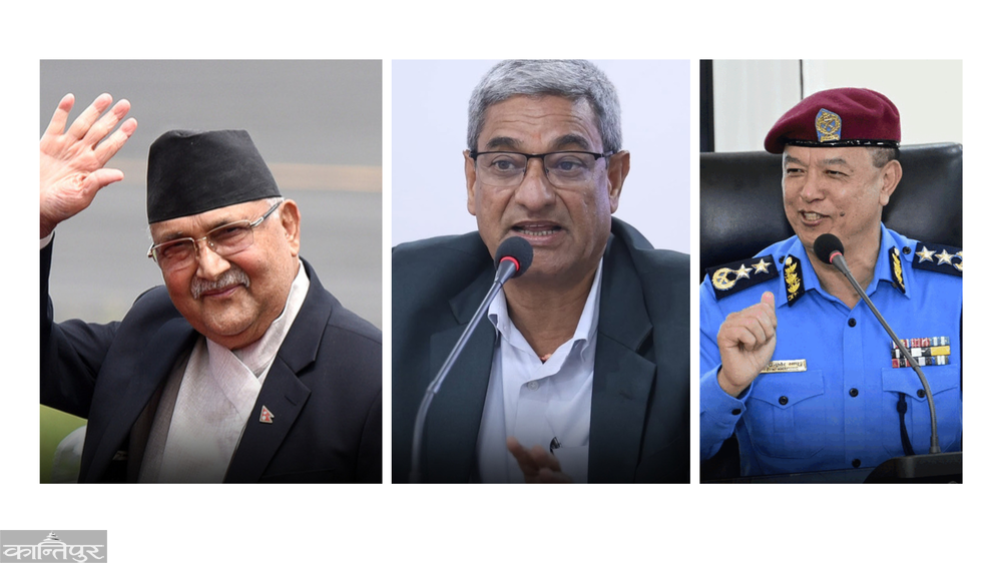
Recommendation to investigate the then Chief District Officer of Kathmandu, Chhabilal Rijal, and others
We use Google Cloud Translation Services. Google requires we provide the following disclaimer relating to use of this service:
This service may contain translations powered by Google. Google disclaims all warranties related to the translations, expressed or implied, including any warranties of accuracy, reliability, and any implied warranties of merchantability, fitness for a particular purpose, and noninfringement.
The inquiry commission into the incidents of Bhadra 23 and 24 has recommended an investigation and action against the then Prime Minister KP Sharma Oli, Home Minister Ramesh Lekhak and other high-ranking officials.
The commission has recommended the government to investigate the then Inspector General of Nepal Police (IGP) Chandrakuber Khapung and the then Chief District Officer of Kathmandu Chhabi Rijal for criminal offenses. The government repression of the Gen-G movement on Bhadra 23 and the violence on Bhadra 24 left 76 people dead.
The inquiry commission led by former judge Gauri Bahadur Karki has concluded that the then political and security leadership should be held accountable for the repression of Bhadra 23. Similarly, it has recommended an investigation and action against those involved in the violence on Bhadra 24, according to the commission officials.
The term of the commission, which was formed on Asoj 5 with a term of 3 months, was extended three times. On Sunday, the commission submitted its report to Prime Minister Sushila Karki. A team of commission chair Karki and members Vigyanraj Sharma and Bishweshwor Prasad Bhandari had reached the Prime Minister and Council of Ministers' Office in Singha Durbar to submit the report.
After submitting the report, commission chair Karki made a brief statement saying that they had completed the work. Prime Minister Karki thanked the commission and said, "You have completed the work, now we will do what needs to be done." The commission's report has not been made public.
Prime Minister Karki has said that she will decide whether to make the full details public or only the conclusions after reviewing the report. She had called Home Minister Om Prakash Aryal, along with some ministers and commission officials, to Baluwatar in the evening to discuss whether to make only a brief summary of the report public. The Gen-G group, however, is pressuring the government to make the full report public.
Commission spokesperson Sharma said that it has been recommended that all those responsible for the incidents of 23 and 24 Bhadra be investigated and prosecuted under the provisions of the Criminal Code. ‘We have written it after finding out maximum facts to serve as a basis for the criminal investigation to be conducted tomorrow,’ he told Kantipur, ‘There is sufficient detail in the report to facilitate the investigation.’
Sharma did not reveal the names of the people recommended for investigation. According to the commission, the report explains the roles of the then Prime Minister Oli, Home Minister Lekhak, IGP Khapung, and the then Chief District Officer of Kathmandu Rijal, among others.
UML leader Pradeep Gyawali said that although the details of the commission’s recommendations are not officially known, if they are made public, it could cause serious problems.
‘It is not in line with the ethics and responsibility of the commission of inquiry to submit a report prepared a week or ten days in advance in a manner favorable to one party by waiting for the election results,’ he told Kantipur. ‘If that happens, it will be a report of political bias rather than a judicial investigation. The commission should have submitted the report on time and the government should have decided to investigate or do something on time.’
A member of the commission said that the report was prepared after studying it impartially. According to him, the report mentions the role of Rashtriya Swayamsevak Sangh (RSS) President Rabi Lamichhane from the Nakkhu Jail in Lalitpur on 24 Bhadau to the role of the then Mayor of Kathmandu Metropolitan City, Balendra Shah.
‘We have also mentioned them in the report as some questions were raised,’ he said. Later, the commission took a statement from Lamichhane, who returned to the prison.
The jailer of Nakkhu Jail, Satyaraj Joshi, was also questioned. The report also analyzed the letter that Lamichhane took when he left the prison on 24 Bhadau, according to the commission. The commission also took a statement from the then Mayor of Kathmandu, Shah.
According to the commission’s spokesperson Sharma, the report presents the incidents of 23 and 24 Bhadau in separate sections and recommends investigation and action. ‘The commission initially investigated by focusing on 23 Bhadra, but we found that the incident of 24 Bhadra was more extensive, it happened all over the country, it was not a small incident,’ he says.
According to Sharma, the investigation of 23 Bhadra focuses on the repression by the state and the failure of the state machinery, while the incident of 24 Bhadra was planned or not and whether geopolitics is connected to it or not. Sharma says, ‘There were allegations that there was some geopolitical influence, international manipulation, we have investigated that. The detailed details will be made public with the report.’
The commission also investigated whether the arson that occurred on 24 Bhadra at the Parliament Building, Singha Durbar, Supreme Court, President’s Residence, commercial establishments and private property was organized or not. For that, the commission collected ashes from government structures as well as from the private sector, Kantipur Publications and Bhatbhateni Supermarket.
‘Various suspicions arose because the fire broke out in an instant. We sent the samples including the ashes we collected to the police forensic laboratory,” said Bhandari, another member of the commission. “Later, the government sent samples to India for testing.” The test report has not come from India.
Discussions on making chemicals and petrol bombs with sodium were held on the servers ‘Youth Against Corruption’ and ‘Youth Hub’ of ‘Discord’, a platform where youth unite for the Gen-G movement. The word ‘Molotov cocktail’ alone was found to be used 356 times in the ‘Discord’ discussion. An attempt was made to examine these topics together, but the commission’s report states that it could not be confirmed that the arson was organized and planned based on the evidence available at the time.
‘We have pointed out in the report that a more detailed investigation is needed on this issue,’ said Bhandari, a member of the commission. The activity of a group called ‘TOB’ was also seen in the demonstration. The police have also investigated it. The presence of the ‘Hami Nepali’ group led by Sudhan Gurung was also present on both days. The commission has also stated that it has studied the ‘activities of non-governmental organizations’ in detail.
‘In a country like ours, if the role of such non-state factors increases, the state becomes weak. We have made some recommendations that the state should address this aspect in a timely manner,’ says spokesperson Sharma, ‘We have pointed out that the sources of investment and expenditure of such organizations need to be studied and regulated through a separate structure.’
He also informed that the state did not have accurate details of how many non-governmental organizations (NGOs) are active in Nepal, and that the report suggested improving that weakness.
According to commission member Bhandari, the original report of the inquiry commission is about 900 pages long, and after including all the details including the schedule, it has reached almost 9,000 pages. ‘It includes interrogations of more than 200 people, statements, conversations with victims and details requested from various agencies,’ he told Kantipur. ‘We have completed our work, now it is the government’s responsibility to make it public and implement it.’
According to spokesperson Sharma, the report mentions that there was some lapse by the police on 23 Bhadra. According to him, there was a serious lapse by the police in security management during the protests on 23 Bhadra demanding the lifting of the ban on social media and protesting corruption.
‘Further investigation and action has been recommended in this matter as well,’ he said. Curfew was imposed in the New Baneshwor area at 12:30 pm on 23 Bhadra. The full details of the conversation that day on the police’s ‘communication set’ are included in the report’s schedule.
According to Sharma, a member of the commission, the Parliament building premises were weak from the beginning that day. ‘There have been weaknesses in everything from placing barricades in the Parliament building premises,’ he says. ‘The police should have stopped the protesters before the Everest Hotel, where the restricted area begins.’ Due to poor security preparations, the protesters broke the barricades and moved towards the Parliament building.
The report states that the National Investigation Department (NID) should be held responsible for the lapse in information collection. The commission also took a statement from the then chief of NID, Hutraj Thapa.
The report of the inquiry commission also mentions that the police could not do anything except fire water from a water cannon for a while at 11:45 pm before the Gen-G protesters reached the Parliament building in Baneshwor. ‘We have included detailed details of the actions taken by the police and the army,’ said a member of the commission. ‘It has been found that due to the weakness of the police, the police fired tear gas indiscriminately when the Gen-G youth started entering the Parliament building. Immediately after, the police were also found to have fired lethal weapons.’
On 23 Bhadra, SSP Bishwa Adhikari was the Kathmandu Police Chief, while DIG Om Rana was the acting chief of the Valley Police Office, Ranipokhari. On 24 Bhadra, AIG Dan Bahadur Karki assumed the responsibility of the Valley Police Chief. Karki is currently the Inspector General of Police. ‘A report has been prepared after analyzing the role of all the officers deployed on the day of the protest,’ said Spokesperson Sharma.
The Sushila Karki-led government, formed after the resignation of the then Prime Minister KP Sharma Oli under pressure from the Gen-G rebellion, had formed a three-member inquiry commission on 5 Ashoja under the chairmanship of former Special Court President Karki. After the work was not completed within the initial three-month deadline, the deadline was extended by one month on 3 Poush. The deadline, which was extended twice after that, expired on Sunday.