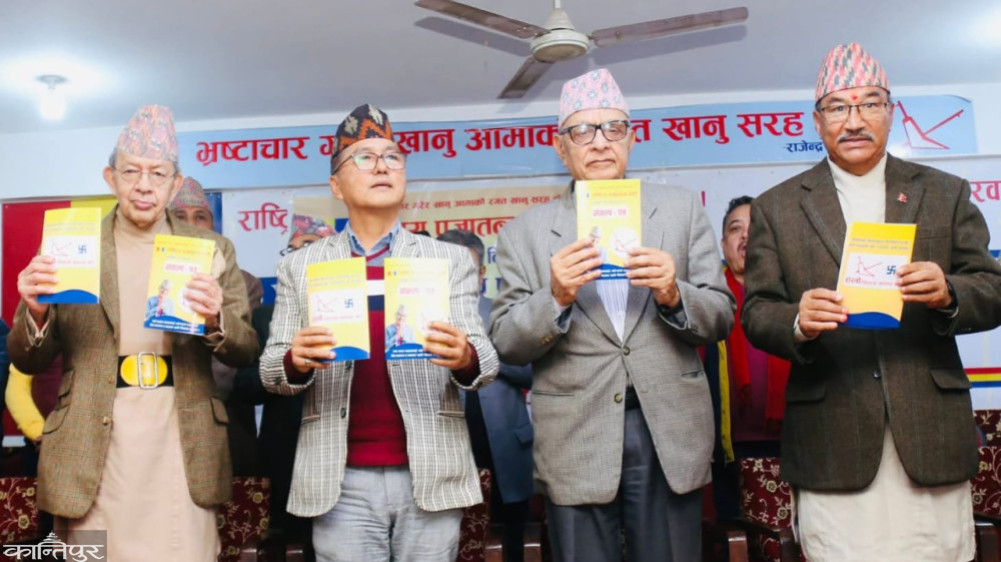
RPP Chairman Rajendra Lingden himself has been defeated in the direct election.
We use Google Cloud Translation Services. Google requires we provide the following disclaimer relating to use of this service:
This service may contain translations powered by Google. Google disclaims all warranties related to the translations, expressed or implied, including any warranties of accuracy, reliability, and any implied warranties of merchantability, fitness for a particular purpose, and noninfringement.
Voters have shown a 'red card' to the Rastriya Prajatantra Party's agenda of restoring the monarchy and restoring the Hindu nation in the House of Representatives elections.
In the direct vote results released by the Election Commission till Saturday night, the RPP has won only one seat. Gyan Bahadur Shahi, who is also the party's spokesperson, was elected from Jumla-1. While the RPP had fielded candidates in 163 constituencies. Even in the constituencies where the counting of votes is ongoing, the RPP candidates are far behind other competitors.
While Shahi won by getting 14,816 votes, his nearest rival Naresh Bhandari of the Nepali Communist Party got 11,635 votes. He started RPP politics while being in the news on social media due to his frank statements against corruption and injustice, he was elected in 2079 BS. In that election, the RPP got 14 MPs both directly and proportionally.
However, this time, RPP Chairman Rajendra Lingden himself has been defeated. In the proportional representation, the RPP is in fifth place with 35,046 votes as of 10 pm on Saturday. Party chairman Lingden, who was elected continuously from Jhapa constituency-3 in 2074 and 2079, was defeated. Lingden, who became the only RPP MP to be elected after receiving the support of the CPN-UML in the 2074 elections, contested the 2079 elections in an alliance with the UML. With the support of the UML in Jhapa-3, the RPP used to support Oli in Jhapa-5.
This time, the RPP had decided to contest alone. However, Prakash Pathak, who is also the Jhapa president of the RPP, defeated him by a margin of 21,380 votes. While Lingden got 17,294 votes, Pathak got 38,674 votes. UML chairman and former Prime Minister KP Sharma Oli was also defeated in Jhapa-5. Oli had sought the support of the RPP this time too. However, in the end, the alliance did not work out.
The welcome Nepal that the RPP had hoped for was also defeated in Jhapa-2. He had contested the 2079 BS election independently and was defeated by UML leader Devraj Ghimire by 2,256 votes. At that time, he was in second place and this time he has slipped to fourth place when he contested the election from the RPP. While former Speaker Indira Rana Magar won with 48,485 votes, CPN-UML candidate Devraj Ghimire got 9,227 votes, Shram Sanskriti Party candidate Keshav Kumar Bhandari got 6,065 votes, Congress candidate Sarita Prasai got 4,596 votes and RPP candidate Nepal got only 2,996 votes.
On the eve of the election, on 16 Poush 2081, the former monarchists participated in the election by uniting with Kamal Thapa-led RPP Nepal and giving a message that the former monarchists were united. Thapa, who left the party and formed RPP Nepal after Lingden was elected RPP chairman, returned to the RPP with the unity. After the unity, Kathmandu Constituency No. Thapa, who became the candidate from 5, received only 1,922 votes.
When Sasmit Pokharel of the Rashtriya Swayamsevak Sangh was elected with 30,737 votes, Congress General Secretary Pradeep Poudel came second and UML leader Ishwor Pokharel came third. Thapa came fourth. His bail has also been forfeited. After his defeat, Thapa said that the RPP should not be disturbed by the election results and move forward by introspection. "There are victories and defeats in elections, but the importance of the Hindu nation and the monarchy will always be alive as long as Nepal exists," he said.
Senior RPP leader Rabindra Mishra was also defeated. In Kathmandu-1, Rashtriya Swayamsevak Sangh's Ranju Darshana won with 15,455 votes, while Congress's Prabal Thapa Chhetri got 6,364 votes and RPP's Mishra got 3,972 votes. However, in the 2079 election, he was defeated by Congress leader Prakash Man Singh by a margin of 125 votes. Mishra was also defeated along with Singh in the 2074 election. Immediately after his defeat in the election, Mishra announced that he has ‘taken an immediate leave from party politics’.
‘Despite the widespread public opinion in favor of the restoration of the monarchy across the country, the Rastriya Prajatantra Party has repeatedly failed to organize and capitalize on that public opinion due to various reasons, for which I am also responsible as the party’s senior vice-president,’ he said in a statement. ‘My stance on issues including the restoration of the monarchy and good governance will remain unchanged and for the time being, I will continue to voice my views and stances in a non-partisan (independent) capacity.’
The RPP’s expected candidate Kuntidevi Pokharel (Upadhyay) also failed to win the people’s trust in Kathmandu-2. While RPP candidate Sunil KC won with 34,238 votes, Kuntidevi came in third with 5,210 votes. KC, who was nominated by the RPP, is a former provincial MP of the RPP. He also went there after the group including Balendra Shah joined the RPP. And, he was the candidate from Balen's quota.
RPP Vice President and former MP Dhruv Bahadur Pradhan was also defeated from Constituency No. 2 of Nawalparasi West. While RPP candidate Narendra Gupta was elected with 37,698 votes, Congress candidate Bhim Bahadur Thapa came second, Janata Samajwadi Party Nepal candidate Devendra Yadav came third and Pradhan came fourth.
RPP spokesperson Mohan Shrestha says that the RPP has always been going through ups and downs in the five elections held after the 2062-63 movement. 'Sometimes it is going down and sometimes it is going up, but that does not mean that the people did not approve of our agenda,' he said. 'The belief that the monarchy is needed is growing among the people, and it has been seen in various forms on the streets in the past.'
Even though the expected results were not achieved in the election, Shrestha said that their belief remains that there cannot be long-term peace and stability in the country without the restoration of the monarchy and that they will continue to raise this demand. "We also received information that many parties were active in influencing our public opinion this time," Shrestha added. "However, we have reached a point where the election results require a serious review. The party will move forward after conducting a deep study, analysis, and review of this matter."