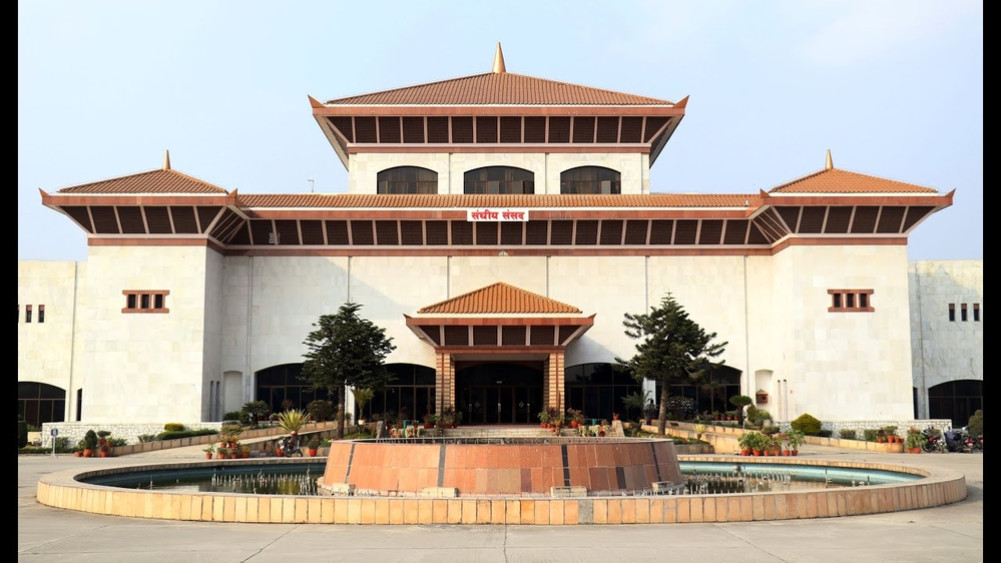
Only two-thirds of the House of Representatives can pass an impeachment motion against the Chief Justice, Supreme Court judges, members of the Judicial Council, heads or officials of constitutional bodies and remove them from office. There is a provision in Article 101, Clause 2 of the Constitution regarding this.
We use Google Cloud Translation Services. Google requires we provide the following disclaimer relating to use of this service:
This service may contain translations powered by Google. Google disclaims all warranties related to the translations, expressed or implied, including any warranties of accuracy, reliability, and any implied warranties of merchantability, fitness for a particular purpose, and noninfringement.
The counting of votes in the House of Representatives elections has indicated that the Rashtriya Swayamsevak Sangh (RSS) will easily win the majority of seats. As the results are being made public, it is also being estimated that it will reach a two-thirds majority. Discussions have also begun on what impact a party will have on the operation of the government if it wins a simple majority or a two-thirds majority in the House of Representatives.
Nepal's federal parliament is bicameral. Article 83 of the constitution states that there will be a federal legislature with two houses, the House of Representatives and the National Assembly. The National Assembly is called the upper house and the House of Representatives is called the lower house.
The House of Representatives has 275 members, 165 directly elected and 110 elected through the proportional representation system. The National Assembly has a 59-member system, with eight members from each province from different clusters and three nominated by the President on the recommendation of the government.
Two-thirds of the House of Representatives requires 184 members, while two-thirds of the National Assembly requires 40 members. Two-thirds of the Joint House requires 223 members.
What can two-thirds do?
Article 274 of the Constitution contains a provision on constitutional amendment. Clause 1 states that ‘this Constitution shall not be amended in a manner that is detrimental to the sovereignty, territorial integrity, independence and sovereignty vested in the people of Nepal’, according to which, even if there is a two-thirds majority in the Federal Parliament, these matters cannot be amended. Other provisions of the Constitution can be amended by at least a two-thirds majority of the total number of members in the Federal Parliament.
There is a constitutional provision that the National Assembly, along with the House of Representatives, has a role in implementing decisions related to the dissolution or suspension of the Provincial Assembly or the Provincial Government. There is a provision that the President can suspend or dissolve the Provincial Council of Ministers and the Provincial Assembly on the recommendation of the government. That decision must be approved by a majority of both houses of the Federal Parliament within 35 days.
Two-thirds of the Federal Parliament will be required to approve the emergency provisions made in Article 273 of the Constitution. Similarly, as per the provisions of Article 275 (1) of the Constitution, two-thirds of the Federal Parliament is also required for the provisions related to referendum. The constitution states that ‘If a two-thirds majority of the total number of members of the Federal Parliament for the time being decides that a decision on a matter of national importance needs to be taken through a referendum, a decision on such matter may be taken through a referendum.
There is a constitutional provision that a two-thirds majority is required in the Federal Parliament for the ratification, accession, acceptance or support of a treaty or agreement to which the State or Government of Nepal is a party. Among the treaties or agreements related to peace and friendship and the sharing of natural resources and their use, those that do not seriously affect the nation can be passed by a simple majority of the House of Representatives. There is a constitutional provision that treaties and agreements related to security and strategic relations and the borders of the State of Nepal must be passed by a two-thirds majority of the Federal Parliament (both houses).
Senior constitutional expert and advocate Tikaram Bhattarai said that a single party can run a strong government if it gets a two-thirds majority in the House of Representatives. ‘A two-thirds majority is required in the Federal Parliament to amend the Constitution and enter into international treaties that will have a far-reaching impact on Nepal,’ he said. ‘The Constitution does not allow me to do anything with a two-thirds majority in just one house.’
A two-thirds majority is sufficient in the House of Representatives alone to pass a motion that the Speaker or Deputy Speaker has not behaved in a manner befitting his office. Article 91 (6) (c) of the Constitution provides that if a motion that the Speaker or Deputy Speaker has not behaved in a manner befitting his office is passed by a two-thirds majority of the total number of members of the House of Representatives for the time being, he will be removed from office.
A two-thirds majority of both Houses of the Federal Parliament is required to pass an impeachment motion against the President or Vice President. Article 101 (1) of the Constitution states, ‘One-fourth of the total number of members of the House of Representatives for the time being may submit a motion of impeachment against the President or Vice President on the grounds of serious violation of this Constitution and the law. If such a motion is passed by a majority of at least two-thirds of the total number of members of both houses of the federal parliament, he/she will be removed from office.’
Only two-thirds of the House of Representatives can pass an impeachment motion against the Chief Justice, a judge of the Supreme Court, a member of the Judicial Council, or the head or official of a constitutional body. There is a provision in Article 101, Clause 2 of the Constitution for this.
What can a majority do?
A majority in the House of Representatives can form a government. A majority is also required for making laws. According to the provisions of the Constitution, a majority is required in the House of Representatives for the Prime Minister to pass a vote of confidence or reject a motion of no confidence against the Prime Minister.
Even if there is a majority in the House of Representatives, the National Assembly also has a role in making laws. The processes that have to be passed in the House of Representatives in making laws must also be completed in the National Assembly.
Article 111 of the Constitution stipulates that a bill passed by the House of Representatives must be passed by the National Assembly within two months or sent back with suggestions, failing which the House of Representatives can submit the bill to the President for ratification by a majority of the members present at the time. The Constitution states that ‘If a bill that has been rejected by the National Assembly or returned to the House of Representatives with amendments is considered and re-passed by a majority of the members present at the time of the House of Representatives as presented or with amendments, the bill shall be submitted to the President for ratification.’ This provision has paved the way for the majority party in the House of Representatives to move forward even if the National Assembly does not support it in making laws.
Senior constitutional expert and advocate Chandrakant Gyawali responded that a strong government can be formed if two-thirds of the same party is in the House of Representatives. ‘If there is two-thirds in the House of Representatives, it means that it will make laws and run the government as it wishes,’ he said. ‘If there is two-thirds in the House of Representatives, it means that it will amend the constitution, sign treaties, pass impeachment, and hold a referendum. Even if we get two-thirds in the House of Representatives, we must collaborate with other parties in the National Assembly to work on constitutional amendments and other matters.'