According to the National Census-2078, 2.2 percent of the total population of Nepal has disabilities.
We use Google Cloud Translation Services. Google requires we provide the following disclaimer relating to use of this service:
This service may contain translations powered by Google. Google disclaims all warranties related to the translations, expressed or implied, including any warranties of accuracy, reliability, and any implied warranties of merchantability, fitness for a particular purpose, and noninfringement.
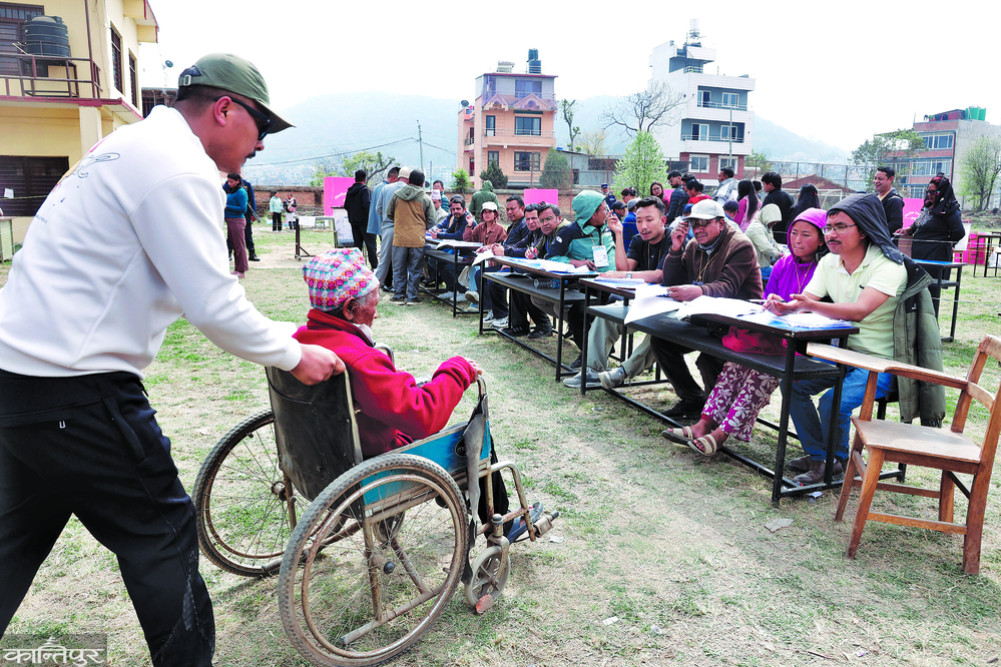
Although the constitution ensures that all citizens can vote, people with disabilities face various obstacles in voting in elections. They have to suffer in every election due to difficulty reaching the polling station, lack of physical infrastructure, problems in using ballot papers, and lack of necessary support.
People with disabilities also had to endure great hardship in the House of Representatives elections held on Thursday. Since they were not disability-friendly, some even reached the polling station but were deprived of voting due to the physical infrastructure.
Rudra Bahadur Thapa, 52, from Okhaldhunga, is a physically disabled person. He cannot walk or stand up normally. His gait is like a child walking with a limp. He depends on the help of others in most of his daily life. His brother Harka Bahadur Thapa is his main supporter.
He shared his experience of facing great hardship while going to vote in the elections held on Thursday. He had to be carried with the help of two people to the polling station at Kalika Secondary School in Chishankhugadhi Rural Municipality-2 in the district. According to his brother Hark, he had to be carried to the vehicle boarding point, which is about 50 meters away from his house.
Only then did he reach the polling station. However, since the physical structure inside the polling station is not disability-friendly, he had to be carried to the polling station. 'It is said that everyone has the right to vote, but there is no comfortable environment for people with disabilities. Since the narrow path and uncomfortable entrance to the polling station are difficult, it is also difficult to carry him to the booth,' he said. He said that he had faced similar problems while voting before. He said that he was carried to the polling station on his head when the vehicle did not arrive.
The experience of Gopalman Thapa, the Koshi Province Secretary of the National Federation of the Disabled, is no different from Rudra Bahadur. Gopalman also voted at the polling station at Kalika Secondary School in Chishankhugadhi Rural Municipality-2.
According to him, it takes him about an hour to reach the polling station under normal circumstances. Since there are restrictions on the operation of vehicles on election days, arrangements were made through party consensus to bring and take people with disabilities to and from the polling station.
He said that this has made it easier to some extent. However, he complains that the physical structure of the polling station is still not disability-friendly. He said that it is difficult for people with disabilities to move around easily due to stairs, heights, and narrow paths in some places.
He said, ‘Polling stations still do not look disability-friendly, and it is even more problematic for friends who use wheelchairs,’ he said, ‘Since the ballot boxes are often placed at high places, it is a problem for people with short stature or physically weak people.’
According to Gopalman, the voting process is also not easy for visually impaired voters. He said that since the ballot papers are not available in Braille, visually impaired people are forced to seek help from others while voting. He believes that it would be much easier for visually impaired voters if the ballot paper is provided in Braille or through an electronic system.
Hari Nepali, a visually impaired person from Kanchanpur, has also exercised his right to vote in this election. He voted from a polling station under Kanchanpur Constituency-2. To vote, he rode a car with the help of a neighbor and reached the polling station.
To complete the voting process, he had to take the help of his wife. According to Hari, he has been voting with the help of his wife in every election. Since he is visually impaired, he is forced to take the help of a person he trusts. He said, "I wish I could have cast my vote myself. There is no system for the visually impaired to vote on their own. There is a big difference between casting your vote yourself and having someone else cast it."
Although there is a system for secret voting, he has experienced that it has not been fully implemented for visually impaired people. He said that he also worries about whether the vote will remain secret if he has to take the help of another person. Hari is a person who can use technology.
He can use a mobile phone and even uses social media. He keeps a close eye on election activities and candidates. He complains that the voting process is still not easy for visually impaired people like him. He cannot vote secretly because the ballot paper is not in Braille or visually impaired-friendly technology is not available.
Another physically disabled person from Kalikot, Manraj Kathayat, also voted with the help of friends. He had reached the polling station at Shree Kalika Higher Secondary School in Mahabai Rural Municipality of Kalikot district.
He, who walks on crutches, said that it took him time to reach the polling station due to the geographical structure. He said that although there was some difficulty in reaching the polling station due to the hilly geography and road conditions, he was able to vote with the help of his friends. According to Kathayat, reaching the polling station is the biggest challenge for physically disabled people living in rural areas.
He said, ‘The process of going to vote is difficult for many due to the limitations of the road, distance and transportation. There has never been any facilitation for this. Only with the help of friends can people like me vote.'
According to the National Census-2078, 2.2 percent of the total population of Nepal is disabled. Of these, 54.2 percent are men and 45.8 percent are women. The census covers 12 types of disabilities.
Section 11 of the Rights of Persons with Disabilities Act, 2074 BS, ensures that persons with disabilities can become candidates in elections and exercise their political rights in a free and fearless environment, with or without assistance.
Although the Election Commission claims that polling stations are made women, senior citizens and disabled-friendly in every election, disability rights activists say that this has not been fully implemented in practice.
Devkumari Parajuli, General Secretary of the Nepal Disabled Women's Federation, cast her vote from Janapriya Secondary School in Waling Municipality-12, Syangja District.
The polling station was convenient for those who do not need to use wheelchairs or crutches. She said that although three voters with disabilities reached the polling station, two could not. ‘There is a situation where many people with disabilities are deprived of voting because there is no way to bring people with physical disabilities to the polling station.’
According to Parajuli, although the Election Commission has promised to make it easy for people with disabilities to participate in the election, it has not paid enough attention to the structural aspect.
She said, ‘There is a situation where many people with disabilities are deprived of voting due to the lack of appropriate physical infrastructure. Many people with disabilities who cannot reach the polling station are deprived of voting, and their right to vote has not been exercised.’
According to her, only disability-friendly structures, easily accessible polling stations, visually impaired-friendly ballots, and provision of assistive technology will ensure the real participation of people with disabilities.
Literary writer Jhamak could not vote
Dhankuta – Literary writer Jhamak Ghimire could not vote this time. As her health problems have been getting complicated for the past few years, the 45-year-old is resting under the supervision of a doctor at her residence in Kachinde, Dhankuta-6.
She could not even reach the polling station at the Multipurpose Community Building at Ram Prasad Pokharel Eye Hospital, which is a 10-minute drive from her home. In previous elections, Jhamak used to mark the swastika on the ballot paper herself with her left toe. In this election, only her mother Asha reached the polling station by auto and voted at 3 pm.
Even though Jhamak prepared to go vote with her, her sister Mausami said that it was not possible. Jhamak, the author of the Madan Puraskar-winning book ‘Jeevan Kanda Ki Phool’, has published one and a half dozen literary books.