Election Commission spokesperson Narayan Prasad Bhattarai said that despite a voter turnout of around 60 percent across the country, no re-voting was required at any center. “Elections were held peacefully at all centers,” he said.
We use Google Cloud Translation Services. Google requires we provide the following disclaimer relating to use of this service:
This service may contain translations powered by Google. Google disclaims all warranties related to the translations, expressed or implied, including any warranties of accuracy, reliability, and any implied warranties of merchantability, fitness for a particular purpose, and noninfringement.
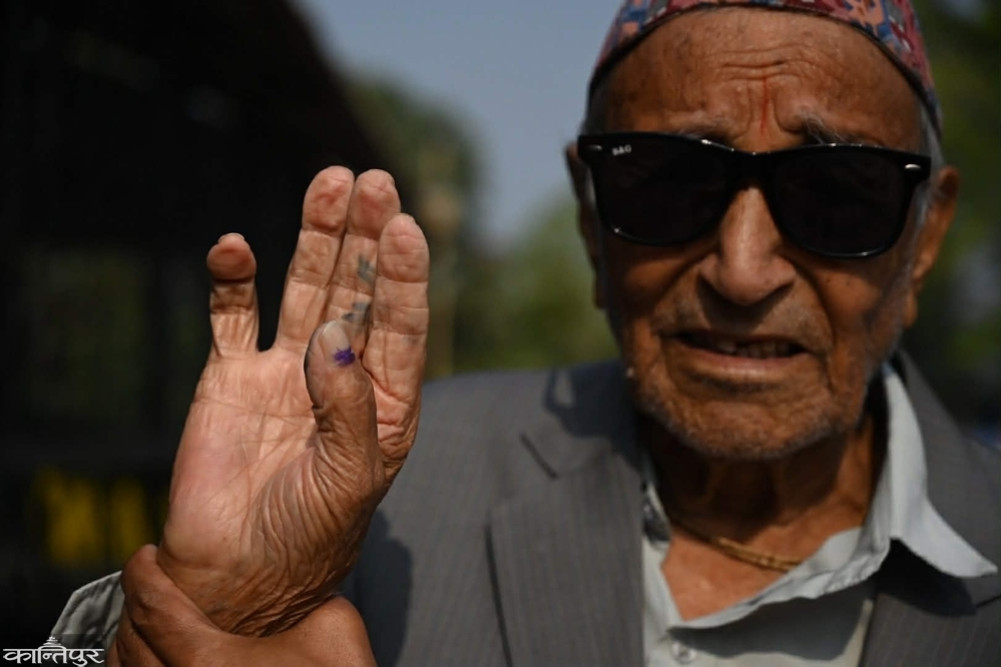
The election of members of the House of Representatives was held peacefully on Thursday amid many doubts.
Some weapons looted during the Gen-G movement and prisoners were still outside, and the morale of the police was low. However, there were no incidents of tension across the country on Thursday, except for sporadic incidents. There was no situation where voting was postponed anywhere.
Home Minister Om Prakash Aryal says that the election was held without shedding a single drop of blood as per the wish of Prime Minister Sushila Karki. ‘The enthusiasm and active participation shown by the voters to successfully conduct the election in a free, fair, fearless and dignified environment has expressed their loyalty and unwavering commitment to democracy,’ he said. ‘A significant achievement has been achieved through this election in implementing the constitution and institutionalizing the rights and freedoms enjoyed by the Nepali people.’
Election Commission spokesperson Narayan Prasad Bhattarai said that there was no need for re-voting at any center despite the fact that about 60 percent of the votes were cast across the country. ‘The election was held peacefully at all centers,’ he said.
Nepal Police spokesperson Abinarayan Kafle says that the elections held under different circumstances after the Gen-G movement did not have as many incidents as in previous elections. ‘It is normal for there to be some jostling in elections. But unlike in the past, there were no activities that would have postponed the elections,’ he said. ‘This is the result of good preparation and joint coordination.’
Kafle said that immediate de-escalation work was done in coordination with all mechanisms in places where tension was likely to arise. Suspicious objects were found at 15 places, including 2 in the Kathmandu Valley, during the election. But the Nepal Army’s bomb disposal team deactivated them.
The army had mobilized 800 bomb disposal teams across the country to prevent any untoward incident.
‘As soon as any news was received, the army was deployed to ensure the safety of the citizens by immediately disposing of them safely,’ said military spokesperson Rajaram Basnet. ‘Most of the items disposed by the army were only objects that looked like bombs placed to intimidate.’ On election day, there was a minor dispute in Sarlahi-4, although voting resumed shortly after. After a dispute between party representatives at Shree Primary School in Balra-4, Sarlahi Chief District Officer Ramuraj Kadariya and Police Chief Yogendra Kumar Khadka had to stay there themselves to defuse the situation.
As of Thursday evening, there were no other untoward incidents in Madhesh Province, which is prone to explosions or political clashes during every election. ‘It was common for gunfire to break out in two or four places during elections in the Terai,’ said former Deputy Inspector General (DIG) of Nepal Police Pitambar Adhikari, ‘but this time, even on the eve of the election, there was no such incident.’
Provincial Police Chief Govinda Thapaliya said that Madhesh was calm due to the joint mobilization and coordination of all security mechanisms by establishing a provincial command post. ‘Groups that could disrupt the election were monitored in advance and made unable to move,’ he said. ‘Even during the election, there was a readiness to take strict action as soon as there was a sign of any activity. Due to strong preparation, no incident occurred.’ Thapaliya says that this is a special election where there was no lathicharge and the election was held.
Even in Dolakha, where booth capture and political clashes were discussed in previous elections, there were no serious incidents. Dolakha has always witnessed violent incidents in elections since 2048. From 2048 to 2056, the Congress and the UML were involved in such activities, and in 2064 BS, the Maoists also joined in. Keeping that sensitivity in mind, the police this time deployed Senior Superintendent of Police (SSP) Somendrasingh Rathore in Dolakha.
An attempt was made to snatch the ballot box at the Malu polling station in Tamakoshi Rural Municipality. But the police fired a round in the air and brought the situation under control. After some time, the voting resumed after a political agreement.
A bullet carried by the police deployed for election security in Udayapur accidentally exploded. During that time, a ballot box containing three votes was slightly damaged at the Tawakhola (B) polling station, a vegetable and fruit center in Katari Municipality-3. Voting was resumed after changing the ballot box.
Security analysts say that the reason the election was concluded without any untoward incident this time may be due to the enthusiasm seen among the voters. 'After the Gen-G movement, there was also a view among the general public that there should be a change. In such a situation, voters themselves participated in the peaceful voting process,' says the former DIG officer.
A police officer says that special precautions have been taken to ensure the security of the vote counting process. In addition to assisting in monitoring social media during the pre-election period, the Nepal Army worked on the security of ballot printing, transportation, and important infrastructure. The army worked in the third circle after the Nepal Police and the Armed Police Force. Spokesperson Basnet says that it was also deployed in coordination with the election officer, local administration, and other security agencies.
'Joint patrols were conducted at various bases, and after the election, the army is again assisting in the transportation of ballot boxes and the security of the counting site,' said Spokesperson Basnet. 'The army alone deployed 79,000 security personnel during the election.' According to the officers, one temporary base each for the army and the armed forces was set up in 165 constituencies to prevent any untoward activity. The army was deployed in three parts - long-distance, medium-distance, and short-distance - for foot patrols, striking forces, and mobile patrols.
The Election Commission had designated 11,901 polling stations and 23,112 polling stations across the country. Of these, 4,114 polling stations were on the highly sensitive list. 4,442 polling stations across the country were classified as sensitive and 2,845 polling stations were classified as places with general security challenges. Security personnel were deployed based on sensitivity.