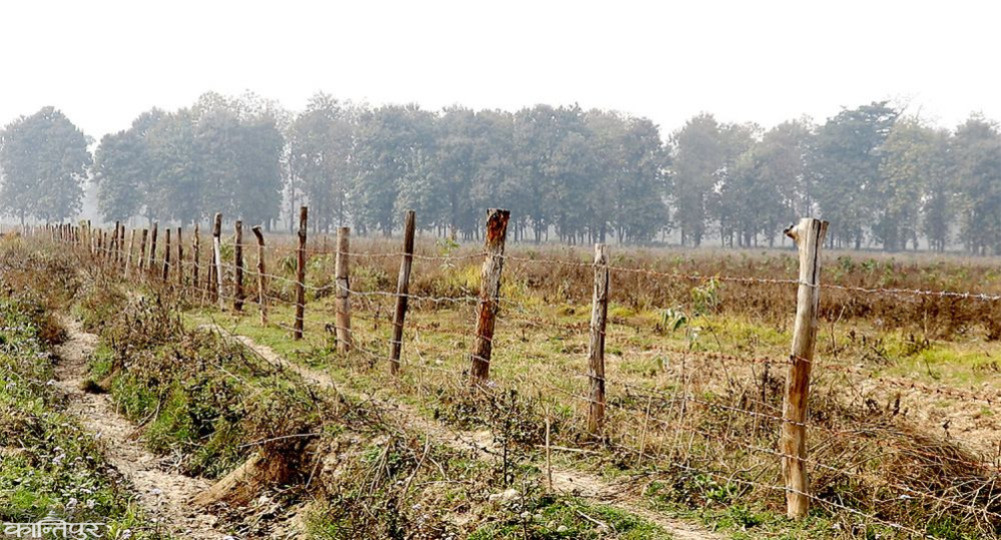
The constitutional bench, headed by Chief Justice Prakash Man Singh Raut, said that although the constitution gives the provinces the right to manage forests, no policy has been formulated for this purpose, and called for the formulation of a national forest policy.
We use Google Cloud Translation Services. Google requires we provide the following disclaimer relating to use of this service:
This service may contain translations powered by Google. Google disclaims all warranties related to the translations, expressed or implied, including any warranties of accuracy, reliability, and any implied warranties of merchantability, fitness for a particular purpose, and noninfringement.
The Supreme Court has issued a directive to the Government of Nepal to formulate a federal policy for the management of forests in all seven provinces, stating that all rights to forests belong to the provincial governments.
The Constitutional Bench, headed by Chief Justice Prakash Man Singh Raut, said that the constitution has given the provinces the right to manage forests, but no policy has been formulated for this, and asked for a national forest policy to be formulated for this.
The Supreme Court ruled in favor of all seven provinces while ruling on a writ petition filed by Madhesh Province, alleging that the Union has interfered despite the constitution giving the provinces the right to manage forests. Similarly, the Supreme Court has ruled that the District Forest Officers (DFOs) of the provinces will have the power to prosecute and decide forest-related cases under the province.
The Constitutional Bench has ruled that the term 'Government of Nepal' in Section 2 of the Forest Act-2076 will be replaced by the provincial government. Thus, with the abolition of the central government, the decision has been made that the provincial DFOs will have the power to prosecute cases, including prosecution, said Advocate Dipendra Jha. The Constitutional Bench, headed by Chief Justice Prakash Mansingh Raut, dismissed the writ petition on Tuesday and issued a two-point directive order in the name of the government.
Jha claimed that the Constitutional Bench had delivered an important verdict in favor of strengthening federalism. He said that now all forest rights are under the province and that the right to file a case was previously under the Nepal Government, and that the pending situation of whether or not to register it in the district court has also been resolved.
The Nepal Government had reached the district court when it was mentioned that the forest itself could decide the case of imprisonment for up to 1 year. But the fact that the district court had not decided and was left hanging was raised by Jha and others in the debate in the Constitutional Bench, and the Constitutional Bench has also addressed it.
The Supreme Court has said in its verdict that according to Article 57(2), Article 162(4) and serial number 19 of Schedule-6 of the Constitution, the national forest within the province and its management are matters under the sole jurisdiction of the province.
‘The use of the term “appointed by the Government of Nepal” in the definition of “Divisional Forest Officer” in Section 2(h) of the Forest Act, 2076 appears to have created a situation where officers are appointed only from the central executive structure in matters falling within the jurisdiction of the province. This has created a situation where the executive authority granted to the province by the Constitution is practically rendered inactive,’ the judgment said.
Even though the Supreme Court dismissed the writ petition, the Constitutional Bench has issued two directive orders. ‘In order to maintain consistency and harmony among the articles of the Constitution of Nepal, the federal government shall exercise its powers under Schedule-5, No. 27 of the Constitution of Nepal in such a way that the constitutional rights of the concerned province are not curtailed and in accordance with the spirit of the constitutional provisions mentioned in Article 232 of the Constitution of Nepal, the federal government shall, without undue delay, issue the powers under Schedule-6, No. 27 of the Constitution of Nepal. The first directive order states that a “National Forest Policy” should be issued as soon as possible on how to manage the national forests within the 19 provinces.
Similarly, after the issuance of the “National Forest Policy”, an order has been issued in the name of the government to review and make necessary amendments to the provisions of the existing Forest Act, 2076 in the light of the said National Forest Policy so that they are in line with the spirit of the federal structure, the executive powers of the provinces, and inter-organizational coordination.
The Supreme Court has also ordered that the provision of the constitution be annulled and published in the Gazette.
‘If any law is declared invalid or void under Article 133 (1) of the Constitution by the final order or judgment of the Constitutional Court, the Registrar shall send a copy of the order or judgment to the Ministry of Law, Justice and Parliamentary Affairs for the purpose of publication in the Nepal Gazette, and the words ‘assigned by the Government of Nepal in accordance with the prevailing law’ in Section 2 (h) of the Forest Act, 2076 BS and the words ‘of the Government of Nepal’ in Sub-section (1) of Section 67 have been repealed, and accordingly,’ the judgment states.
Similarly, the Supreme Court has also issued a mandamus order directing the Division Forest Officer deployed under the executive structure of the provincial government to immediately make arrangements to process and settle cases under the Forest Act, 2076 BS.
What was the dispute ?
The Government of Nepal, which had decided to place the Sagarnath Forest Development Project under the Nepal Forest Corporation Limited, After the decision of 23, the Ministry of Forests filed a writ petition in the Constitutional Bench of the Supreme Court on behalf of Madhesh Province, challenging the decision. In the writ petition registered in July 2076, the Supreme Court, while giving its verdict after 6 years, explained the rights of the province and the union.
Although the provincial government has the right to protect and manage the national forest according to the constitution, the federal government had made a decision in this regard. Province 2 had filed a case in the Supreme Court alleging that the federal government's decision had taken away the province's rights over the Sagarnath Forest Development Project, which is a national forest.
Bechan Kumar Mahato, on behalf of the Ministry of Forests, Industry, Tourism and Environment of Province 2, had filed a writ petition, alleging that the federal government was trying to take away the rights granted by the constitution and convert it into a forcible company and bring it under its control.
The writ petition stated that the federal government's attempt to convert the forests within the province into a company and bring it under its control was a misuse of the constitution. The case filed against the Office of the Prime Minister and Council of Ministers, Singha Durbar, Kathmandu, also sought injunction, prohibition and injunction.
The ministry's writ petition claimed that an attempt was made to weaken the province by merging it with the timber sales and distribution company TCN with the aim of destroying the forest development project, which is one of the main sources of the province's economic resources, covering about 18,000 hectares.
Serial number 19 of Schedule-6 of the Constitution states that all national heritage, resources and property within the province shall be under the jurisdiction of the concerned province.
Here is the full text of the order