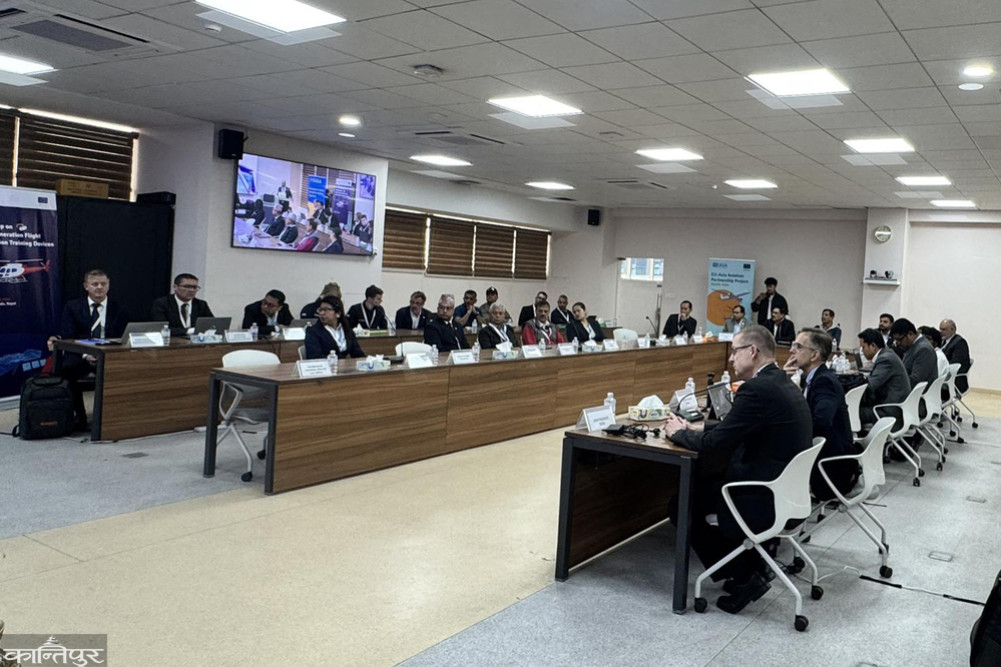
The technical team that has arrived in Nepal will stay for one month and a program will be conducted to demonstrate the simulator system to Nepali businessmen and stakeholders.
We use Google Cloud Translation Services. Google requires we provide the following disclaimer relating to use of this service:
This service may contain translations powered by Google. Google disclaims all warranties related to the translations, expressed or implied, including any warranties of accuracy, reliability, and any implied warranties of merchantability, fitness for a particular purpose, and noninfringement.
The Civil Aviation Authority of Nepal (CAAN) has officially launched the mandatory simulator training for helicopter pilots in Nepal on Tuesday.
The program was jointly inaugurated by Anil Kumar Sinha, Minister for Culture, Tourism and Civil Aviation of the Government of Nepal, Véronique Lorenzo, Nepal's Ambassador to the European Union, and Devchandra Lal Karna, Acting Director General of the CAAN. According to this arrangement, which will be implemented from 2024, every Nepali helicopter pilot will have to undergo mandatory simulator training once a year. The CAAN has taken this as a necessary step to further strengthen national aviation safety and ensure pilot efficiency.
According to an engineer from the CAAN's Flight Safety Standards Department, four major agencies, including the CAAN, are involved in the training that started on Tuesday. Two technicians from the European Union Aviation Safety Agency (EASA), three from Airbus Helicopters and three from Loft Dynamics (Switzerland) have arrived in Nepal.
The simulator equipment manufactured by Loft Dynamics will arrive in Kathmandu on Wednesday, the engineer said. The simulator will be kept at the Authority's Air Transport Capacity Enhancement Project office in Sinamangal for a month. The Authority has stated that interested Nepali helicopter pilots and technicians can take training there. Currently, 40 helicopters are in operation in Nepal through 11 companies and there are about 60 licensed helicopter pilots, according to the Flight Safety Standards Department.
Most of the helicopters are Airbus B-3 series models. However, the Russian helicopter operators will not be able to take simulator training. Although the International Civil Aviation Organization (ICAO) has not made simulator training mandatory for helicopters, the Authority has made it mandatory at the national level from 2024. The Authority has clarified that those who do not want to participate in this training approved by the European Union are not obligated to do so.
The technical team that came to Nepal will stay for a month and a program will be conducted to demonstrate the simulator system to Nepali businessmen and stakeholders. This step is expected to significantly improve Nepal's helicopter flight safety. A simulator is a technical training device that gives pilots the experience of real flight. It has a setup like the cockpit of a helicopter or aircraft and the pilot can practice real flight conditions such as controls, weather changes, mechanical problems, and emergency situations.
Generally, it is also called a virtual flight training device. This training contributes significantly to the pilot's skills, decision-making ability, and flight safety. Before 2024, simulator training was not mandatory for helicopters in Nepal. The senior pilot used to train the copilot or captain while flying. However, in recent years, as Nepali helicopters have been involved in accidents every year, simulator training was made mandatory for helicopters, just like for aircraft pilots.