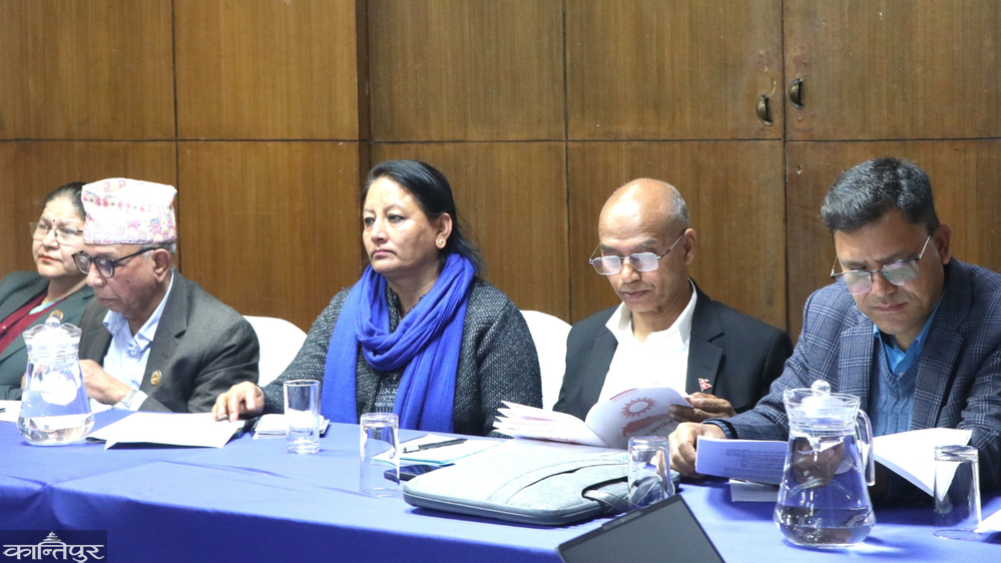
Stakeholders have said that not only commitment but also guarantees of implementation are needed on the issues of Dalits, women, and marginalized communities.
We use Google Cloud Translation Services. Google requires we provide the following disclaimer relating to use of this service:
This service may contain translations powered by Google. Google disclaims all warranties related to the translations, expressed or implied, including any warranties of accuracy, reliability, and any implied warranties of merchantability, fitness for a particular purpose, and noninfringement.
As the upcoming House of Representatives elections on Falgun 21 are approaching, stakeholders have said that not only commitments on issues of Dalits, women and marginalized communities are needed in the manifestos released by political parties, but also guarantees of implementation.
At the ‘Communication Program on Political Parties’ Manifestos on Issues of Dalits, Women and Marginalized Communities and Commitments’ organized by Jagran Media Center in Kamadau on Friday, constitutional scholar and administrative expert Kashiraj Dahal presented a study on the manifestos of 10 political parties and noted that there is an increasing trend of repeating inclusion issues but not seeing a clear framework for implementation.
He said that although most parties have mentioned commitments on Dalit empowerment, proportional representation, ending untouchability and social justice, they have not presented a concrete plan on budget, time frame and monitoring mechanism.
Nepali Congress central member Prem Bishwakarma said that the programs mentioned in the manifestos cannot be implemented due to lack of majority to run the government. In the program, Dr. Netra Timilsena, a member of the CPN (UML) manifesto drafting committee, said that caste discrimination is a structural problem and a progressive movement is needed to end it.
Beduram Bhusal of the Nepali Communist Party's center expressed his commitment to make the implementation effective now that the law has been made.
He emphasized that justice will be achieved only through the policy of special rights for the Dalit community. Discussing the issues of the manifesto brought by the party, he said that there are programs such as running women's empowerment programs, emphasizing women's entrepreneurship programs, giving 25 percent discount to women, and providing concessions up to 12th grade to the poor.
Savitri Sharma, a member of the National Women's Commission, said that it is the job of studying, monitoring and evaluating the activities carried out on women's issues and making recommendations to the ministries and other relevant bodies. She said, "Members of the Dalit Commission will monitor the issues of Dalit women and marginalized communities during the election campaign."
Jagran Media Center President Kamala Bishwakarma emphasized that political parties should be serious about implementing the commitments in the manifesto.