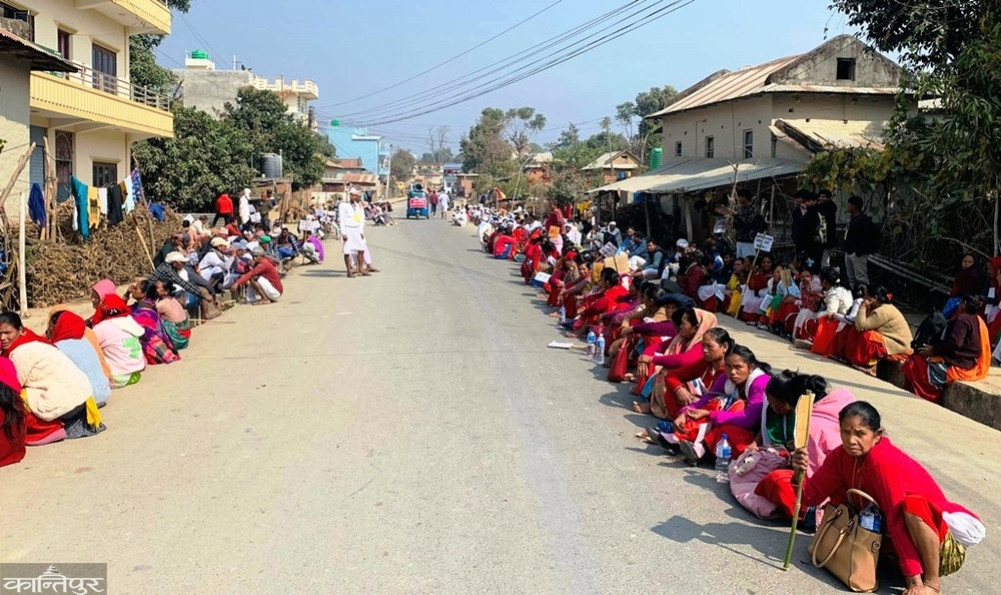
They have decided to participate in the elections only if the political parties in the district give a written commitment to fulfill their demands.
We use Google Cloud Translation Services. Google requires we provide the following disclaimer relating to use of this service:
This service may contain translations powered by Google. Google disclaims all warranties related to the translations, expressed or implied, including any warranties of accuracy, reliability, and any implied warranties of merchantability, fitness for a particular purpose, and noninfringement.
The long-suffering farmers of Swargadwari Guthi have used the election opportunity to explain their demands to political parties. They have warned that they will not participate in the vote if the parties do not mention addressing their demands in their election manifestos.
The political parties in the district have decided to participate in the elections only if they give a written commitment to fulfill their demands. The victims had previously protested from the district to Kathmandu to get their demands fulfilled. 39 such farmers in the district had staged a sit-in at Maitighar Mandala in Kathmandu in Magh and Falgun in 2081.
They protested demanding that the rights of the farmers who had leasehold rights on the land of Swargadwari Ashram be upheld. After protesting in Ghorahi for a long time without any hearing, they reached Kathmandu to put pressure on the government from close quarters.
They had organized various protest programs in Ghorahi from Falgun 2080 to Chaitra 2080. During the protest, they slept on the streets, ate plates, plowed the streets, and staged a sit-in in front of the district administration day and night. The police had lathi-charged and fired tear gas at the farmers who had gone to surround the land revenue and survey offices.
The government then assured to fulfill the demands through talks. After the talks held at the Ministry of Land Management, Cooperatives and Poverty Alleviation on Chaitra 2080, it was agreed to immediately start the process of formulating a new integrated Guthi law to address the demands of the farmers affected by the Swargadwari Guthi.
The negotiation and study committee formed under the leadership of the then Joint Secretary of the ministry, Krishna Prasad Sapkota, had reached the said agreement with the farmers. During the talks, the then Minister for Land Management, Cooperatives and Poverty Alleviation, Balram Adhikari, had expressed his commitment to end dual ownership of land by bringing an integrated Guthi law.
However, before the Guthi Bill was passed, Parliament was dissolved and their demands remained unfulfilled. Praveen Chaudhary, spokesperson for the Swargadwari Guthi-affected Mohi Kisan Sangharsh Samiti, said that even when the new parliamentary elections were about to be held on Falgun 21, no party had shown seriousness in fulfilling their demands. ‘We have submitted our demands to the government as well as political parties several times,’ he said, ‘yet there has been no seriousness in addressing the demands. Our demands have not been mentioned in the party manifestos either.’
He said that he had decided not to participate in the elections until a written commitment is received from the parties. ‘A written commitment to address the demands is needed from all parties. If not, we will not go to vote,’ he said, ‘We will boycott the elections. It has always been a deception.’ He said that there are more than 10,000 Guthi-affected voters.
What are the demands?
After a month and a half of the agreement with the government, there was no initiative for implementation, the Guthi-affected held a national conference in Ghorahi on Baisakh 24 and 25, 2081 and issued a 9-point manifesto.
The conference demanded that a Guthi Act be introduced as soon as possible after meaningful dialogue with Guthi farmers, Guthi land should be registered and land ownership certificates should be issued to farmers, land registration certificates should be made for the land remaining to be registered in the name of the cultivator, and ownership should be restored to the tenant farmers who were evicted unilaterally by filing a lawsuit.
Similarly, the conference demanded that farmers who have built houses on Guthi land and lived there for generations should be provided with houses and fields based on their residence, that arrangements should be made to pay the kut, tiro, and rakir to be paid by Guthi farmers and that they should be paid to the ward, that land ownership certificates should be cancelled and rakir certificates should be provided, and that a policy of productive use should be adopted by taking inventory of the embezzled Guthi land. They are continuously agitating to fulfill these demands.
Why did the problem become complex?
Swargadwari Ashram, which has a main temple in Swargadwari, Pyuthan, has land in 12 places in the Deukhuri, Ghorahi and Tulsipur areas. The farmers who have been tilling the land have tenant rights in their names. There is a legal provision that farmers with tenant rights will get half of the land. However, due to legal complications, dual ownership persists in the land of Swargadwari Ashram.
On the one hand, the Supreme Court has ordered that the ashram's land cannot be divided as the Swargadwari Guthi is a special private Guthi. On the other hand, the tenant farmers have been demanding rights for a long time with landowner proof. They have been protesting repeatedly, saying that they have been tilling the land for three generations and have proof that they have tenant rights, but they have not received their rights yet.
On Chaitra 14, 2062, the Supreme Court ruled that Swargadwari Guthi is a private trust of a special nature and issued an order not to allow any division or misappropriation of the land registered in the name of the ashram in any way that would undermine the autonomy of the ashram. After that, the Mohi farmers were deprived of their rights to the land.
A bench of Justices Ram Prasad Shrestha and Damodar Prasad Sharma had ordered that no interference should be allowed to disrupt the Yagya Homadhi work on the land purchased from the pocket money of Mahaprabhu Hanshananda Giri of Swargadwari Ashram.
Since the Supreme Court has already ruled on the Swargadwari Ashram, the Mohi farmers are demanding that Swargadwari Guthi be mentioned in the Guthi Bill as a private trust of a special nature, instead of looking at all the Guthis in the same light. The agitating farmers have said that the bill, which was stalled due to opposition, should establish tenant rights on the land of Swargadwari Guthi and the land should be distributed accordingly.
Prabhu Chaudhary, the chairman of the Swargadwari Guthi Victims' Tenant Farmers' Struggle Committee, said that out of the 1,034 bighas 17 katta 7 dhur land of the ashram, 753 bighas of land are still tenant farmers. According to him, initially 289 families were tenant farmers. Now, as new houses are being built, the number has reached 3,050 households. He said that more than 15,000 members are dependent on them.
In 1982 BS, Swargadwari 'Mahaprabhu' Hanshananda Giri had purchased the ashram land by collecting offerings received from devotees. There has been a dispute over the land for a long time. The Supreme Court has made this decision after reaching the court during this dispute.
Some lands are owned by actual tenant farmers, while others are encroached upon by other people. Tenant farmers are also consuming more land than they should have received as tenant farmers. Some lands have not been released since they were seized during the Maoist war. Hari Adhikari, the ashram's chief administrative officer, said that the ashram has not been able to receive income from the land for 29 years. He said that the regular work of the ashram has been affected after the income from the land stopped. According to the officer, the ashram spends Rs 150 million annually. Out of which, Rs 45 million is spent on employee salaries, Rs 30 million on cattle rearing, Rs 35 million on pujas and Rs 40 million on food. He said that the ashram earns only Rs 62 million annually from various sources. The officer said that the ashram earns Rs 50 million from donations and offerings, Rs 50 million from dharamshalas, Rs 55 million from land rent and Rs 15 million from dog crops. The official said that insufficient expenses are managed by taking loans.