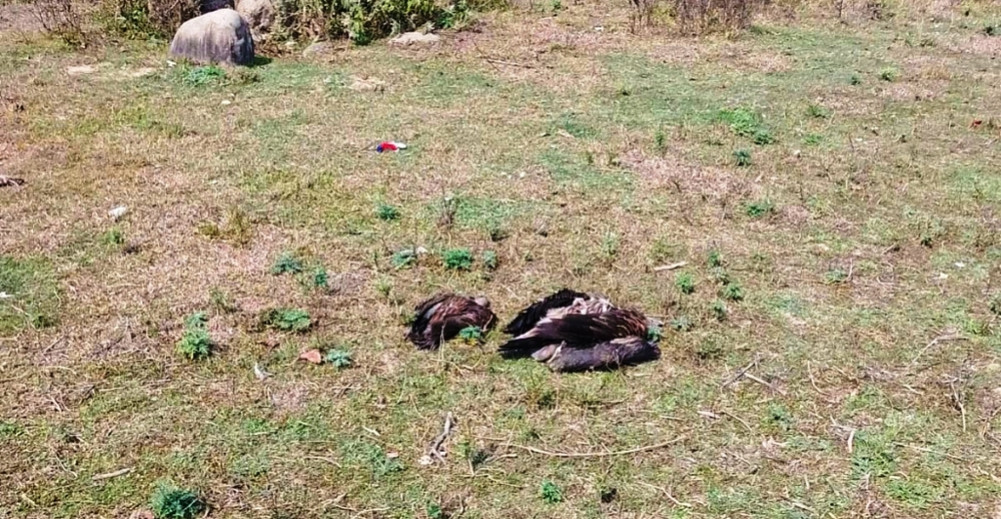
Jayaprakash Pandey, chairman of the Tilaurakot Partnership Forest Management Group, said that the vulture died after eating a dog's chest near the Banganga River east of Motinagar village under the Taulihawa-Gorusinghe road section.
We use Google Cloud Translation Services. Google requires we provide the following disclaimer relating to use of this service:
This service may contain translations powered by Google. Google disclaims all warranties related to the translations, expressed or implied, including any warranties of accuracy, reliability, and any implied warranties of merchantability, fitness for a particular purpose, and noninfringement.
Nine vultures have died in Buddhabhumi Municipality-10, Motinagar after eating poisonous food. Four of the world's rare Dangar vultures and five of the critically endangered Himalayan vultures have died.
The vulture died after eating the chest of a dead dog near the Banganga River east of Motinagar village under the Taulihawa-Gorusinghe road section, said Jayaprakash Pandey, chairman of the Tilaurakot Partnership Forest Management Group.
After locals reported that the vulture had died and caused a foul smell, they sent forest rangers to dig a hole and bury it. He said that the dead vultures were buried on Thursday after receiving the information on Wednesday. Three vultures are sitting on a tree in an injured state. Chairman Pandey said that the incident occurred after a dog that had been poisoned was thrown away.
Vulture expert Krishna Prasad Bhusal said that the killing of vultures, which are considered to be nature's predators, has increased concerns. He said that although the number of vultures has been gradually increasing across the country due to the impact of conservation and public awareness in recent times, such incidents are saddening. "The black vulture is the rarest in the world. The culprits of such incidents should be brought to justice. Otherwise, such incidents may repeat," he said.
The Himalayan vulture is a bird that is close to extinction. The Himalayan vultures have come to the Terai to escape the winter. Now it is time for them to return. The Egyptian vulture is a native bird. It is estimated that the number of Egyptian vultures in Nepal is about 2,000 and the number of the Himalayan vultures is 10,000.
Despite its ugly beak, naked and long neck, the vulture is a bird that plays a big role in environmental cleanliness. Since it plays an important role in making the environment free from pollution, odor and disease by eating animal carcasses and discarded meat waste, awareness should be raised to prevent such incidents, said Ankit Vilas Joshi, Vulture Conservation Officer of the Bird Conservation Association (BCN).
Carnivores eat only about 36 percent of rotten meat and skeletons. ‘However, vultures help to clean the environment by eating most of the rotten meat and skeletons,’ he said. ‘The highly acidic juice in the vulture’s stomach also easily digests rotten meat containing various harmful germs.’
A vulture, which can see eight times farther than a human, eats one kilogram of civets in an average of three days. A vulture flies up to 300 kilometers in search of civets. By eating dead animals containing bacteria, viruses, and disease germs, vultures help to keep the environment clean.
The value of the services provided by vultures in maintaining the balance of the ecosystem in the Southern African Development Community (SADC), which has 16 member countries, is estimated to be worth $1.8 billion per year. A study conducted by the same group has stated that a single vulture contributes $11,000 to cleaning the civets. That is why vultures are also called free natural cleaners.
Krishna Prasad Bhusal, who is doing his PhD in vultures, said that 224 vultures of seven species were found dead in Nepal from 2011 to 2023 due to such poisoning incidents. During that period, poisoning incidents occurred in 22 places in the country. Of these, 108 Himalayan vultures died. This was followed by 93 Dungar vultures and a small number of vultures of four other species.
Saving Asia's Vultures from Extinction (SAVE) declared Nepal the world's first protected area for vultures in 2078 Mangsir. A vulture protected area is considered to be a vulture's habitat, including the grazing and roaming areas around it. 'SAVE' is a 'consortium' of 24 partners collaborating to save Asia's endangered vultures.