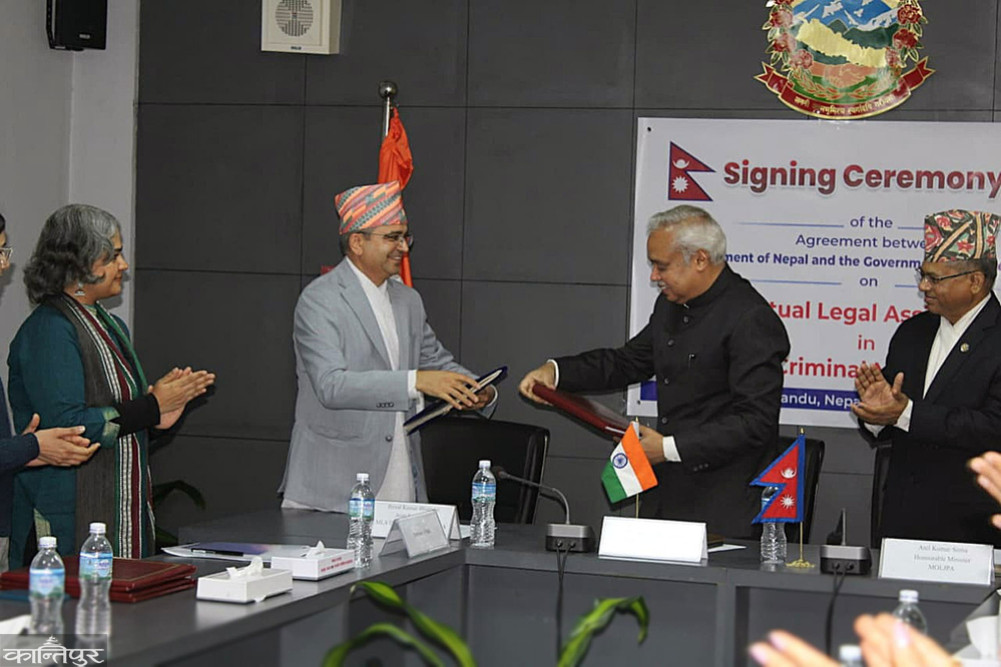
According to the Ministry of Law, the agreement will reduce financial crime in Nepal and make investigation, prosecution, and judicial processes more effective.
We use Google Cloud Translation Services. Google requires we provide the following disclaimer relating to use of this service:
This service may contain translations powered by Google. Google disclaims all warranties related to the translations, expressed or implied, including any warranties of accuracy, reliability, and any implied warranties of merchantability, fitness for a particular purpose, and noninfringement.
Nepal and India have signed an agreement on mutual legal assistance in criminal matters. The two countries signed the agreement at a program organized in Kathmandu on Tuesday.
The news that Joint Secretary of the Ministry of Law, Justice and Parliamentary Affairs Binod Kumar Bhattarai and Indian Ambassador to Nepal Naveen Srivastava signed the agreement on behalf of Nepal is published in today's Kathmandu Post .
Minister for Law, Justice and Parliamentary Affairs Anil Kumar Sinha, high officials of the ministry and representatives of the Ministry of Foreign Affairs were present at the program.
The Ministry of Law said that the agreement was concluded with the aim of exchanging mutual legal assistance between the two countries in criminal matters. 'The agreement will pave the way for exchange of cooperation between competent authorities of both countries in matters including collection and exchange of evidence during investigation, prosecution and judicial proceedings of criminal cases,' the ministry said in a statement.
The agreement will prove to be a milestone in reducing financial crimes in Nepal and making investigation, prosecution and justice more effective, and the ministry believes that it will also further help in mutual evaluation on preventing money laundering and financing of terrorist activities.
An initial agreement was reached in this regard at the Home Secretary-level meeting held in New Delhi in July last year. After the previous extradition treaty signed in 1953 expired a few decades ago, the security agencies of both countries had been relying on mutual understanding for the transfer of criminals and investigation.
Earlier, Nepal has also signed an agreement on mutual legal assistance with China. Although a draft of the extradition treaty was signed at the Home Secretariat in 2005, the negotiations were postponed due to differences in some provisions.
Although preparations are currently underway to update the treaty, a new treaty with China has not been concluded due to differences on the extradition of third-country nationals.