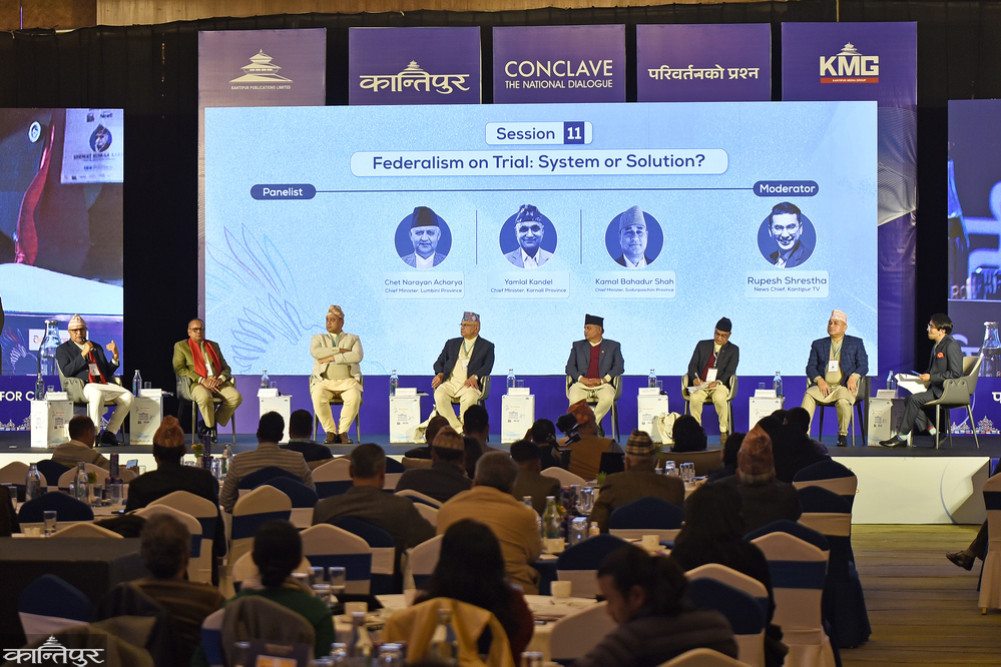
'Provinces are limited in structure, laws are necessary to make them carriers', Chief Ministers complain that the federal government has not enacted the necessary laws and delegated powers as per the constitution
We use Google Cloud Translation Services. Google requires we provide the following disclaimer relating to use of this service:
This service may contain translations powered by Google. Google disclaims all warranties related to the translations, expressed or implied, including any warranties of accuracy, reliability, and any implied warranties of merchantability, fitness for a particular purpose, and noninfringement.
Chief ministers have complained that even after a decade of implementing the federal structure, the provinces have not been able to exercise government. They have said that federalism has become limited to a structural form as the federal government has not enacted the necessary laws and delegated powers as per the constitution.
On the second day of the ‘Kantipur Conclave’, Tuesday, in a session titled ‘Federalism: Only Structure or Also a Conveyor?’, the Chief Ministers of Koshi, Madhesh, Bagmati, Gandaki, Lumbini, Karnali and Sudurpaschim commented that the centralized mindset of the federal government and leadership has not allowed the provinces to have full powers. They also argue that the federal government is creating a negative perception of federalism among the people.
Bagmati Chief Minister Indra Bahadur Baniya said that the single and common rights mentioned in the schedule of the constitution have not been implemented due to the apathy of the federal government. ‘This (province) is not a government, it is only a structure. If there had been a government, there would have been geographical rights. The rights to land and forests have not been exercised. There is no police. There are no civil servants,’ he said, ‘All these are needed to form a government.’
Gandaki Chief Minister Surendra Raj Pandey said that the provinces have not been able to practice government due to the incompetence of the federal leadership and government. ‘Businessmen come saying that they have to open a hospital, build a resort, give land. They should say that they do not have the right to give land. They come saying that a tree is blocking the road, it has to be cut down. We do not have the right to cut it down, we should ask the higher-ups,’ he said.
Chief Minister Pandey also said that there is no information about when and where an employee comes to the province, when and where he goes. ‘Some time ago, I transferred an employee of a ministry after finding irregularities, but Ramana did not come to pick him up. After some time, he went to the municipality as a secretary,’ he said.
The chief ministers allege that no matter which party forms the government in the federation, it has not been able to come out of the centralized mentality. Since the federal structure was established, all three parties, Congress, UML and the then Maoist (currently CPN), have led the government. Parties including the Rashtriya Swayamsevak Sangh (RSS) have also participated in the government. Since the laws on police, civil servants, education, forests and other matters were not formed in the federation, the provincial government has not been able to make laws related to them. The provincial government is waiting for the center to come forward as laws cannot be made that conflict with the constitution and federal laws.
Gandaki Province Chief Minister Pandey said that there is no longer a situation where the union has not made a law and it will be stopped. ‘Laws and necessary regulations will be made. Whoever comes to challenge the conflict will go to court,’ he said, ‘You should not stop revenue, employment and production just because the law conflicts.’
Informing that the province is preparing to make and implement some laws, he said that some laws have been challenged in court. ‘We are on a campaign to brand domestic alcohol and legalize commercial marijuana cultivation, and to expand the production and employment sector by making laws related to ride sharing,’ he said.
Sudurpaschim Chief Minister Kamal Bahadur Shah said that the province has not been able to exercise the sole and common rights mentioned in the constitution because it is linked to the constitution, federal leadership and federal laws. He mentioned that the impact of federalism is not visible at the public level due to the lack of laws on police, civil servants, education, health, forests, land, etc. ‘This is why a negative perception is being created among the general public towards federalism,’ he said.
Lumbini Province Chief Minister Chetnarayan Acharya said that the provincial government has made significant progress in the areas of local development, health, education, etc. He also informed that he has reduced the provincial expenditure by cutting the benefits available to former office bearers. He said that it is wrong to analyze it as burdensome and costly since the province works as a government close to the common citizen.
The Chief Ministers said that the report of the Auditor General’s Office mentions that the federal government spends 50 percent, the local government spends 44 percent, and the provincial government spends 4 percent. ‘The main thing is not the expenditure, but the mentality. Even today, we have to work amidst a centralized mindset,' said Karnali Chief Minister Yamalal Kandel, 'If federalism is to be effective, we must be free from the centralized mindset.'
Koshi Chief Minister Hikmat Kumar Karki said that the provinces are in a situation where 'the elephant has entered and the tail is stuck'. 'The constitution divided the government into three levels. But the tail was taken to the center and connected. Because the tail is stuck, the provinces are not able to show effective work now,' he said, 'Much better work has been done by the provinces than by the federal government. Federalism is neither costly nor burdensome.'
Madhesh Chief Minister Krishna Prasad Yadav said that federalism is necessary for Madhesh. He said that only after the federal structure has Dalits, oppressed, indigenous people and poor citizens in Madhesh been able to experience the government. ‘But since the union has not made a law, it has not been able to exercise its rights,’ he said, ‘due to the lack of some laws, there is a problem in spending the budget on development plans.’ Chief Minister Yadav commented that the transfer of employees in the province is being viewed as a punishment. ‘How can an employee who has come with a punished mentality work in the province?’ he said. Chief Minister Yadav also informed that he is committed to addressing the issue of good governance raised by the Gen-G movement. Yadav became the Chief Minister after the Gen-G movement.
Chief Ministers complained that despite the lack of discussion about the good work done by the province, there is a negative public opinion towards federalism. Chief Minister Pandey of Gandaki said that there is no discussion about the good work done by the province in the media and social media and only negative news comes. ‘Only things that are broken become news, things that are done do not come out. This has spread despair in the society, which has also given strength to the Gen-G movement in some way,' he said, '32 offices in Gandaki were reduced to 19 and unnecessary posts were cut to reduce expenses. But there was no news about this.'
Karnali Chief Minister Kandel said that with the change of government at the center, the provincial government should also go to a system of directly elected Chief Ministers to prevent turmoil. Some other Chief Ministers said that the current electoral system should be amended instead of directly. 'The Gen-G movement has become like an unnatural disaster. The electoral system must now be reformed to address the demands raised by the Gen-G movement. As long as this system remains, no party can form a majority government,' said Bagmati Chief Minister Baniya, 'Now the parliament that comes after the elections should amend the electoral system in the constitution.'