The then Tourism Minister Rabindra Adhikari formed the investigation task force after the American company 'Traveler Assist' repeatedly requested an investigation and action, saying that there was a growing business of rescuing tourists going for trekking and climbing in the Himalayan parts of Nepal by pretending to be sick or pretending to be sick, taking them to hospitals, and collecting 'large sums of money' from insurance companies by preparing fake documents.
We use Google Cloud Translation Services. Google requires we provide the following disclaimer relating to use of this service:
This service may contain translations powered by Google. Google disclaims all warranties related to the translations, expressed or implied, including any warranties of accuracy, reliability, and any implied warranties of merchantability, fitness for a particular purpose, and noninfringement.
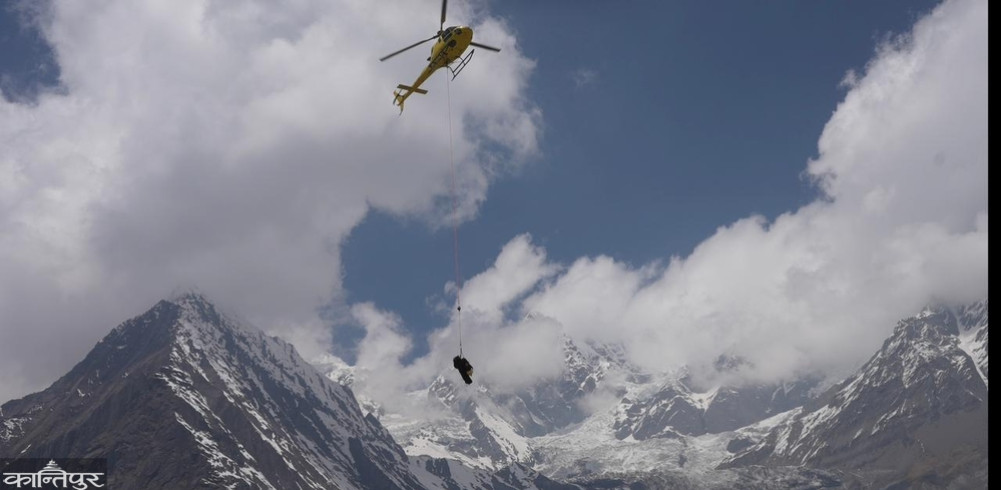
Helicopter rescue is a common practice when tourists are stranded, in natural disasters or in accidents during trekking and mountaineering in high-altitude and mountainous areas. However, there have been incidents where some individuals and organizations forcibly rescue tourists by helicopter even when they are in a minor problem, repeatedly claim insurance for the same flight, and collect ‘large sums’ from insurance companies by preparing fake documents.
After the incident of conducting fake rescue flights, bringing patients directly to hospitals, and cheating by inflating insurance claims worth millions of rupees became public, the then Tourism Minister Rabindra Adhikari formed a special investigation task force under the leadership of current Finance Secretary Ghanashyam Upadhyay. The task force formed at the ministerial level in Jestha 2075 was given the responsibility of finding out the truth about fake rescues, insurance fraud, and organized financial irregularities.
The task force prepared a report by ‘confirming with evidence the suspicion that travel, trekking, rescue companies, hospitals, helicopter companies, and insurance companies were colluding to show excessive expenses and collect insurance payments.’ The report was sent to the Police Headquarters via the Home Ministry for further investigation.
Due to increased pressure from some airlines through the then Prime Minister, none of the Tourism Ministers and Home Ministers after Adhikari initiated further investigation. The Central Investigation Bureau (CIB) of the police informed in a press conference on 11th Magh that the investigation was initiated based on the report after complaints about fake rescue flights were received.
Upadhyay's task force had studied the helicopter rescue flights, insurance claims, hospital expenses, foreign currency payment details, registration status of travel and rescue companies from January 2015 to May 30, 2018. During that period, 1,532 tourists used rescue flights, and 10 helicopter companies were used in them.
Several evidences of Nepal-based agents of foreign insurance companies being involved in rescue or travel company operations and collecting insurance money through fake rescues were made public 7 years ago through a report. After that, the insurance premiums of tourists visiting Nepal increased drastically, and some foreign companies stopped providing insurance services to Nepal. These incidents not only had a serious impact on Nepal's tourism image when negative news was published in the international media, but Nepal's Prime Minister, ministers and high-ranking officials also had to face questions from journalists while participating in foreign programs.
Why does the police now have to investigate this report in more detail? At that time, the task force did not receive all the details requested from the companies involved from the relevant bodies on time, and the investigation remained incomplete. During the investigation period, the details of foreign currency received in Nepal for insurance were not available in an integrated manner from the Nepal Rastra Bank.
The amount claimed by the foreign insurance company and the details of the Rastra Bank did not match . The task force was not able to obtain the necessary details from the Insurance Committee and many foreign companies that insure tourists in Nepal. The task force completed its study based on the available documents and details without conducting an on-site study and submitted its report in Bhadra 2075. Similarly, details were collected from only a limited number of companies and hospitals based on complaints and details provided by helicopter service providers.
Tourist insurance system
When tourists come to Nepal, they usually take out 'travel insurance' through a foreign insurance company. For mountaineering, there is a provision to go with a guide by paying a fee to the Department of Tourism. For trekking, permission is obtained individually or through a company by paying a specified fee. Special permission is required from the Immigration Department to trek in prohibited areas.
If a tourist falls ill or has an accident during the rescue process, the guide informs the 'travel insurance' company, then the insurance company itself or through the rescue company coordinates with the helicopter company to manage the rescue. The study report states that after the rescue, the tourist is taken directly to the hospital and the insurance claim is made through the rescue company, insurance company or hospital. However, the helicopter company does not appear to have made a direct insurance claim. This suggests that there is no transparency in the rescue costs and insurance claim process and that the costs have been increased through other parties.
The study report concludes that the risk of abuse is high due to the lack of clear standards, monitoring and strictness in the rescue system. The report warns that unnecessary rescues have increased insurance costs and have had a negative impact on Nepal's tourism image in the international market, which could put the tourism industry at risk in the long term.
Recommendation for further investigation and action
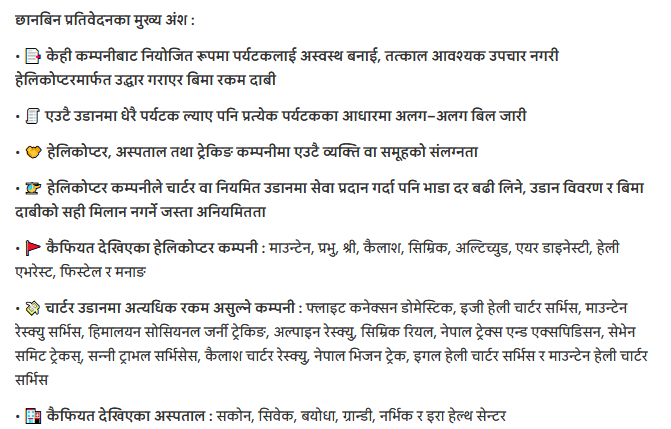
The companies that the report has asked to investigate include Sakon Hospital Pvt. Ltd., Sibek Hospital Pvt. Ltd., Bayodha Hospital, Grandee International Hospital, Norvic International Hospital and Era Health Center Pvt. Ltd. The report has recommended that the relevant government agencies investigate and take action, stating that there are widespread irregularities in helicopter rescue and insurance claims in Nepal. The report has shown that some companies have deliberately kept tourists in an unhealthy condition or have helicopter rescues without providing them with necessary treatment and claimed insurance money, and have brought multiple tourists on the same flight and issued separate invoices for each tourist.
The investigation task force also recommended that the same person or group be involved in the helicopter, hospital and trekking company through the Special Investigation Unit of the Ministry of Home Affairs and Nepal Police, stating that the same person or group is involved in the helicopter, hospital and trekking company. As some companies claimed rescue payments in US dollars without permission for foreign currency transactions, the National Bank was also recommended to conduct necessary investigations and take appropriate action in accordance with the Foreign Exchange Act.
The report also asked the Ministry of Health to investigate, stating that based on the details received in the hospital and helicopter rescue, the treatment fees were not within the standards, fees were charged under multiple headings in the same insurance claim, and it was not clear whether the treatment was within the medical standard.
The hospitals that the report asked to investigate include Sakon Hospital Pvt. Ltd., Sibek Hospital Pvt. Ltd., Bayodha Hospital, Grandee International Hospital, Norvic International Hospital, and Era Health Center Pvt. Ltd.
The task force also recommended the Revenue Department for further investigation and action as some helicopter companies, trekking companies, and hospitals were found to have earned excessive profits, prepared false accounting statements, and conducted transactions without reconciling insurance claims and tax payments.

The report mentions irregularities such as charging higher fares and not properly matching flight details and insurance claims when helicopter companies provide services in Nepal on charter or regular flights. The task force recommended that further monitoring be carried out by the authority and that the Department of Tourism should monitor and investigate the complaints, information and documents received and take necessary action.
Regarding helicopters, the report had called for further investigation as Mountain Helicopter Pvt. Ltd., Prabhu Helicopter, Shree Airlines, Kailash Helicopter, Simrik Air, Altitude Air, Air Dynasty, Heli Everest, Fishtail Air and Manang Air had charged abnormal amounts for rescue flights.
The report had suggested further investigation into the rescue flights and claim details of Flight Connection Domestic Pvt. Ltd., Easy Heli Charter Service, Mountain Rescue Service Pvt. Ltd., Himalayan Social Journey Trekking Pvt. Ltd., Alpine Rescue, Simrik Real, Nepal Treks and Expeditions Pvt. Ltd., Seven Summit Treks Pvt. Ltd., Sunny Travel Services Pvt. Ltd., Kailash Charter Rescue Pvt. Ltd., Nepal Vision Trek, Eagle Heli Charter Service and Mountain Heli Charter Service, which charge exorbitant fees for charter flights. Similarly, the report had also stated that the transactions of 20 trekking companies were also suspicious, along with financial details, and had asked for further investigation.
Pressure on ‘Traveller Assist’ company and formation of an investigation task force
As tourism activities in Nepal increased, fake helicopter flights in the name of rescue and fraud in insurance claims increased, and a foreign company named ‘Traveler Assist’, claiming to have an address in Latin America, was the one who pressured the government to expose the incident and form an investigation committee. In 2075, it had written to the government several times, accusing it of ‘some Nepali tourism entrepreneurs of cheating in helicopter rescue’ and asking it to investigate.
After it threatened to make the emails public, the then Tourism Minister Rabindra Adhikari formed a six-member investigation committee led by Upadhyay, the then Joint Secretary in charge of the Administration Division and current Finance Secretary, in the ministry.
Danny Kane, Head of Assistance at ‘Traveler Assist’, had pressured the government to take action by setting a deadline in an email sent to Pramod Nepal, the then Under-Secretary in charge of Civil Aviation in the ministry. He had warned that if the government did not stop the fake rescues by September 2018, he would make all emails sent to the Ministry of Tourism public to the international media.
Cain claimed that the ministry had been informed more than six times through emails and warned that if the decision-making authorities did not contact him by the timeline he had given, he would make all emails sent to the ministry, the investigation committee and other officials available to the media. “We will release every email we send to the media, which will make it clear that the ministry is lying,” Cain wrote in an email received by Kantipur.
At the time, ‘Traveller Assist’ described itself as a company working on behalf of major insurance underwriters in the UK, Australia and the United States, claiming that these insurance companies insured a large portion of English-speaking tourists visiting Nepal. He wrote in an email at the time, “If a concrete solution to control fraud is not found by September 1, 2018, these insurance companies will stop providing travel insurance services to Nepal.”
According to his claim, about 30 percent of the helicopter rescues for tourists in Nepal at that time were completely unnecessary. In addition, ‘Traveler Assist’ claimed that its research had shown that insurance companies were losing millions of rupees every year due to the extremely expensive treatment provided in some hospitals opened only for tourists in Kathmandu.
‘Traveler Assist’ had claimed that Nepali trekking companies, especially those selling trekking packages for less than 1,000 US dollars, were involved in the fake rescue scam, and that these trekking companies were related to the insurance companies. ‘Traveler Assist’ had repeatedly warned through emails that it would affect Nepal’s economy and international image, and that if the Nepalese government did not control fraud, there would be serious long-term consequences for Nepal, and the Ministry of Tourism had formed an investigation task force on the matter.
After news about the Nepali helicopter company started appearing in international media, the Nepal Helicopter Society, which was then chaired by Captain Rameshwor Thapa, denied the allegations through a press conference, saying that they did not recognize ‘Traveler Assist’ and were harassing many companies via email without concrete evidence. The society had stated at the time that this issue had become ‘Nepal victimized by the war of insurance companies’.
Suggestions for improvement with two options
The task force report also proposed measures to improve Nepal’s tourist rescue system and make it systematic, transparent and effective.
The proposed suggestions are based on two main options. First, the responsibility for all tourist rescue operations would be given to the Nepal Police. Under this, it is said that the police can conduct rescue operations through its own helicopters or helicopter companies and hospitals available in accordance with the Public Procurement Act. Second, it is said that priority will be given to collaborative management. It proposes to set up a 'Tourist Rescue Coordination Cell' at Tribhuvan International Airport during the main tourist seasons (September-November and March-May). The police will receive initial information about the rescue through this cell and only then should permission be granted for rescue flights.