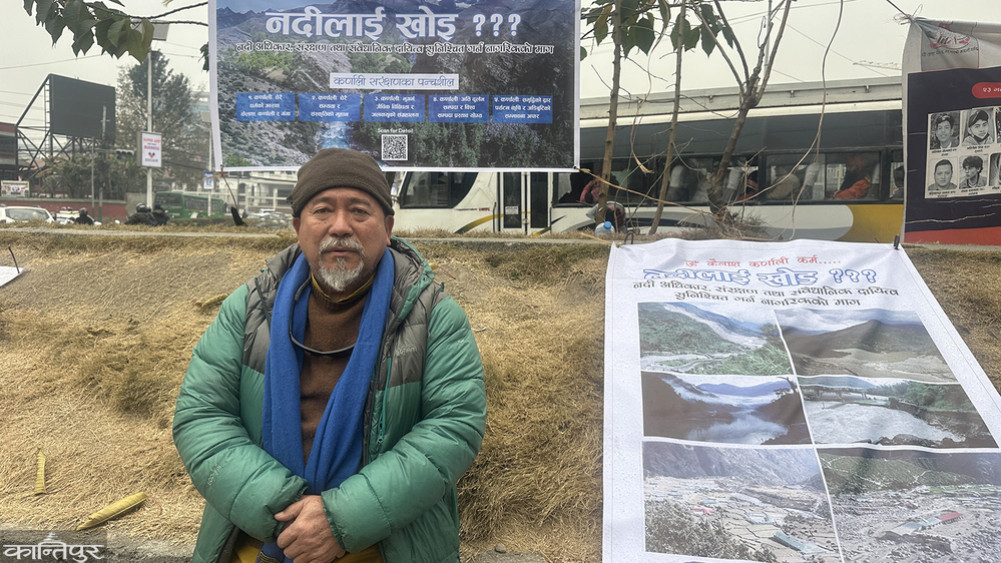
On the eve of the House of Representatives elections, Ale has been on a hunger strike since 12th Magh, demanding that the issue of river conservation be included in the election manifestos of all parties by creating pressure on political parties and candidates through the 'Save Rivers, Save the Country' campaign.
We use Google Cloud Translation Services. Google requires we provide the following disclaimer relating to use of this service:
This service may contain translations powered by Google. Google disclaims all warranties related to the translations, expressed or implied, including any warranties of accuracy, reliability, and any implied warranties of merchantability, fitness for a particular purpose, and noninfringement.
River conservation activist Megh Ale is on a relay hunger strike in Maitighar Mandala, demanding river rights, protection, and ensuring constitutional obligations.
On the eve of the House of Representatives elections, Ale has been on a hunger strike since 12th Magh, creating pressure on political parties and candidates through the 'Save the River, Save the Country Campaign' to include the issue of river conservation in the election manifestos of all parties. 'No political party has raised this issue as its agenda. The issue of infrastructure in such a sensitive country has been seen only as a place for extracting gravel and sand, generating hydropower and displacing waste,' Ale said. 'I have gone on a hunger strike with the aim of ensuring that candidates who are engaged in the election understand this issue before entering Singha Durbar and include it in their election campaigns.'
Ale wants the issue of rivers to be included in the election manifestos of all political parties and candidates. There are more than 6,000 rivers and streams in Nepal. Although national parks have been declared in the names of the Himalayas, the hills and the Terai, Ale says that the fact that no national park has been declared in the name of a river to date is a serious policy weakness.
He has demanded that the Karnali River be included in the World Heritage List as it is the main lifeline connecting Kailash, Khas and Ganga civilizations. He has made 14 demands, saying that the Bagmati River needs to be legally given human rights.
In his demand, he has mentioned that only development through river conservation will be constitutional, just and sustainable development. He has demanded that river-based conservation areas be designated in all seven provinces, any development work that destroys river civilization should be stopped immediately, the Kali Gandaki diversion project should be stopped immediately, the natural flow of the river and the rights of local communities should be ensured, and a separate law on river conservation should be made.
Similarly, in the context of cross-border rivers, a transparent agreement process based on equality and mutual benefit should be adopted with India, and the right policy on renewable energy should be made and implemented in the context of climate change.
64-year-old Ale has been involved in river conservation for more than 30 years. He is a river guide by profession. His main demand is to let the rivers flow without hindrance. He is currently involved in the Karnali River Protection Campaign, including the Syangja Andhikhola and Bhotekoshi Conservation Campaign. He is also a member of the Bagmati Cleanup Campaign. In the context of river protection, Ale had also been a victim of attacks. ‘It is necessary to always protect the river,’ he says, ‘but the branch river can be used from an environmental perspective.’
Ale says that if the problem arises at the root, there could be a huge loss of wealth tomorrow. Not only that. Nature itself will be destroyed. ‘There should be no destruction in the name of development, there should only be balanced development,’ he says, ‘There should be no development. That is why a leader is needed to raise this demand. This issue needs to be raised in our law.’