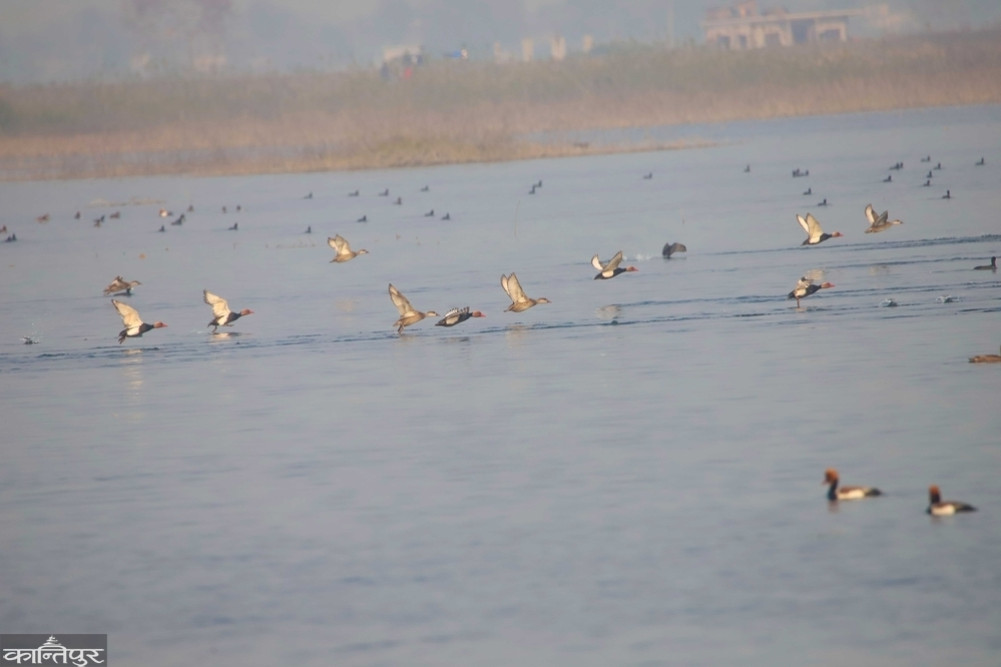
Although there has been a significant increase in waterfowl in the lakes and wetlands of the Shuklaphanta region this year, the crisis has increased due to habitat encroachment, fish farming, and climate change.
We use Google Cloud Translation Services. Google requires we provide the following disclaimer relating to use of this service:
This service may contain translations powered by Google. Google disclaims all warranties related to the translations, expressed or implied, including any warranties of accuracy, reliability, and any implied warranties of merchantability, fitness for a particular purpose, and noninfringement.
The number of waterfowl has increased this year in Shuklaphanta National Park and surrounding wetlands.
In the recent waterfowl census, 25,660 waterfowl of 82 species were found. This is 3,500 more than last year.
Waterfowl were counted in areas including Sikari Lake, Rani Lake, Baba Lake, Salgauri Lake, Radhapur Wetland Area, Mahakali River, Chaudhar River coastal area, and Puraini Lake, Ratanpur Wetland Area, and Banda Lake outside the park. Last year, about 21,800 waterfowl were counted. In this year's census, the highest number of waterfowl was seen in Sikari Lake and Puraini Lake.
According to Hirulal Dagaura, senior ornithologist of the Bird Conservation Society of Nepal (BCN), during the census, 645 waterfowl were sighted in the Mahakali River, 227 in Rani Lake, 212 in Radhapur Wetland, 618 in Ratanpur Farmland, 450 in Tara Lake, 53 in Kalikich, the highest number of 20,949 in Sikari Lake, 1,554 in Puraini Lake Belauri, 70 in Nakaiya Wetland, 130 in Gadbijula Lake and 281 in Banda Lake Belauri.
The waterfowl census was conducted under the leadership of Shuklaphanta National Park with the joint participation of the National Nature Conservation Trust Shuklaphanta, ZSL Shuklaphanta Nepal, Nepal Bird Conservation Society, Buffer Zone Management Committee, Himali Prakriti, RW, Nature Guide Association, Ranatharu Homestay, Kanchanpur Bird Conservation Group and Nepal Ornithologists Association.
Ornithologist Hirulal Dagoura said that compared to previous years, the number of waterfowl has improved in the Sikari Lake inside the park and the Puraini Lake, Nakaiya Wetland and other areas outside the park. He said that conservation is essential as Puraini Lake, Banda Lake and Ranital are gradually becoming covered with vegetation of the Michaha species.
According to Dagoura, this year the water flow in the Mahakali River has been reduced, while the beauty of the lake has been reduced due to the spread of vegetation such as Nakkurt and Water Lilies in Rani Lake inside the park. However, he said that the presence of waterfowl in the Sikari Lake is encouraging as it is much better than the previous year.
'Although the number of birds has increased, the habitat is in danger,' he said, 'The increasing encroachment in the wetland area, unscientific fishing, exploitation of riverine products and climate change have added challenges to the habitat of waterfowl.'
Vinay Kumar Jha, Conservation Officer of Shuklaphanta National Park, said that the improvement in the number of waterfowl due to the continuous protection of the lakes is a positive sign. He emphasized that wetlands and birds should not be limited to conservation alone but should be linked to eco-tourism.
'It is necessary to make birds and wetlands a medium of tourism by scientifically managing the lakes without spoiling their natural beauty,' he said. 'Since there is a great potential for tourists to come for bird watching, cooperation from all parties in conservation along with widespread publicity is indispensable.'