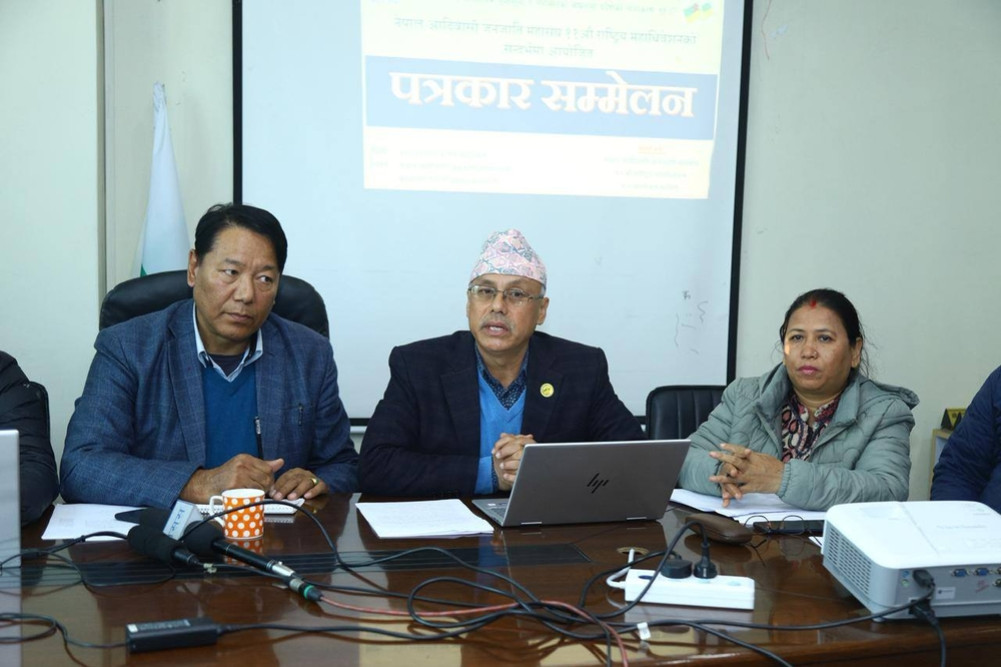
It was informed at the press conference that out of the 60 indigenous communities listed in the National Foundation for the Upliftment of Indigenous Peoples, the Government of Nepal has affiliated 56 communities and 12 different affiliated organizations with the federation.
We use Google Cloud Translation Services. Google requires we provide the following disclaimer relating to use of this service:
This service may contain translations powered by Google. Google disclaims all warranties related to the translations, expressed or implied, including any warranties of accuracy, reliability, and any implied warranties of merchantability, fitness for a particular purpose, and noninfringement.
The 11th National Convention of the Federation of Indigenous Peoples of Nepal is scheduled to be held on January 29 and 30. The Federation held a press conference on Sunday and informed that it has decided to hold the convention in Biratnagar, the capital of Koshi Province.
The general convention is being held with the main slogan of 'Ensure the rights of indigenous peoples over natural resources, water, forests and land, and re-nominate provinces based on the identity of ancient civilizations and historical backgrounds,' informed Gelje Lama Sherpa, president of the federation and coordinator of the main organizing committee of the general convention.
He said that preparations are being made by forming 12 different sub-committees to make the general convention grand and successful.
The Federation of Indigenous Peoples of Nepal was established in 2047 BS with the aim of establishing collective rights with identity by uniting all indigenous peoples of Nepal. Indigenous people constitute about 36 percent of the total population in Nepal.
It was informed at a press conference that out of the 60 indigenous peoples listed in the National Foundation for the Upliftment of Indigenous Peoples, the Government of Nepal has 56 communities and 12 different affiliated organizations affiliated with the federation.
Similarly, Federation President Sherpa mentioned that work is being organized through the Federation's migration organizations in 25 different countries, seven provincial coordination councils across the country, 77 district coordination councils, local municipalities and ward coordination councils.