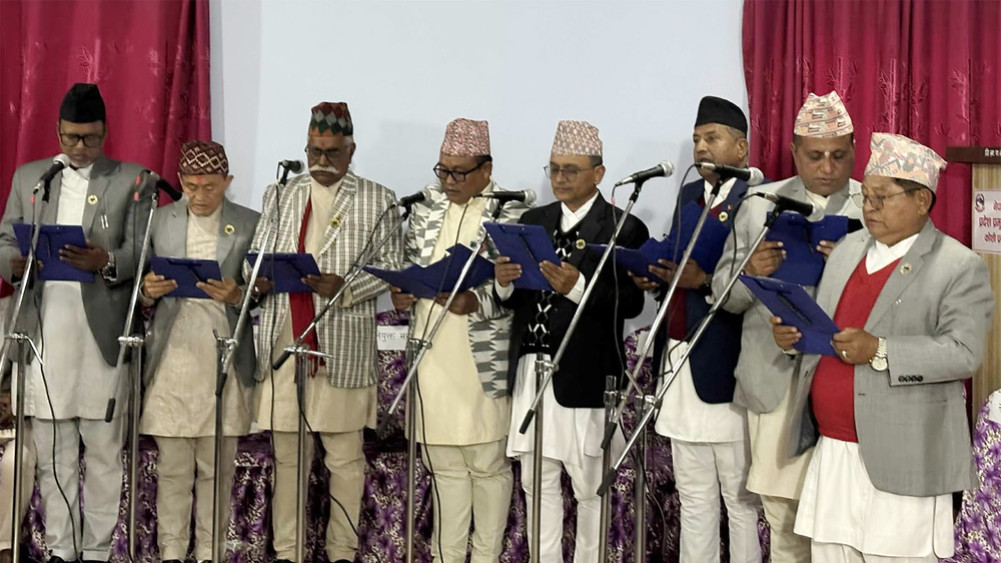
Social inclusion has once again been pushed to the background as the balance between the Deuba, Sitaula, and Koirala groups within the Congress and the Oli-pro-Oli and other groups within the UML is adjusted.
We use Google Cloud Translation Services. Google requires we provide the following disclaimer relating to use of this service:
This service may contain translations powered by Google. Google disclaims all warranties related to the translations, expressed or implied, including any warranties of accuracy, reliability, and any implied warranties of merchantability, fitness for a particular purpose, and noninfringement.
Hikmat Kumar Karki, who became the Chief Minister of Koshi Province for the third time in his second term, barely included a woman Minister of State when he reorganized the provincial cabinet on Tuesday. The issue of the Koshi government's cabinet reorganisation has brought the debate on inclusive governance back to the fore.
The reconstituted cabinet continued the same practice and did not allow the Dalit community to enter the executive branch. The Kosi Province government, whose proportional inclusion guaranteed by the constitution is limited to paper, has become more lenient towards the Dalit community.
In the reconstituted cabinet, four ministers and one minister of state were appointed in equal numbers from the Congress and the UML. Although the arithmetic of power sharing seems to be in line, the cabinet has become 'one-sided' from the point of view of social inclusion. Like the previous government, this time too, not a single Dalit MP has been made a minister.
This mistake is not a one-time mistake. This repeated problem is the result of structural continuity. Since 2074, the government in Kosi Province has changed nine times. Three times in the first term and six times in the current term.
More than 95 ministers have been appointed in the 18th cabinet reshuffle. However, not a single cabinet minister from the Dalit community has been appointed in all these governments.
In the previous term, UML's Dalit MP Jamaya Gajmer became the Minister of State for Social Development. In the second term, Congress' Sunita Kumari Gurung Ram became the Minister of State. These two examples clearly show that the Dalit community is being limited to a supporting level rather than the center of policy making.
'The participation of the Dalit community is limited to a symbolic presence, not at the center of policy making,' says Koshraj Neupane, Principal of the Faculty of Law at Manmohan University. 'This is not inclusiveness, it is only management.'
There are MPs, but no power
There are four Dalit MPs in the Koshi Provincial Assembly, one each from the Congress and UML, and one each from the CPN (Maoist Centre) and the RPP. Representation is not zero, but there is no access to the decision-making level. According to Dalit rights activists, this is the main problem, ‘there is presence, but there is no power.’
‘Dalits are sent to parliament after winning elections, but they are forgotten when power is shared.’ Naresh Khati, a Dalit activist and advocate from Jhapa, says, ‘The failure of the state to implement the rights given by the constitution in practice is a failure.’
According to advocate Khati, the Constitution of Nepal clearly states that the executive should also be formed on the basis of proportional inclusion. Article 76(9) states that the principle of inclusion should be adopted while forming the Council of Ministers. Article 40 gives the Dalit community the right to proportional participation in all organs of the state.
‘However, looking at the practice of Koshi Province, inclusion seems to be limited to speeches and documents,’ Khati adds, ‘Political parties tend to evade the responsibility of inclusion by fulfilling the minimum legal obligation. The executive has been kept limited to the old power structure by arguing that there is no legal obligation not to make women and Dalits ministers.’
Dalit rights activists see this issue not as a ‘reservation demand’ but as a question of constitutional rights. Dalit rights activist and writer JV Vishwakarma says, ‘Making Dalits ministers is not a mercy, it is a right.’ If the constitution talks about proportional participation, then the presence of Dalits in the power structure should be mandatory.’
According to Vishwakarma, the Dalit community is always dismissed by creating a narrative that they are ‘not qualified’, but most non-Dalit leaders who have reached the leadership also become ministers on the basis of political distribution.’
Factions, Mathematics and Exclusion
In the latest cabinet reshuffle in Koshi, faction balance, regional division and party power mathematics seem to have been prioritized. Social inclusion has once again been pushed to the background while balancing the Deuba, Sitaula and Koirala groups within the Congress and the Oli-like and other groups within the UML.
‘The failure to change the social character of the power structure despite repeated changes in government is a major weakness of Koshi Province’s democratic practice,’ says political analyst Krishna Pokharel. ‘Continuously keeping women and Dalits out of the decision-making level weakens the quality of democracy.’ According to him, inclusion is not only a moral issue, but also an issue directly linked to good governance and effective service delivery.
Questioning the credibility of democracy
The Dalit community is an important part of the social structure of Koshi Province. Despite having a significant presence in terms of population, their continued exclusion from the executive branch is a question of the credibility of democracy.
Due to lack of representation, Dalit community issues are not prioritized in policy making, which further institutionalizes social discrimination. For example, the Dalit Empowerment Act has been shelved for the past 7 years.
CPN-Maoist Center MP Sapna Pariyar said that the government has repeatedly shelved the draft of this act, citing the increase in expenses. “The government does not agree to make an act for the empowerment of Dalits,” Pariyar said. “Making a Dalit a cabinet minister is unimaginable.”
Dalit rights activists have a common conclusion that if inclusivity is not implemented according to the spirit of the constitution, then federalism and democracy will become empty slogans for the Dalit community.