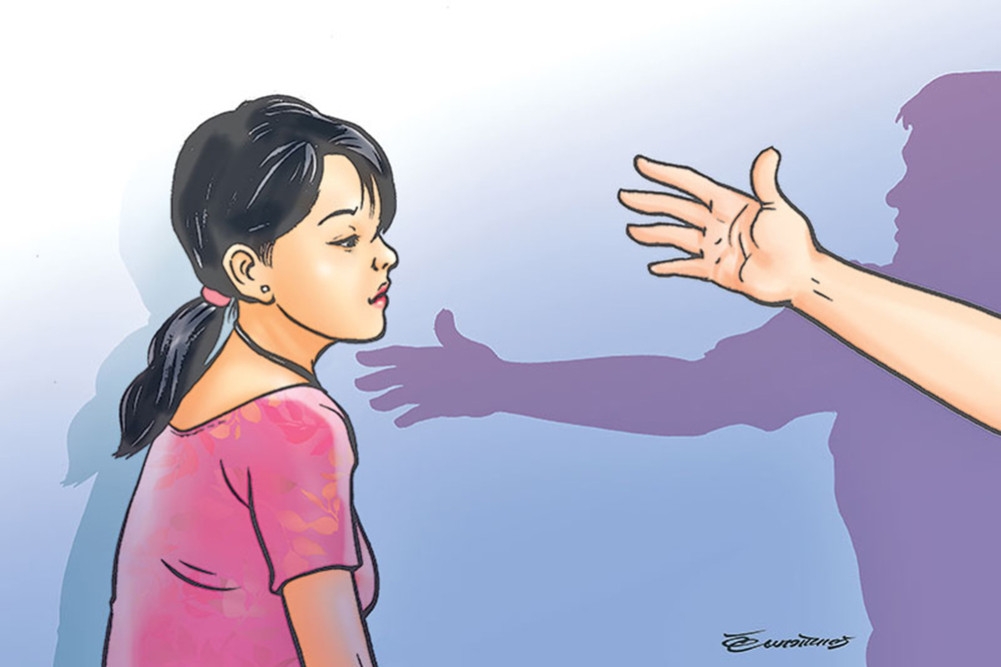
According to police statistics, more than 2,000 girls have been subjected to sexual violence and rape in the last three years, most of which are committed by relatives or acquaintances.
We use Google Cloud Translation Services. Google requires we provide the following disclaimer relating to use of this service:
This service may contain translations powered by Google. Google disclaims all warranties related to the translations, expressed or implied, including any warranties of accuracy, reliability, and any implied warranties of merchantability, fitness for a particular purpose, and noninfringement.
Anshu Gautam, 12, of Letang-2, Morang, went out to play ping pong with her friends on October 21, 2005. But she did not return home until late in the evening.
The police started a search but did not find any clue about her. There was no news for 18 days. On Kartik 7, Anshu's body was found in the Belbari Chisang partnership forest area of Letang-2.
After investigation, it was found that 59-year-old neighbor Padam Adhikari had taken Anshu to the forest after asking for help in cutting grass, raped and murdered her. Anshu not only became a victim of violence but also lost her life before she could fulfill her young dream.
000
Ganga (name changed) from Dhanusha was living with her family. A 22-year-old man who worked in a nearby workshop used to tease her repeatedly, make obscene gestures and behave uncomfortably. Since he was an acquaintance, she initially thought it was a simple joke.
One evening, when she was going to a snack shop, the man and his friend forcibly took her to a room. And while resisting, he raped her . The parents who went out to search did not find their daughter that night . The next day, when the local community joined forces to search for her, she was found in the accused's room in a very weak and limp condition .
The accused was arrested after a police investigation . The victim is currently under the protection of a child care center .
000
A 7-year-old girl from Bardiya Municipality-6 was playing alone some distance from home in the evening 8 months ago . The father, who was working as a housemaid, found the daughter, but she was unconscious . Two boys, 17 and 12 years old, who were acquaintances, were involved in this incident . They forcibly took the girl to a bush, gagged her and raped her .
The victim is currently in a child protection home in Kathmandu . The 17-year-old perpetrator is in the Hetauda Correctional Home, while the 12-year-old boy is at his own home . The family is alleging that both the perpetrators were not taken to court due to local political patronage.
000
A 17-year-old girl from Sindhuli had been living with her maternal uncle since the age of two after her parents remarried. Due to her poor financial condition, she dropped out of school after grade 8. The girl's brother's mental health deteriorated. To meet the expenses of her brother's treatment, she started working at a guesthouse in Dudhauli Bazaar with a monthly salary of Rs 8,000.
Dudhauli Municipality Mayor Dinesh Adhikari used to visit the guesthouse. One day, the girl explained her situation to the mayor and expressed her hope for help. It was the third week of Baisakh.
After hearing her pain, the officer assured her of help, but taking advantage of her delicate condition, he raped her repeatedly one night. Then he gave her money to buy and take medicine to prevent pregnancy. She took the medicine as she was told, but her period stopped. She quit her job after experiencing symptoms of nausea and loss of appetite. One day, she told her mother, who worked as a full-time worker in Kathmandu.
She came to Kathmandu on her mother's advice. When she went to the hospital for a medical check-up, it was confirmed that she was pregnant. Due to her poor financial situation, the family could not afford the 25,000 rupees demanded for an abortion. Later, an NGO took the girl under protection and she gave birth to a baby in a maternity hospital last Falgun. The incident is currently under legal process. The police have stated that the mayor's official is absconding and the search is on.
000
The above-mentioned cases are only representative. Nepal Police statistics show alarming statistics of rape and sexual violence. Which shows how the graph of sexual violence against girls in Nepal is rising. The police statistics also show another alarming fact. Because young girls are more likely to be victims of rape and sexual violence.
According to Nepal Police, in 2079/80, 1,772 girls were subjected to sexual violence and rape. Of these, 375 are under 10 years of age, and 1,393 are between the ages of 11 and 16. Similarly, in 2080/81, 2,255 girls became victims. Of these, 376 are under 10 years of age, 777 are between the ages of 11 and 14, 673 are between the ages of 15 and 16, and 429 are between the ages of 17 and 18.
According to Nepal Police, in 2081/82 alone, 2,355 girls were subjected to sexual violence. Of these, 351 are under 10 years of age, 690 are between the ages of 11 and 14, 616 are between the ages of 15 and 16, and 378 are between the ages of 17 and 18.
Experts and specialists say
There are many girl victims who are afraid to speak out due to fear and terror even after being raped. And psychiatrists say that they struggle with mental health problems internally because they do not dare to bring their pain out of fear of losing respect in their families.
Sociologist Samjhana Wagle Bhattarai says that violence against women has a very negative impact on society. She says, 'Incidents like rape and violence have a very negative impact on society. The society we imagined is not like this. It is very different,' she says, 'We are very far ahead in education, access to everything, technology, and everything.'
Samjhana says that this can be viewed from two angles. She says, 'This still shows where we are, our society, what is the mindset of people. Our daughters are still not safe in society.'
She says that such incidents show that society is not as safe as we thought. 'Our society is not as safe as we thought. We need to build a safe society. One aspect of this is that awareness programs should be conducted,' she adds, 'The other aspect is how and under what circumstances the crime occurs. Whom should we trust, who should we not trust, and how strong we can be.'
She says that the number of victims has increased because they are no longer tolerating violence perpetrated by anyone, but are speaking out for their rights. 'Girls used to be more exposed to violence before. People are more aware now than before,' she said. 'Earlier, no matter how many incidents came up, the victims did not come out. There was a tendency to be afraid when such incidents were brought out. People used to think about what people would say, there was a tendency to hide their pain. There was a lack of public awareness.'
She says that now, most of the time, people hide their pain. Incidents like violence against women should not be kept hidden and should not be kept hidden. Her analysis is that the incidents have come to light because of the development of the idea that if they are not brought out, such incidents will increase.
Nepal Police statistics show that most rapes are committed by people at home, family, neighbors, and acquaintances. Experts say that girls who are victims of their own, victims of characters they trust, are always thinking that they were wronged by their own people.
Child guardian Geeta KC Darnal says that the victim girls she has taken in get scared as soon as they see a man in the early days. She says, 'There are many cases where the victim girls get scared even when they see a boy for some time after they come.'
She said that the pain according to their age is reflected in the eyes of the victim girls she has. 'The victims, aged 4 to 10, sometimes play and have fun because they don't know what happened,' she said, 'but the girls above 10 years old, because they understand what happened to them, and because they feel victimized by society and themselves, seem very sad about this pain.'
She says that they help the girls a lot to live a life outside the incident. She says, 'We help them a lot, from consulting with doctors to forgetting the past. But no matter how happy and joyful their lives are, at some point they still feel sad because of their pain.'
Darnal says that she has seen more fear in girls who have been victimized by society's perspective, and by people from their own family and acquaintances. She says, 'It always hurts in the heart to feel like they have been betrayed because they thought they were safe from themselves,' she said, 'Little children who don't know what happened to them. If society and family find out about it in the future, they will be very worried about what will happen to them.'
He says that the structure of society also makes the victimized girls feel weak. 'When the criminal commits a crime, he should be punished, but the children who have had to suffer for no reason and are innocent. Society treats them with respect and treats them with respect. That is why they feel like they have been ostracized by society after the incident.'
According to Nepal Police Spokesperson DIG Abinarayan Kafle, the misuse of technology is also one of the reasons for the increase in rape and coercion. 'It seems that incidents have increased from being friends and acquaintances on social media,' he said.
He says that the fact that girls aged 11 to 14 are the most victims is one of the reasons why they trust them easily. 'It seems that girls between the ages of 11 and 14 are raped a lot because they are easily tempted and deceived,' he said.
He suggests that parents should think carefully about what their children are doing, as the family environment plays a big role in this. Statistics also show that such incidents occur due to relatives, acquaintances, close friends, friends who come to them as helpers, let them look at their mobile phones, and sometimes act as if they care a lot.
Advocate and Vice President of the Nepal Bar Association Ajay Shankar Jha says that rape incidents have increased due to very little knowledge about the law. He says, 'We say that everyone knows the law. In fact, few know the law. To prevent such incidents, we should start from the school curriculum.'
He says that the law prescribes different punishments for rape cases according to age. 'If there is rape and murder in a very brutal way in any incident, the law has provided for life imprisonment for the culprit in such an incident, considering all the circumstances of the incident,' he said.
Clinical psychologist Hashana Shrestha says that a girl needs the love of her family and society at such times. 'We call such an incident a traumatic incident. Children's age is a time when everything from brain development to physical, emotional, and mental development is developing,' she said. 'This stage is a learning stage for them on how to see the future, who to trust or not, and how to approach relationships.'
She says that such incidents affect the girl's entire life. She says, 'Once a traumatic incident occurs, it is not easy to forget. The support of the family and society is necessary to reduce its impact. The culprit should be punished,' she said. 'If someone has committed such a crime on their own, they should not hide the incident. Other family members should take a stand on it.' The child needs various treatments, from counseling.'
Psychiatrist Shrestha says that family and society play a very important role in returning to social life. 'It is only with the love and support of family and society that it becomes easier for the girl to return to social life.' Otherwise, they remain stuck with the incident. They are tormented by fear and anxiety,' she said, 'An incident has happened. But whether or not they get family support, support, and from what perspective society views them. That is also very important.'