”A home should not only be a place to live, a place to protect from the sun and rain, but should also reflect all the customs and culture. If there is no feeling attached to the home, no one will stay. There should also be an opportunity for financial gain,” said Arjun Timsina, a student at Pulchowk Engineering Campus.
We use Google Cloud Translation Services. Google requires we provide the following disclaimer relating to use of this service:
This service may contain translations powered by Google. Google disclaims all warranties related to the translations, expressed or implied, including any warranties of accuracy, reliability, and any implied warranties of merchantability, fitness for a particular purpose, and noninfringement.
Students from Pulchowk Engineering Campus have taken on the responsibility of finding a way to ensure that the residents of the houses enjoy themselves after the Bagmati Province government provides budget for building an integrated model settlement for the Chepang community.
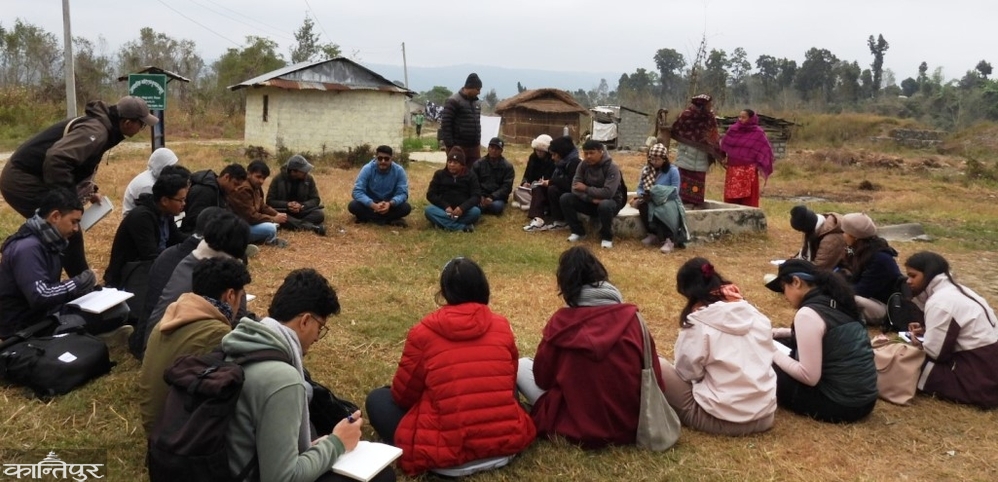
Out of the 57 houses along the Parui River in Madi Municipality-8, 50 belong to the Chepang community. They have been forced to live here for the past seven years, fearing the floods and the animals in the nearby forest. A student studying at the Pulchowk Engineering Campus of the Tribhuvan University Institute of Engineering is busy understanding their stories, pains and desires. Arjun Timsina is an eighth-semester student studying architecture at the undergraduate level. Arjun, who was met at the Parui River with 23 of his friends, said, ‘A house is not just a place to live, a place to keep out the sun and rain, but it should reflect all the customs and culture. One should be attached to the house. If there is no attachment to the house, no one will live in the house. There should also be an opportunity to earn money.’
Emotions were also attached Arjun said that if there are ways to earn money, people can live happily at home. That is why 10 engineering students, including a girl student, are conducting door-to-door interviews with the locals.
Before coming to Parui Khola, the residents lived in a place called Kusumkhola. The place is within the Chitwan National Park area. ‘The park started sending letters every year saying that it is an illegal settlement, we cannot live here. Even when the flood came, it caused great damage.’ So we went to Lakhapakha to say that we would not live there. Some went somewhere, some went somewhere, we came here,’ said Kamal Chepang, who lives in Parui Khola.
There were 160 houses in Kusumkhola. Some left there and settled in Pyauli, some in Shivdwar, and some in Raidanda. 57 houses came to the banks of Parui Khola.
Initially, they lived near the river. Kamal said that after two years, the settlement was moved a little higher by building an embankment along the river. He said that although some were safe from the river, the fear of floods still persists.
It has been two years since electricity was turned on in the settlement. Initially, they used to drink water from the river. Now, the settlement has 12 drinking water taps and 2 tubewells. But there is a lack of concrete toilets.
Although five houses are made of bricks or blocks, the rest are mostly made of wood. It is difficult to live in such houses during windy and cold weather. Local Anjali Chepang said that it is difficult to sleep in the cold weather.
Kamal had a house near Syadul, Dhading. There was no good farmland in the village either. There was a patchwork of fields. The floods and landslides that occurred in 2059 left even the patchwork fields. Kamal said that he reached Kusumkhola, which is located in the forest, looking for a place to live.
Kamal spent about 15 years there from 2061 BS. But after Chitwan National Park did not allow them to live in Kusumkhola, the settlement was moved at the initiative of the municipality. A model settlement was ready in Raidanda. Parui also lacked basic infrastructure. ‘Now electricity and water have been provided. Other work is being done. A settlement is also being built,’ said Chandra Kumari Baniya, ward chairperson of Madi-8.
The people living here have no good way to earn a good living. Some have farmed on lease or contract, but the yield is not good. There are many who work as casual laborers. ‘How can you build a good house when you have no income,’ said Kamal. That is why he said that he has repeatedly requested the local and provincial governments to build a settlement.
But the program did not come up only for Parui. While working by distributing the budget across Madi, only five relatively safe houses have been built in Parui so far. The rest remain unfinished.
Govindaram Chepang, central chairman of Nepal Chepang Association, urges people to be confident that this time the settlement plan is for Parui only. ‘The main thing is that there is no land title deed here. Earlier, the people from the Land Commission had said that the land along the river Ukas would not be surveyed. Later, the survey was done. They had said that other work would be done from Asoj, but now there is confusion after the commission was dissolved in the middle,' Kamal expressed his suspicion.
But Chepang Association President Govindaram Chepang reiterated his commitment to completing the settlement construction work this time. Abhishek Budhathoki, an engineer at the Makwanpur Division of the Urban Development and Building Office of Bagmati Province, said that a maximum of four hundred thousand rupees would be paid for a house to be built in the model settlement.
He said that after the house was built on the Parui River, students were engaged in studying the daily lives of the locals living there and preparing a suitable house map. 'What we learned from reading the articles is that even though the government built settlements and houses for the Chepangs, they have not been living there. The house has been built, but how can it be connected to the house? They should design the house and settlement keeping in mind the environment in which they lived before,' said student Arjun Timsina. He said that he would suggest planting chiuri trees near the river if the climate and geography allow. He said that since it is a settlement where some people go to work in the morning and some go to work in the afternoon, the infrastructure will be built accordingly. There will be places for the elderly and children to enjoy themselves in the settlement. 'If someone raises a buffalo, they should build a house for it accordingly. From where to store the dung to whether there is a possibility of selling milk, we should also analyze it. We will calculate all these and prepare the design of the house and settlement,' said Arjun.

