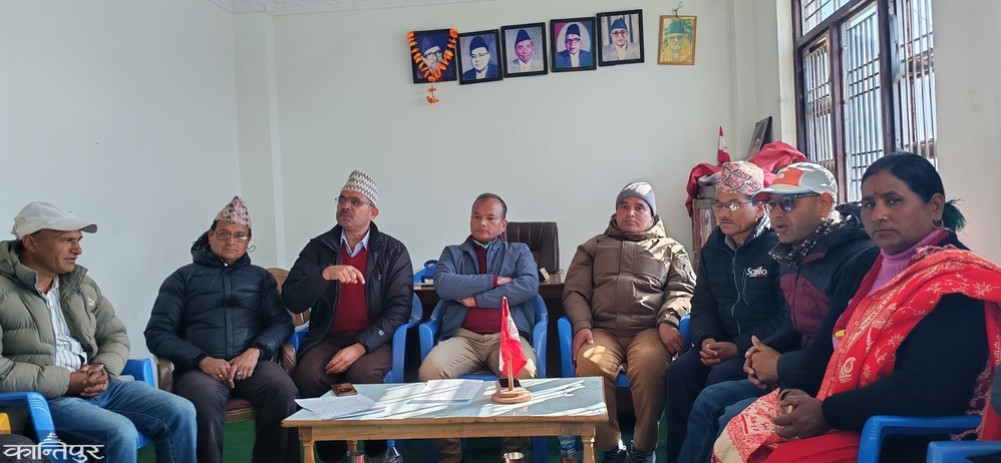
Ratan Bahadur Shahi, president of the Kalikot Chamber of Commerce and Industry, says that giving priority to Karnali appears to be limited to the speeches of the so-called new parties.
We use Google Cloud Translation Services. Google requires we provide the following disclaimer relating to use of this service:
This service may contain translations powered by Google. Google disclaims all warranties related to the translations, expressed or implied, including any warranties of accuracy, reliability, and any implied warranties of merchantability, fitness for a particular purpose, and noninfringement.
Stakeholders here complain that the Karnali region has been neglected by new parties despite the adoption of a proportional electoral system to ensure equal access and representation of backward areas and marginalized communities.
Although the new parties are widely discussed on social media, the priority given to Karnali is limited to speeches, says Ratan Bahadur Shahi, president of the Kalikot Chamber of Commerce and Industry. ‘There is a lot of talk and propaganda about the new parties.’ Looking at the proportional list, it seems that Karnali has been completely ignored,’ he said, ‘Instead, I hope that the old parties will represent it.’
He said that based on the proportional list of the parties, there is a greater possibility of proportional representation from the former Karnali than the list included by the Congress, UML and the Nepali Communist Party.
Civil society leader Daman Raj Bam said that Karnali was ignored in the list of proportional representation MPs submitted by the National Independent Party led by Ravi Lamichhane, including Kathmandu Mayor Balendra Shah and Kulman Ghising of the Ujjaj Nepal Party.
Only one person from Humla has been included in the proportional list of the former Karnali district. ‘The talk of the unity of these three people seemed to be coloring the social media. But while recommending 110 proportional candidates, the geographically largest Karnali district was ignored,’ said Bam. ‘The representation of the former Karnali district seems to be concentrated in Chitwan and Morang. There are 21 people from Chitwan and 15 from Morang in the list.’ Environmental activist Tashi Lama from Namkha, Humla has been included in the proportional list of the former Karnali district. Bam said that not a single person has been included from Jumla, Mugu, Kalikot and Dolpa in the former Karnali district.’
Pawan Shahi of Kalikot, a victim of the Gen-G movement, has been included in the proportional list of the RSNP, although some have promoted his inclusion in the proportional list of the RSNP, but his address is mentioned as Chitwan. His voter ID card also does not match.
Shahi's voter ID card submitted to the Election Commission mentions 2428757, while Pawan, registered at Khadachakra-1 Mahadev Abi polling station, has ID card number 23821864 in the voter list.
Campaigner Ashika Tamang, who recently returned from visiting Humla via Kalikot, Jumla, and Mugu in Karnali and experiencing the difficult geography and life there, has also made strong comments on social media about the proportional list of the Rashtriya Swayamsevak Sangh (RSS). ‘Only 3 people have been included from the backward districts of Karnali, including remote Jumla, Humla and Kalikot, out of a minimum of 15,’ she wrote on Facebook. ‘The old party has always left Karnali behind, but the same has been seen from the new party.’
She lamented on social media that the Rashtriya Swayamsevak Sangh (RSS) has included contractors, relatives, sons of contractors who have left the country, and neighbors in the proportional list. ‘I thought that the new party would not make a single mistake, the old party would not get a chance to raise a finger, but that is not the case. Here, Miss Nepal will be in the quota allocated for the disadvantaged classes and castes.’
Rashtriya Swayamsevak Sangh (RSS) Kalikot President Prem Bahadur KC said that although Dinesh Bogati of Narharinath and Mahesh Pandey of Tilagufa were included in the initial list, they could not make it to the final list. ‘Earlier, my name was at number 1.’ "We were all excluded because we had to reconcile everyone," said Rashtriya Swayamsevak Sangh (RSS) President KC.
The Nepali Communist Party led by Pushpa Kamal Dahal, Congress and UML, which have been accused of putting their close associates and relatives in the proportional representation in the past, claim that this time the leaders and cadres of those parties have done justice to Karnali. 'The Congress has made a lot of efforts to improve more than before. I am happy that Kalikot's old leader Kali Bahadur Sahakari got the opportunity,' said Congress leader Bhupendra Jung Shahi.
Sahakari is the former president of the Congress Kalikot and is currently the vice president of the Karnali Province Committee. Sahakari, who has been active in party politics since 2049, has not been able to be elected as a public representative so far.
Similarly, the Dahal-led Nepali Communist Party has put young leaders Pancha Singh, Ganga Khadka Bogati and Nalini Singh on the closed list of proportional representation from Kalikot this time. Leaders Singh and Khadka are also family members who lost relatives in the armed conflict. Despite announcing on social media that he would not contest the election, leader Prem Bahadur Singh has managed to include his wife Nalini in the proportional representation.
Similarly, UML has done justice by including former leader Durga Bahadur Shahi in the Khas Arya list, said party secretary Pushparaj Acharya. "Becoming an MP is a matter of getting a lot of votes in the proportional representation. It is also a big thing for the party to name him as an honor," he said.
UML has placed Eshoda Baral, a leader of Kalikot Raskot-8, in the proportional representation list from the disabled, backward areas and women's clusters, while Humla leader Gorakh Bahadur Bogati has been placed first from the backward areas. He was elected MP in 2016.