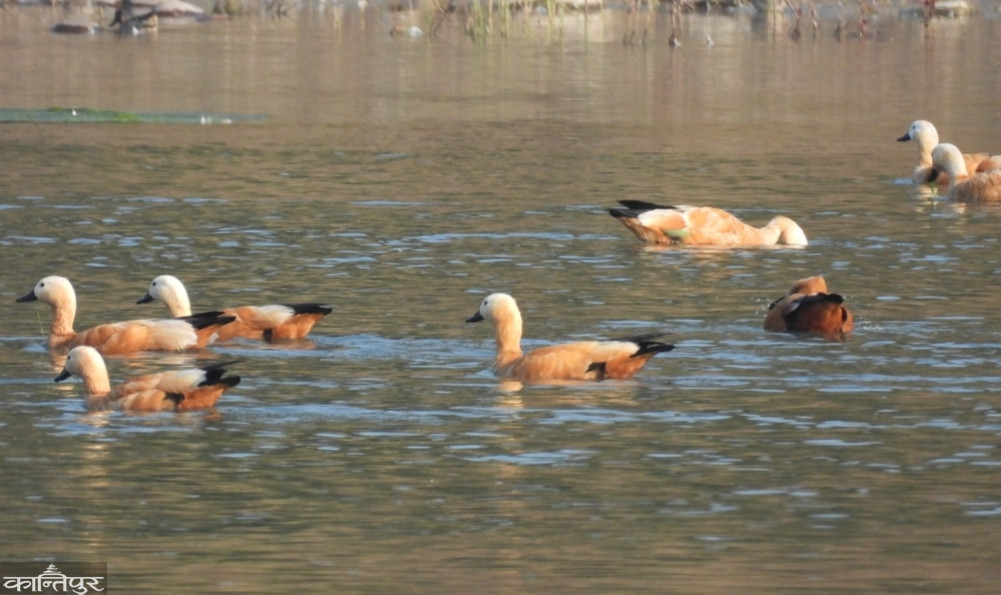
Twenty youth are active in studying migratory and native birds in Chitwan National Park and its buffer zone, and educating the community about their importance and conservation methods.
We use Google Cloud Translation Services. Google requires we provide the following disclaimer relating to use of this service:
This service may contain translations powered by Google. Google disclaims all warranties related to the translations, expressed or implied, including any warranties of accuracy, reliability, and any implied warranties of merchantability, fitness for a particular purpose, and noninfringement.
With the onset of winter, flocks of migratory waterfowl begin to appear in the Narayani and Rapti rivers that flow through Chitwan National Park. Their species and numbers have been counted every year. The species and numbers of these birds that cross the mountains have been fluctuating every year. 20 'champions' have now gathered to find out the reason for this.
A 'champion' team has been formed with the participation of local youth to study the condition of birds, educate the community about their importance and conservation methods. Youth from Nawalparasi and Chitwan are in this team. The youth of the team are currently active in studying the potential habitats of birds.
Prem Poudel, in-charge of the eastern 'cluster' of Tal, said that local youth have been trained under the Terai Land Conservation Program (TAL), run in partnership with the World Wildlife Fund (WWF) Nepal and the Government of Nepal. Poudel clarified that they have been named 'champions' because they are prepared with information. Based on the concept that the behavior of birds or wildlife cannot be changed, what needs to be changed is human behavior, a Behavior Change Communication (BCC) campaign has been launched. A team of youth has been formed to join hands in bird conservation under this campaign.
One of those 'champions' is Lal Bahadur Bote of Bagkhor, Kawasoti Municipality-15, Nawalparasi (Bardaghat Susta East). He is a nature guide who takes tourists to Chitwan National Park and its surrounding buffer zones. Lal Bahadur Agraj and his friend, who were found in the old wetland ‘Budhauli Kuna Ghol’ in Kawasoti, were taking notes on the birds that come there, the condition of the ghol, the surrounding plants and the farming system. The team has made a record of 32 species of birds, both migratory and native, there.
Budhauli Kuna Ghol is not only for birds, but also the basis of life for the local community. This ghol is the source of water flowing in the canal even in mid-winter. There are rice stalks cut in Mangsir around the ghol. Preparations for Chaite rice have already begun in this area, which has moist land. Sacks and plastic have been tied around the seed beds to make it look like people are standing around to keep birds away, but even in the meantime, birds were seen picking seeds.
Large birds like the Ghungifor Garuda, the Bhundifor Garuda, and a pair of migrating chakhewa were found in the Ghol area. This Ghol is about one and a half to two kilometers away from the forest connected to Kawasoti Bazaar. There are houses along the forest, then fields and below it, the Ghol. To the south of the Ghol is the village of Laukhani. Locals believe that if the Ghol is preserved, irrigation and farming will be better. But few know why the birds come and how human activities affect them. The feeling that the number of birds is decreasing is common to everyone. The 'Champion' team is active in finding answers to these questions and explaining the importance of birds.
According to Poudel, the eastern 'cluster' in-charge of the lake, 20 youths, including five from the Kalabanjar Intermediate Consumers' Committee on the Chitwan side and 15 from Pithauli, Lamichaur, Gundrahi-Dhakaha areas of Nawalparasi, are in this campaign. Nine of them are young women. Common cranes (Laxman Saras) migrate to the fields of Divyanagar in the Kalabanjar area in winter. Four ‘common cranes’ were also seen in the paddy fields near Budhauli Kuna Ghol. According to Manesh Limbu, president of the Meghauli Ghatgain Nature Guide Association, more than 200 ‘common cranes’ were counted there five-six years ago, but this year only 26 have been seen.
The lakes within the park are also the main habitat of migratory birds. But those lakes are being covered by michaha bushes and gegran, says Avinash Thapa Magar, information officer of the Chitwan National Park. Outside the park, human pressure, use of pesticides, chemical fertilizers and plastic is also increasing. ‘The arrival of birds is a sign of a clean environment,’ says Thapa Magar, ‘so the increase in the number and species of birds migrating in winter is a positive sign.’
Nepal is the main route for migratory birds in winter. The number of such birds is particularly significant in the river area flowing through Chitwan National Park. Now, along with counting the number of birds, it is necessary to analyze the condition of the habitat, says Rajendra Suwal of WWF Nepal. He informed that while monitoring birds, details such as the condition of rivers and streams, plants in wetlands, grass-covered areas, grazing of cattle, and gravel and stone quarrying will also be collected.