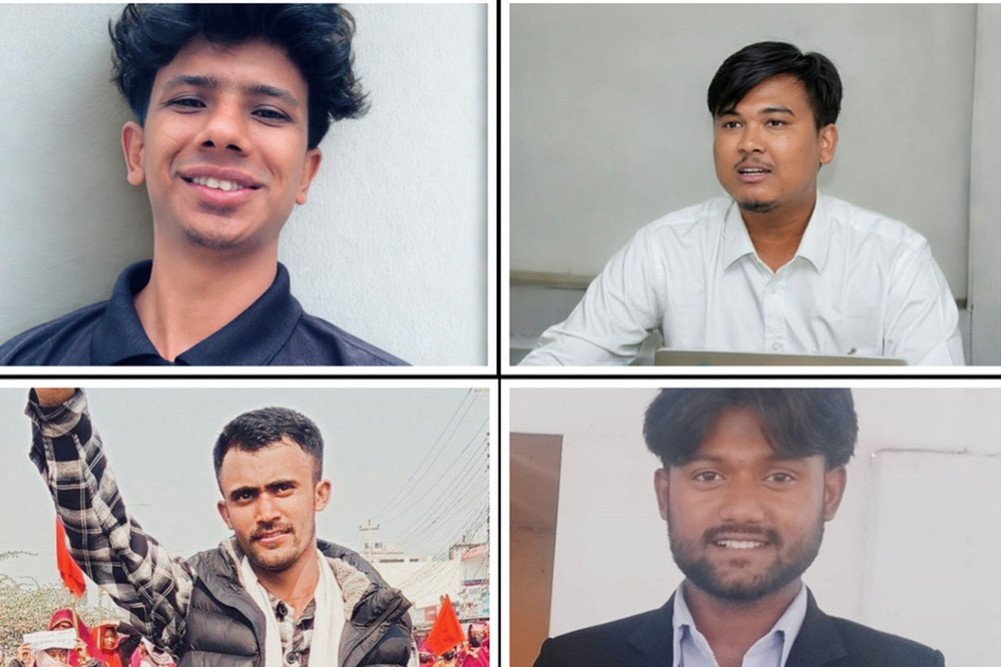
Having different opinions, some have called it a repetition of the old style, while others have seen it as a new hope and challenge.
We use Google Cloud Translation Services. Google requires we provide the following disclaimer relating to use of this service:
This service may contain translations powered by Google. Google disclaims all warranties related to the translations, expressed or implied, including any warranties of accuracy, reliability, and any implied warranties of merchantability, fitness for a particular purpose, and noninfringement.
'Gen-G' leaders have expressed mixed reactions to the recently announced political agreement between Rastriya Swatantra Party (RSWP) President Ravi Lamichhane and Kathmandu Metropolitan City Mayor Balendra Shah (Balen).
Gen-G Movement Alliance leader Amit Khanal (Amit Urja) has said that Ravi and Balen will also be exposed eventually. He says that these new faces who came in the name of displacing the old corrupt are also the same.
'These new 'thieves' who came saying that they will remove the old 'thieves' are not going to do anything, it is just like one thief tricking another thief by saying that he is a policeman,' he said.
According to Khanal, although the path of liberalism and capitalism embraced by Ravi and Balen is said to make the country prosperous, it will further harm the lower classes. He argues that even if they try to make the country like the UK or the US, the problems faced by the middle class there and the control of resources by a limited number of people will be repeated in Nepal too.
'Only those who have resources and money will drive on smooth roads, but the lower class will always be used,' he said. He expressed the fear that such cooperation without ideology will make the country ugly and chaotic instead of making it better.
Similarly, Gen-G leader Vikas Rasaili commented on the agreement reached to keep the Ravi Party in power and put forward Balen as the prime ministerial candidate as a 'power sharing' in the style of the old parties. According to him, this agreement is mainly focused on the distribution of posts. He said that this agreement is a form of power sharing between KP Sharma Oli and Pushpa Kamal Dahal in the past.
'There is no fundamental difference between the old and the new, writing the distribution of posts in the document shows their hunger for power,' he said, 'There is no social issue in the agreement. The ideological ground is zero.' If there is no fundamental difference in practice, the so-called new ones will also move forward in the old style.'
Even though the points of agreement have been made public externally, Rasaili argues that there is no fundamental difference between the new and old parties because the main thing is the transaction of positions internally. 'It is a misconception that everything will be fine if they are new, they have to prove it by working,' he said.'
Another Gen-G leader, Arnab Chaudhary, said he welcomed the agreement. He expressed the expectation that the new generation will do a better job than the old leaders. 'It is a common expectation that even if the new ones come, they will do a better job than the old leadership,' he said, 'However, this agreement is not complete.'
He stressed that constitutional issues such as federalism and inclusiveness should be included in the agreement as a priority. 'It would have been more effective if the issues of federalism and inclusiveness mentioned in the constitution had also been highlighted,' he said, 'It also needed to include the sentiments of the Gen-G movement.' He indicated that while this agreement has raised new hopes in politics, how it advances constitutional and inclusive issues will be important. However, he said that such a struggle to displace the old leadership should also be within other political parties. He stressed that the new generation should play an interventionist role in displacing the old in other parties as well.
Majid Ansari considers this agreement as a 'positive but challenging' step. Although he is in favor of the merger of forces like Ravi and Balen, he said that the basis for this merger is not clear. According to Ansari, this effort by the new forces should not only be a means of joining forces to gain power but should be based on 'issues and agendas'. 'If this equation focuses on individuals rather than issues, it risks repeating the struggles of Prachanda or UML in the past,' he said. 'The power struggles between Girija Prasad Koirala, Sher Bahadur Deuba and Prachanda in the past have not yielded the right results because they were focused only on power and individuals.'
He has also questioned the indifference shown towards the country's current system by this new equation. In particular, he has considered the decision of the National Independent Party not to field candidates in the provincial assemblies and the neglect of issues such as the 12-point understanding, which is considered the basis of political change, as 'matters of concern' in this process. He argues that such activities can weaken the issues of democratic republic and inclusiveness. He wished the new forces well and said, 'My best wishes are that the forces should unite, but that union should be agenda-focused.'