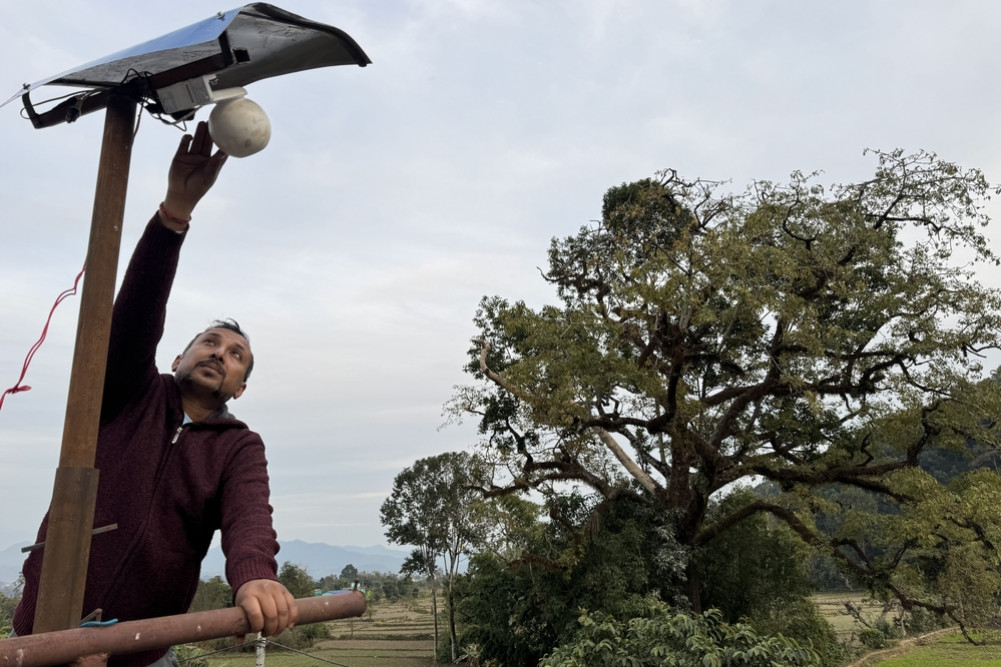
CCTV cameras have been installed near the nest to learn how the vulture hatches its young, how the young grow, what their potential enemies are, and what conservation programs are needed.
We use Google Cloud Translation Services. Google requires we provide the following disclaimer relating to use of this service:
This service may contain translations powered by Google. Google disclaims all warranties related to the translations, expressed or implied, including any warranties of accuracy, reliability, and any implied warranties of merchantability, fitness for a particular purpose, and noninfringement.
In Pokhara-33, Bagmara, the branches of a Simal tree spread out like fingers on a large rock. In the same tree, there is a nest of the critically endangered Little Brown Vulture. A CCTV camera has been installed on the house on the other side of the tree to monitor the nest.
Conservationist Hemant Dhakal has been monitoring this nest for the past four years. Recently, a CCTV camera has been recording the vulture's daily life from the roof of local minister Lal Poudel's house.
Dhakal watches the vulture's movements on his mobile screen from home. He is the secretary of the Pokhara Bird Society and is pursuing a PhD in the ecology and conservation of the lesser grey vulture. He said that this is the first time in Nepal that a CCTV camera has been installed to monitor a vulture's nest.
The lesser grey vulture is one of the most endangered species in the world, with various statistics indicating that its number in Nepal is less than 75.
Dhakal, who has been monitoring vultures in Kaski and various parts of Nepal for fifteen years, has been continuously monitoring the nest since he learned about it. There is a pair of vultures in the Simal tree in Thuldhunga.
Out of six nests of the lesser grey vulture found in Nepal, five were breeding last year, of which one is the Thuldhunga. Currently, there are only four nests, two in Dang, one each in Shuklaphanta and Pokhara. In Gachepani of Shuklagandaki Municipality in Tanahun, there was also a nest of this species of vulture in a Simal tree, but the Simal tree was cut down during the expansion of the Prithvi Highway. In Pokhara-17, Dobilla, there was also a nest of the lesser grey vulture. After that area was converted into a settlement, the vultures moved to Thuldhunga.
Dhakal remembers that it was possible to install CCTV in Thuldhunga only after explaining the importance of the rare vulture to the locals, landowners and householders who have CCTV installed. Pokhara Panchhi Samaj organized a vulture awareness program on Saturday by gathering locals. The Toll Improvement Committee, women's group, general public and ward chairperson were present at the program. ‘Locals have expressed their commitment to join hands in vulture conservation,’ said Dhakal.
Landowner Taranath Lamichhane has expressed his commitment not to cut down the Simal tree to protect the vulture’s nest. CCTV cameras were installed at Mantri Lal’s house on Sunday. The Ruford Foundation and Pokhara Bird Society, which are supporting the conservation effort, have made arrangements for some of the expenses related to CCTV and internet.
Dhakal says that CCTV is necessary to understand how vultures hatch, how they grow, what their enemies are, and what conservation programs can be done. ‘The camera could have been placed next to the nest, but we decided to monitor it with a good camera from a distance so as not to disturb the vulture,’ he said.
The specialty of the little brown vulture is that it lays only one egg a year. The number is small, and reproduction is also slow. The male and female mate in the months of Kartik-Mangsir. From that time on, they start looking for nesting materials. After building the nest by mid-February, the female lays eggs. The male and female take turns nesting. They raise the chicks in mid-June and fly away. It is impossible to distinguish between males and females except through genetic testing. ‘If we don’t know what the problems are until the chicks are laid and raised, we can’t make a conservation plan,’ says Dhakal. ‘For example, if you bring and feed the chicks, the chicks may be poisoned, and the mother and chicks may die. Such campaigns and research are important when they are on the critically endangered list.’
During his doctoral research, Dhakal has planned to catch 10 small brown vultures and attach ‘satellite tags’. According to him, this will provide information about the vulture’s habitat, nesting area, how far it travels, how often it visits for food, where it stays for a long time, whether there is a protected area around the nesting site, and whether it has safe food.
The Nepal Bird Conservation Association has already attached 'satellite tags' to ten vultures in Nawalpur and Shuklaphanta. Dhakal said that the vultures have been found to reach many places in India and Nepal, die by hitting power lines, and die by eating poisoned pine needles. He added, 'This shows that the vultures are still very much in danger.'
72-year-old Mantri Lal Poudel is thrilled to have been able to contribute to the conservation of the critically endangered vultures by installing a CCTV camera in his own home. 'Earlier, the number of vultures was a little more. Now, there are a little less,' he says. 'Earlier, cattle were kept in large numbers and when they died, they were thrown everywhere. The vultures would come to eat the pine needles. Now, animal husbandry is declining. The number of vultures must have also decreased due to not being able to eat pine needles.'
According to Poudel, vultures were not considered auspicious in the past. It was believed that even if a vulture crossed a house, it would be inauspicious. ‘There is no such understanding now,’ he said, ‘vultures keep the environment clean by eating the sap.’
Taranath Lamichhane, 75, who owns land with Simal trees, says that the vultures have been wiped out because of pesticides everywhere. ‘Thirty-three to thirty-five years ago, vultures were seen covering our Simal trees,’ he said, ‘but that is not the case now.’