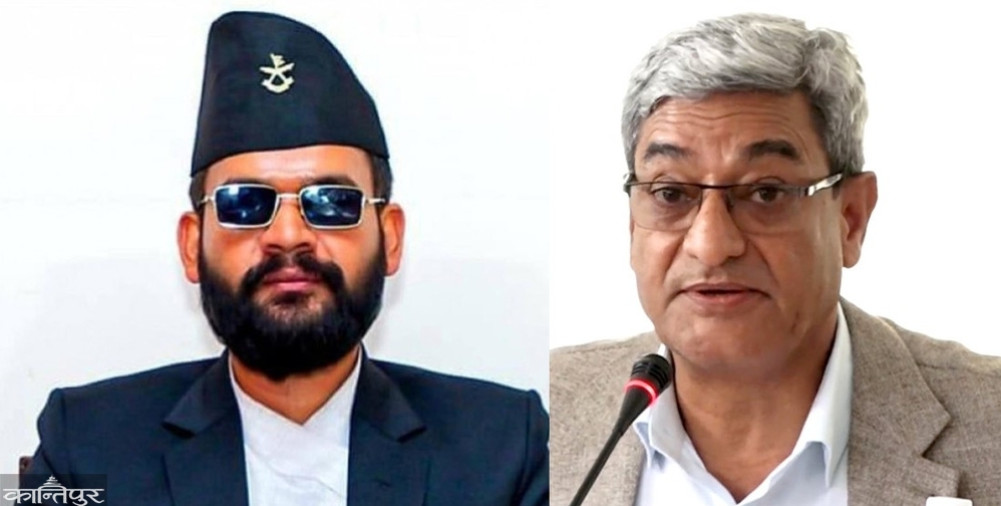
Preparations are underway to interrogate the then Prime Minister Oli, while 148 people have been interrogated so far regarding human rights violations and repression during the Gen-G movement.
We use Google Cloud Translation Services. Google requires we provide the following disclaimer relating to use of this service:
This service may contain translations powered by Google. Google disclaims all warranties related to the translations, expressed or implied, including any warranties of accuracy, reliability, and any implied warranties of merchantability, fitness for a particular purpose, and noninfringement.
The National Human Rights Commission has questioned everyone from the then Home Minister Ramesh Lekhak to Kathmandu Metropolitan City Mayor Balendra (Balen) Shah regarding the incidents of 23 and 24 Bhadra.
The commission had questioned the writer this week. Balen was questioned for about 2 hours on Monday. The commission, which has questioned 148 people so far on the issue of human rights violations and repression during the Gen-G movement, has stated that the investigation has reached the final stage.
The commission is investigating by dividing it into four topics. The investigation is based on human rights violations during the Gen-G movement, the use of force (repression) by the police in the 23 Bhadra movement, transparency and accountability, and impunity, said the commission's spokesperson Tikaram Pokharel.
On the government side, an inquiry commission led by former judge Gauri Bahadur Karki has been formed to investigate the incidents of 23 and 24 Bhadra.
The Karki Commission was initially given a three-month term, but the government has recently extended it by one month. The commission is yet to take statements from some political figures, including the then Prime Minister KP Sharma Oli and Home Minister Ramesh Lekhak, during this period. The Human Rights Commission, after questioning Home Minister Lekhak, has started taking statements from the then ministers who were members of the Security Council.
The Human Rights Commission has also summoned the then Foreign Minister Arju Rana Deuba for questioning. He is a member of the National Security Council and was attacked by protesters on Bhadra 24, so he is being questioned. The Commission had also written a letter to the then Prime Minister Oli for questioning. Oli was busy with the party general convention and had sent a message that he would be present after the convention. The Commission is preparing to recall Oli again next week.
The Human Rights Commission had formed a study team led by member Lily Thapa. The team has been investigating the situation of human rights violations for a month, starting from field monitoring of the incidents of Bhadra 23 and 24. According to the commission, the investigation focuses on the repression and human rights violations in the 23rd Bhadra incident, while the investigation focuses on issues such as accountability and impunity in the 24th Bhadra incident. The commission has studied through its mechanisms in Kathmandu and various districts.
The commission has questioned the security personnel deployed in the field on 23rd and 24th Bhadra, including the District Security Council. The commission had also sought details from the Nepali Army. The army has submitted a report to the commission.
The commission had made public a brief report on the monitoring conducted during the Gen-G movement on 10th Asoj. In the report, the commission concluded that the government's failure to assess the possible causes prior to the incident was a weakness. ‘Although the demonstration was peaceful on the morning of the first day, the incident turned violent after noon due to incidents of arson and shooting at protesters, resulting in the deaths of some protesters,’ the report said. ‘Due to the deaths of protesters by security personnel during the demonstration on the first day, indiscriminate arson and vandalism were found during monitoring on the second day.’ The commission had directed the government to identify the causes of such violent incidents and create an environment that would prevent them from recurring in the future.
The commission had issued a statement on 24 Bhadra, requesting it to stop killings in the name of peace and security and take steps to fulfill the demands of the protesters. Similarly, in a statement on 23 Bhadra, the commission had mentioned that excessive force was used on the protesters.
The officials who interrogated
Still to be questioned