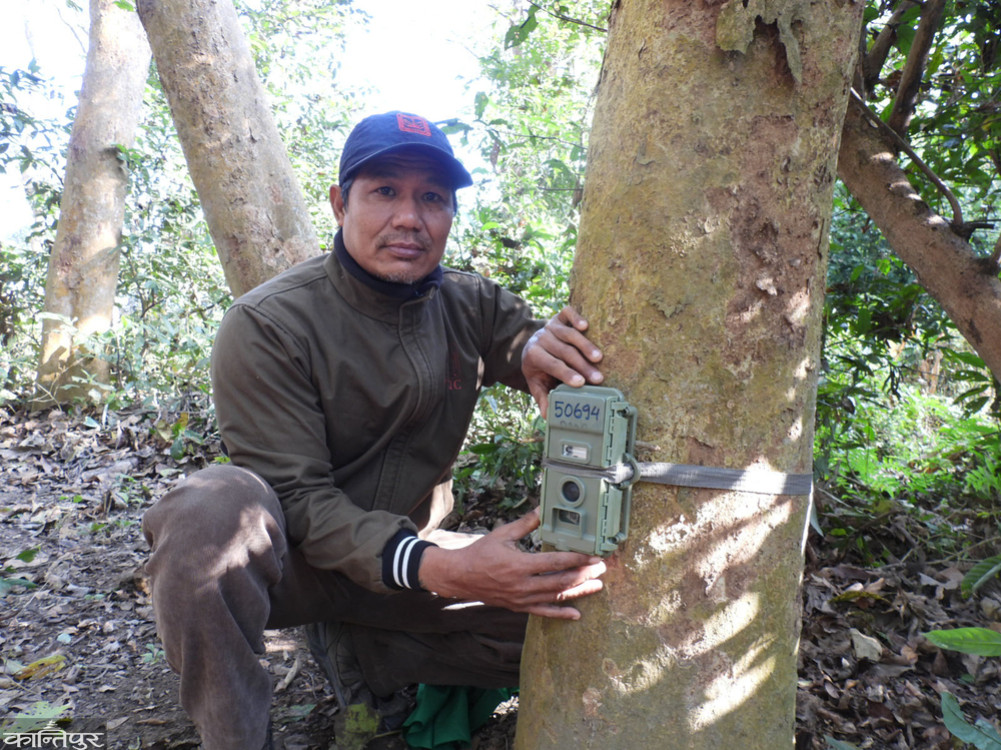
The same Lama had shown the then Forest Minister Ramsahay Prasad Yadav the same thing during the tiger census four years ago. In fact, the Lama has been continuously participating in every tiger census since 2009.
We use Google Cloud Translation Services. Google requires we provide the following disclaimer relating to use of this service:
This service may contain translations powered by Google. Google disclaims all warranties related to the translations, expressed or implied, including any warranties of accuracy, reliability, and any implied warranties of merchantability, fitness for a particular purpose, and noninfringement.
As preparations were underway for the formal inauguration of the National Tiger Survey 2082, Minister for Forests and Environment Madhav Chaulagain himself had reached the Sauraha office of the National Trust for Nature Conservation. The atmosphere in the office premises was different due to the presence of the minister.
High-ranking government officials were busy explaining the method and process of tiger census to the minister . Tirtha Lama, the fund's technician, was found a little away from the venue .
His responsibilities were a little different . When Minister Chaulagain switched on the automatic camera, the official inauguration of the tiger census was announced . Everyone was curious, 'How does the camera placed in this way work and determine the number of tigers' . If something passes in front of the camera, its photo is automatically captured .
To explain this, Tirtha Lama himself came in front of the camera on all fours . As soon as the Lama stepped forward, the green light on the camera turned on, indicating that the photo was taken . Four years ago, the same Lama had shown the then Forest Minister Ramsahay Prasad Yadav the same way during the tiger census . Not only in this and that tiger census, the Lama has been a constant participant in every tiger census since 2009 .
‘I have been participating in camera trapping since 2000,’ said the 45-year-old Lama. Tirtha’s grandfathers Bishnu Lama and Baba Harkaman Lama are former technicians at the Sauraha office of the National Trust for Nature Conservation. Following in the footsteps of his father and grandfather, Tirtha, who became a wildlife technician, is a person who does not miss out on every tiger census. He said that the first job he did was camera trapping.
‘In 2000, cameras were placed in Thootekhola, Sikaribash and Kasara in Parsa to monitor tigers. My formal working life began three or four years later. But I had already gained work experience,’ said the Lama. He had started placing cameras with his father and grandfather. Chitwan National Park used to estimate the number of tigers by looking at their paws.
‘In 1995/96, paw print analysis was used to estimate the number of tigers. A systematic census began in 2009,’ said Haribhadra Acharya, senior ecologist and information officer of the Department of National Parks and Wildlife Conservation. This time, 250 employees will be deployed for the tiger census. Tirtha is one of the few people who are deployed in the field for every census.
‘I am the only technician when I started working. I have worked with six friends who have been working with me since 2009 during the tiger census, and I am still working,’ said the Lama. The main work of the Lama is related to wildlife rescue. ‘When big animals like tigers, rhinos, elephants and other animals are also shot, I am responsible for throwing darts,’ said the Lama.
Tirtha is considered to be very skilled in darting during wildlife rescue. He is very active in rhino census, tiger survey, and rhino relocation. Acharya, the information officer of the National Parks Department, also says that there are not many people like Tirtha who are in the field for every census. ‘This is what Ba and Thulaba did. I also learned from them and did the same. That is why I will do this work as long as I can,’ said the Lama.
It is not that there have been incidents of people saving lives by encountering animals in the forest during wildlife rescue. But such a thing has not happened in the tiger census. ‘Once, we found a wild elephant sitting on a camera in Parsa. It did not see us even when it saw us. Otherwise, nothing like that has happened,’ said the Lama.
1,100 cameras have been used to count tigers. Acharya said that the parks and forests of the Terai, where tigers live, from East Bagmati to West Shuklaphanta Laljhadi, have been divided into three complexes. In those complexes, different blocks have been made and square grids of two kilometers in length and two kilometers in width have been made in each block, said the information officer Acharya.
He informed that a pair of cameras have been installed in each such grid to identify the possible places where tigers may come. When the tiger passes in front of the camera, both sides of the body are captured on the camera. ‘The stripes of the tiger’s body never match those of another tiger. In this way, we determine the number of tigers by analyzing the pictures of the tiger taken by the automatic camera,’ said Acharya.
He said that even if the camera takes more than one picture of a tiger, the technicians have adopted a technology to count it as a single tiger. Technicians like Tirtha Lama will do the work of installing the cameras to bring pictures that make it easier for the technicians to count. After placing the camera in a block, the camera is left in the field for 15 days to take pictures.
‘The rule is that the day begins when all the places in a block are filled with cameras. There are three blocks in the Chitwan Parsa Complex. If cameras are placed in the west block, it will not be possible to place the entire block in one day. The day on which the work of placing the camera in the entire block is completed is considered one day,’ said the Lama. After placing the camera in this way, what is the condition of the cameras in the meantime? You have to go and see.
The camera may not work due to theft, animals pulling it, throwing it, and battery problems. Therefore, you have to go to the places where the camera was placed at least three times to see. The camera should be taken out after 15 days. Thus, Tirtha Lama explained that during the tiger census, you have to enter the forest repeatedly. Going to the place where you can find tigers is definitely not a normal task.
‘How dangerous is it to go to work on the tiger’s path?’ The chief guest of the program, Forest Minister Madhav Chaulagain, also asked. Lama says that since he is a wildlife technician, he has general knowledge about what to do in the forest to be safe. ‘Anything can happen suddenly.’ But by knowing whether there are animals in the forest or not based on smell, footsteps, and sounds, we can avoid it,’ Lama said.
According to Haribhadra Acharya, the department’s information officer, one has to work in the field for about two to three months. He said that an allowance of eight hundred rupees will be provided for each day spent in the field. Food arrangements should also be made from the same amount. Apart from this, Acharya informed that each person working in the survey will also have an accident insurance of one million rupees.
Tiger surveys have been conducted in Nepal every four or five years. Acharya said that since the number of tigers has to be determined and management work has to be done accordingly, it is necessary to quickly determine the number of tigers and their presence in which area. He said that information such as how many tigers are in parks and protected areas and how many are outside protected areas is becoming necessary.
‘If we know whether they have increased or decreased, we can make a management plan. Otherwise, even if the animals increase, it will not take long to decrease again. The results of such surveys are also necessary to make a plan to prevent human-wildlife conflict,’ said Buddhisagar Poudel, Director General of the Department of National Parks and Wildlife. The contribution of those who work in the field, such as pilgrims, is important for such important results required by policymakers. Elephants and the army are also in the field for their protection.
After the field work, the results of the tiger survey will be made public on July 29 after technical analysis. In the last tiger census conducted in 2022, there were 355 tigers across the country. The highest number of tigers, 128, was found in Chitwan. The department's information officer Acharya informed that Rs 30 million will be spent on this tiger census. This does not include the cost of cameras.
He said that the same cameras used earlier were used this time. He said that the tiger census would be completed with the help of organizations such as the National Trust for Nature Conservation, WWF Nepal, ZSL Nepal. Nepal has achieved significant achievements in tiger conservation.
In 2010, the heads of government of 13 tiger-range countries in Russia announced that the number of tigers would be doubled by 2022. At that time, there were 121 tigers in Nepal. But Nepal did not double it, but almost tripled it.