There were discussions on topics ranging from spirituality to the use of AI, the challenges of carbon emissions, and world peace and prosperity.
We use Google Cloud Translation Services. Google requires we provide the following disclaimer relating to use of this service:
This service may contain translations powered by Google. Google disclaims all warranties related to the translations, expressed or implied, including any warranties of accuracy, reliability, and any implied warranties of merchantability, fitness for a particular purpose, and noninfringement.
The 'World Peace Program' concluded in Lumbini on Saturday.
The three-day program featured debates on topics including peace and prosperity, climate change, development, internal welfare, and social justice. Discussions were held in various sessions on the development of Buddhist culture in Lumbini, the rise and fall of institutes and universities, and the challenges and mitigation measures of carbon emissions. Speakers shared their experiences on topics ranging from spirituality to the use of AI and its challenges.
On the first day of the inauguration, the hall at the International Buddhist Conference Hall resonated with spiritual, natural, and Chinese traditional songs and music by UN Ambassador of Peace Wuluo Hai. The audience was mesmerized when a band including Nepal's popular sitar player Sita Maiya Rajchal played original Nepali melodies. Lochan Rijal, a scholar and singer of traditional instruments, also gave his performance.
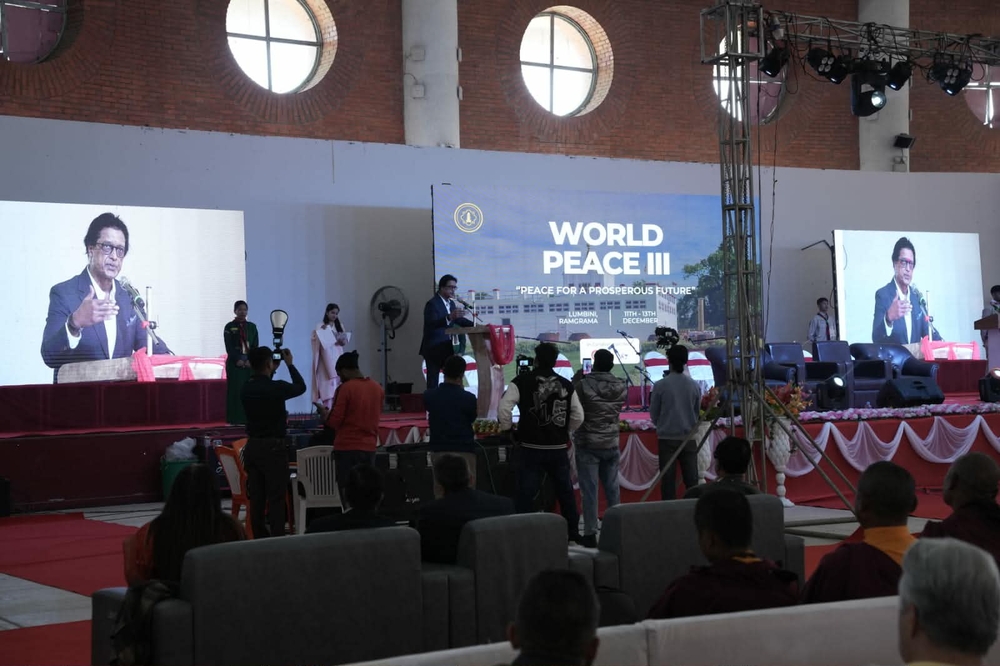
Actor Rajesh Hamal, who participated in the program, said in his 'Key Note Speech' that Nepalis have the ability to embrace happiness even in times of despair.
There was also a debate on how to promote sustainable development by utilizing natural resources and reduce global carbon emissions.

Former Ethiopian Prime Minister Tamrat Leyen, who came to participate in the World Peace Program, expressed his interest in the Lumbini Development Master Plan, the excavations in Lumbini, conservation efforts, the archaeological and historical importance of Lumbini, and visited the Mayadevi Temple.
In the first day's session, Tamrat spoke on spiritual transformation, leadership, learning for world peace, and community empowerment. On the second day, in the hall of Lumbini Buddhist University, he discussed the politicization and reform measures in the university, the construction of institutions, justice, and peace.

During the program, a lamp was lit in Ramgram with the participation of Buddhists and guests from different countries wishing for world peace.
Former Ethiopian Prime Minister Tamrat Lein, Treasure Carbon Group CEO Susan Zhu, international tourism expert Martin Hang, Lumbini scholar Basanta Bidari, Sunil Sharma of the Nepal Tourism Board, Sagar Bhante, Kathmandu University's Uddhav Poudel, Manoj Shakya, Dobhan Rai, Balkrishna Bal, LP Bhanu Sharma and other experts presented their views and opinions in various sessions. Industrialists and businessmen from countries including China, India, Vietnam, Indonesia also participated in the program.
Nikesh Adhikari, chairman of the organizer The Promise Land, said that the program was organized to promote peace and harmony in the world and tourism to Lumbini. He said that such programs would also help in attracting foreign investment.

