Since it appeared that the then Prime Minister KP Sharma Oli and the then Home Minister Ramesh Lekhak would not appear for statements, the commission has devised a strategy to arrest them and bring them to testify.
We use Google Cloud Translation Services. Google requires we provide the following disclaimer relating to use of this service:
This service may contain translations powered by Google. Google disclaims all warranties related to the translations, expressed or implied, including any warranties of accuracy, reliability, and any implied warranties of merchantability, fitness for a particular purpose, and noninfringement.
The commission formed to investigate the incidents of 23 and 24 Bhadra has started taking statements from officials at the policy-making and directive levels. However, since it appears that the then Prime Minister KP Sharma Oli and the then Home Minister Ramesh Lekhak will not appear for statements, the commission has devised a strategy to arrest them and bring them to testify.
The term of the commission formed on 5 Asoj is ending in 3 months, i.e. 5 Poush. With only about 2 weeks left, the commission has not even completed its statement. After completing the statements of security personnel and administrators deployed in the field and at the level of implementing orders, the commission has started entering the political level.
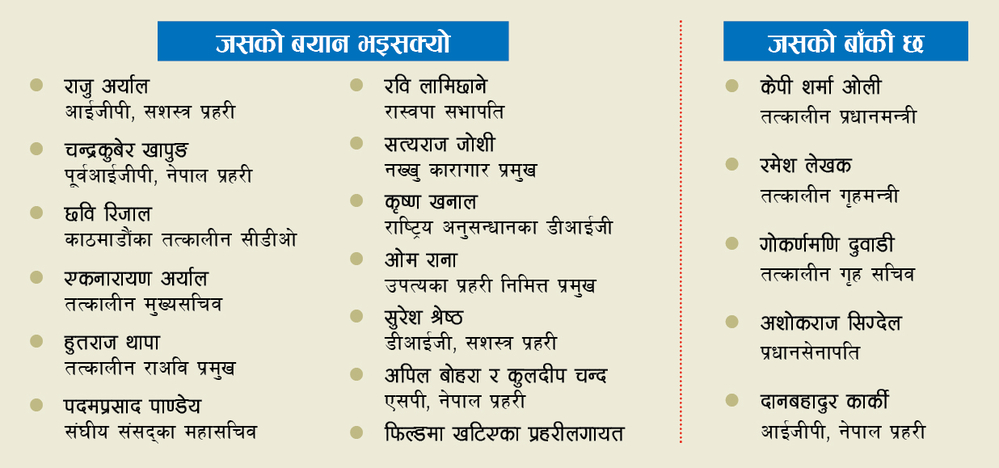
According to the commission's spokesperson, Vigyanraj Sharma, statements have been completed with about 150 people. Now, statements of the then Prime Minister Oli, the then Home Minister Lekhak, the then Home Secretary Gokarnamani Duwadi, the Chief of Army Staff Ashokraj Sigdel, and the IGP of Nepal Police Dan Bahadur Karki are yet to be taken. On the morning of 24 Bhadra, Karki was transferred to the Valley Police Chief.
On the recommendation of the commission itself, the then Prime Minister Oli and the then Home Minister Lekhak have been banned from traveling abroad and going outside the Kathmandu Valley without permission. Oli has been taking a stand against giving statements, publicly commenting that the commission is unconstitutional.
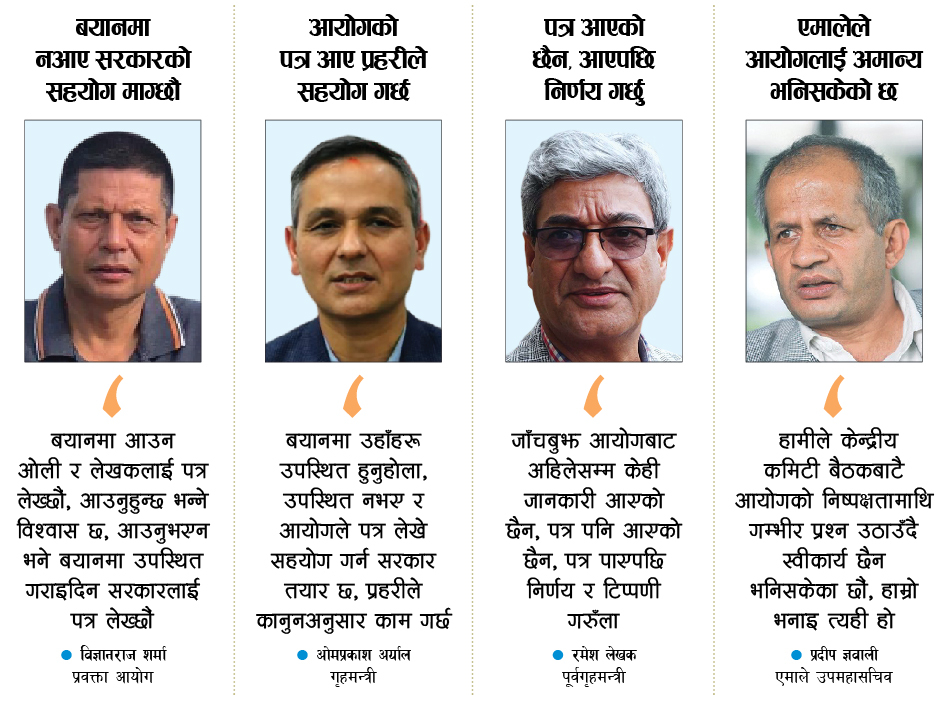
Commission spokesperson Sharma, however, urges people not to doubt the fact that statements will be taken from them. 'The commission is clear. We will first write a letter informing them about the statement,' he says, 'We believe that they will come to the commission to give their statement based on the letter. If they do not come, legal proceedings will begin. The commission will write a letter to the government requesting them to be brought before it in accordance with the law.'
Home Minister Om Prakash Aryal says that the government is clear about mobilizing the police to make them present if the commission writes a letter. 'If the commission makes a written request, the government will cooperate,' says Aryal, 'We believe that they will accept the rule of law as it is for everyone. In case they do not, the government will implement the necessary laws.'
Sharma says that Oli, the writer and others were confined to their places because the statement had to be taken for the investigation of the incident. 'The commission will move forward after deciding to take their statements quickly in terms of procedure,' he says, 'The heads of the police and security agencies have come here, the Chief Secretary came, and even the General Secretary of Parliament went to express their views. It is the belief that they should come to the commission and give their statements. That is also the practice.'
The then Home Minister Lekhak says he will not comment as he has not received any information from the inquiry commission yet. ‘The commission has not given a letter yet, we will comment after receiving the letter,’ he said.
UML Deputy General Secretary Pradeep Gyawali says there is no point in going to former Prime Minister Oli’s statement as the inquiry commission itself is invalid. ‘We have already raised serious questions about the impartiality of the commission in the central committee meeting and said it is not acceptable,’ he said. ‘Since the commission itself rejected it, it should be understood in that way.’
The commission took the statement of Armed Police Inspector General Raju Aryal on Tuesday only. It has been said that he will be called again if necessary. The commission has also stated that it will call former police chief Chandrakuber Khapung, who was called for a statement earlier, again if necessary.
The statement of the then Chief District Officer of Kathmandu, Chhabi Rijal, was taken on 17 and 18 November. The commission has said that he will be called later, saying that some questions are still pending. Rijal was sharply criticized for ordering the killing of Gen-G protesters in New Baneshwor on 23 Bhadra.
The commission had earlier taken statements from the then Chief Secretary Ek Narayan Aryal, the then Inspector General of Nepal Police Khapung, the then Chief of the National Investigation Department (NID) Hutraj Thapa, and the General Secretary of the Federal Parliament Padam Prasad Pandey. The commission stated that statements were also taken from the acting Chief of the Valley Police Office Ranipokhari Om Rana, DIG of the Armed Police Suresh Shrestha, DIG of the NID in charge of the Valley Krishna Khanal, SP duo Apil Bohara and Kuldeep Chand of the Nepal Police.
The commission has taken statements from the Chief of the Operations Department of the Armed Police Force Narayan Dutta Poudel and AIG of the Nepal Police Siddhi Bikram Shah. Earlier, statements were taken from the police officers deployed in the field. The commission initially took statements from Rashtriya Swayamsevak Sangh (RSS) President Rabi Lamichhane and Prison Chief Satyaraj Joshi, who were released from Nakkhu Prison on 24 Bhadra.
The government had set a three-month deadline and formed a three-member commission led by former judge Gauri Bahadur Karki on 25 Asoj. The members of the commission include former AIG Vigyanraj Sharma and legal expert Bisheshwor Prasad Bhandari. Prime Minister Sushila Karki had expressed her commitment on the day she took office to open fire on 23 Bhadra and to bring those involved in vandalism and arson of government/public and private property to justice on 24 Bhadra. Accordingly, the inquiry commission has been formed.
Commission spokesperson Sharma informed that some 'field' visits are also being conducted along with the statements of the people who were at the leadership level and policy level of the concerned bodies when the incidents of 23 and 24 took place.
He also informed that preparations are underway to take statements from the remaining officials within this week and start writing the report. "Now we will take the statements of the then Valley Chief and current Inspector General of Police Dan Bahadur Karki, the then Home Secretary Gokarna Mani Duwadi, the then Home Minister and the Prime Minister," he said. As for the army, the commission is prepared to take the statements of Army Chief Ashok Kumar Sigdel first and if necessary, go to other officers as well.
The commission has concluded that the army should clarify its presence in the incidents of 23 and 24 Bhadra. The commission had sent a letter to the army base after questions were raised publicly about the role of the army in protecting structures like Singha Durbar and Sheetal Niwas.
'The army did not act uncooperatively as it appears. The army has given the details it needs to give to the commission, it is providing the necessary assistance,' said Sharma, spokesperson of the commission. 'The army's statement is in the process, it will be the day after tomorrow.' Regarding taking a statement from Army Chief Sigdel, he said, 'The commission will have to understand from whom, it will understand from the relevant person.' He said that it should be clarified since the army was also present in the incidents of 23 and 24.
The time to complete the statement with the commission and prepare the report is only two weeks. If the report is not ready by then, the commission can request the government to extend the deadline. 'Rather than answering the question of whether the commission's deadline will be extended, we will do it according to what happens as we work,' said Sharma, spokesperson of the commission. 'We are in favor of not extending the time as much as possible. But if it is not enough, we will ask the government for some time.'
The government has given five mandates to the Karki-led inquiry commission. The main mandate is to 'receive information or applications related to material and human damage, analyze it and give opinions for action.' The commission is also responsible for investigating the physical and human damage caused during the protests, finding out the causes of the incidents, suggesting measures to be adopted to prevent such incidents from recurring, and presenting a clear action plan for implementing the suggestions mentioned in the report.
The commission may direct the investigation to proceed with the action against those found guilty in the investigation. It may order any person to produce documents for the investigation, examine evidence, and request documents and copies from government offices and courts. Section 4 of the Act also gives the commission the power to conduct searches and seize any found items if it believes that there are documents or evidence related to the investigation.
The commission also has the power to withhold the passport of any suspicious person, arrest them, etc. However, the commissions of inquiry so far have not practiced arresting and detaining individuals. The much-discussed Rayamajhi Commission after the 2062/063 People's Movement had summoned the then King Gyanendra Shah for a statement, but even though he did not give a statement, no force was used on him. His name was mentioned in the report.

