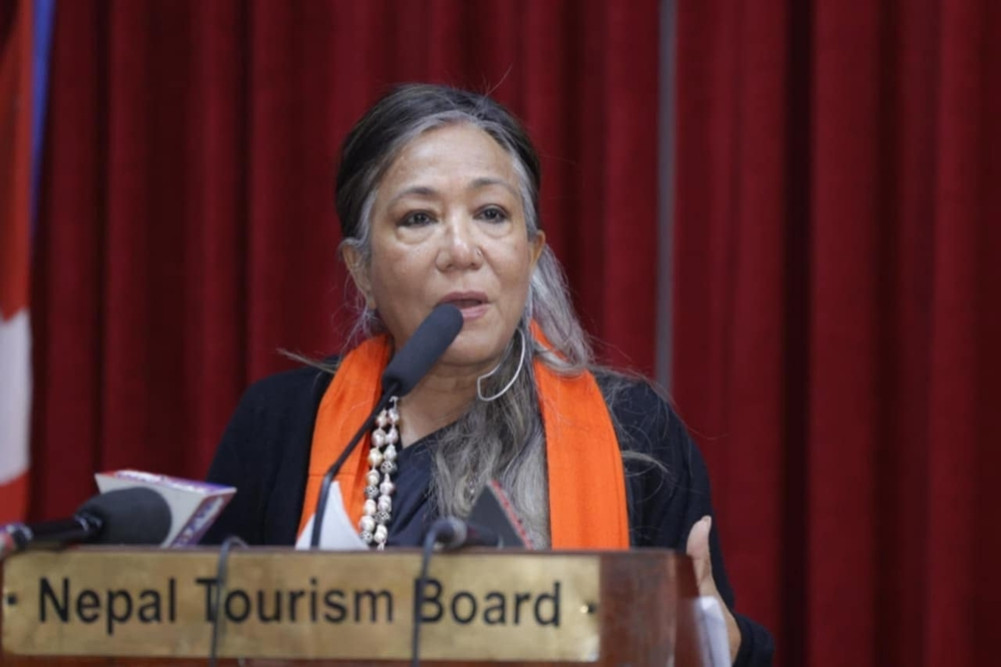
”Violence has not been reduced in Nepali society at present, the form of violence has changed and continues to exist,” she said. ”Invisible forces have not allowed the voice of society to come out, injustice against women continues, to reduce it, we must continue to connect with the situation.”
We use Google Cloud Translation Services. Google requires we provide the following disclaimer relating to use of this service:
This service may contain translations powered by Google. Google disclaims all warranties related to the translations, expressed or implied, including any warranties of accuracy, reliability, and any implied warranties of merchantability, fitness for a particular purpose, and noninfringement.
Supreme Court Justice Sapana Malla Pradhan has said that technology should not be allowed to become a weapon of violence. Addressing a discussion program jointly organized by Nepal Law Campus, Forum for Women, Law and Development (FWLD) and Nepal Tourism Board, Justice Pradhan said, “Society should be connected to technology and be able to embrace change.”
At the program organized under the 16-day campaign against violence against women, Judge Pradhan said that traditional violence persists in society. She said that violence persists in society due to narrow-mindedness and patriarchal thinking. ‘Violence has not been reduced in Nepali society at present, the form of violence has changed and continues to exist,’ she said, ‘Invisible forces have not allowed the voice of society to come out, injustice against women continues, to reduce it, we need to connect with the situation.’
Sharing her experience in the course of administering justice, Judge Pradhan informed that 99 percent of cases of domestic violence are women. She said that men are also victims in society, but their number is not more than one percent.
She said that violence against women occurs everywhere, including at home, in public places, and in the workplace. Presenting marital violence as an example of the law entering the home, she said, ‘It is not only sexual violence, it is also a right.’ To use sex as a right, the mindset of the male-dominated society must first change.'
'Not all men are violent, moving forward with the support of men also brings about rapid and effective change in society,' said Justice Pradhan, 'If women and men fly together and make an institutional commitment against violence against women, the violence prevalent in society can be reduced.'
At the program, Professor Manisha Poudel of Nepal Law Campus informed that the campus has been conducting a 16-day campaign against violence against women for the past 4 years. She said that this year, the Nepal Tourism Board and FWLD have supported and cooperated to conduct the campaign in a different way. Professor Poudel informed that the campaign against violence against women was conducted in a new way this year as such programs test the knowledge, skills and experience acquired by the students.
Dr. Bhaskar Tejshree Memorial Foundation is studying and researching violence against women and children. Rita Thapa gave the information. She presented the data that 66 percent of children and 22 percent of teachers are victims of violence in schools. Presenting the data of a study conducted in Lumbini Province, Thapa said that 74 percent of women are sexually abused, and 31 percent of them are victims of sexual violence.’
At the program, students of Nepal Law Campus presented the play ‘Let’s start a joint journey to reduce violence to zero’, and various art exhibitions were also held against violence against women. At the end of the program, a panel discussion was held against violence. Bidya Kumar Sinha of the Women’s Commission, human rights activist Renu Rajbhandari, and FWLD advocate Sushma Gautam participated in the discussion.
In the discussion, advocate Sushma Gautam emphasized that violence against women by family and society members cannot end unless they are economically and socially empowered, and for that, the government should take the initiative to provide education and employment opportunities to women. Stating that even if the existing laws are implemented, there will be some changes in the current situation, she said, "We have spent a long time enacting laws and the next task is to put the existing laws into practice."