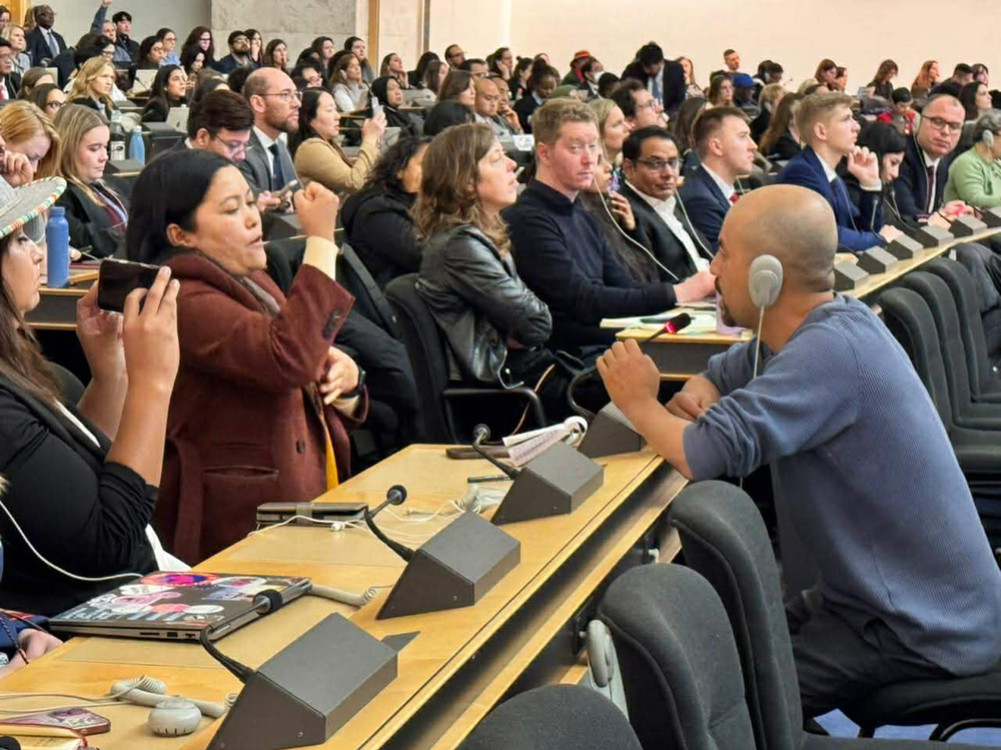
At the 14th World Conference on Business and Human Rights organized by the United Nations in Geneva, Sunita Thapa, a member of the Provincial Assembly of Gandaki Province and a disability rights activist, raised the issues of indigenous people, deaf people, and people with disabilities in Nepal.
We use Google Cloud Translation Services. Google requires we provide the following disclaimer relating to use of this service:
This service may contain translations powered by Google. Google disclaims all warranties related to the translations, expressed or implied, including any warranties of accuracy, reliability, and any implied warranties of merchantability, fitness for a particular purpose, and noninfringement.
At the 14th World Conference on Business and Human Rights organized by the United Nations in Geneva, Gandaki Province Provincial Assembly member and disability rights activist Sunita Thapa raised the issues of indigenous people, deaf people, and people with disabilities in Nepal.
Thapa, who stands as a deaf woman from an indigenous community, represents a distinct identity, struggle and capacity.
She reached Geneva with the support of the Voluntary Fund for Indigenous Peoples under the United Nations. Which in itself is a significant achievement for the representation of Nepal's communities, she said from Geneva.
In a session titled 'Reiterate and Protect the Commitment to Diversity, Equality and Inclusion' held at the Assembly Hall in Geneva, she clearly presented the idea that the principles of inclusion should not be limited to paper only, but should be implemented in practice.
She highlighted the reality that indigenous people, deaf people and people with disabilities living in rural areas are still far from professional practice, employment opportunities and accessible services before the international community.
She mentioned that the lack of sign language services and lack of communication access are weaknesses of the global system in particular.
She raised the question during the session that the global policy of inclusion and equality sometimes makes indigenous and disabled communities invisible. Her question attracted wide attention throughout the assembly.
In Nepal, she is leading the development of Nepal's first provincial disability rights act. The act is expected to bring significant improvements in the rights, services, facilities, health, education, employment and access of persons with disabilities. Her participation in the international forum has also created an opportunity to link the act with global best practices, which will help make the bill more effective, inclusive and in line with international standards.
During her stay in Geneva, she also met with officials from the United Nations High Commissioner for Refugees and drew special attention to the situation of refugees with disabilities in Nepal.
She seriously raised the need for a reliable data recording system, special protection, essential services, priority in emergencies and sign language services for deaf refugees. She urged UNHCR to closely understand the real challenges of Nepal and expand disability-friendly refugee programs. Thapa also expressed her views on the situation where indigenous and rural communities are being affected by global business, investment and exploitation of natural resources.
Resources such as minerals, land and water are intertwined with the lives, culture and identity of indigenous peoples. Therefore, she warned the international community not to weaken their rights in the name of business and investment. She addressed the reality that indigenous people with disabilities, in particular, are being marginalized in the decision-making process.
Noting that the participation of deaf indigenous women from South Asia has been rare, Thapa said that her presence on the platform is not only a personal achievement but also an opportunity to bring the voice of the community to the world. According to her, these voices heard on an international platform will allow the world to understand the struggles, experiences and capabilities of the disadvantaged groups of Nepal from a new perspective.