The draft law, prepared with stringent provisions regarding the qualifications of candidates, has been stalled in the House for two and a half years.
We use Google Cloud Translation Services. Google requires we provide the following disclaimer relating to use of this service:
This service may contain translations powered by Google. Google disclaims all warranties related to the translations, expressed or implied, including any warranties of accuracy, reliability, and any implied warranties of merchantability, fitness for a particular purpose, and noninfringement.
Due to the lack of strict criteria for the eligibility of candidates, those convicted and accused of various crimes have been running for office in every election, and some have been elected. As the draft law prepared to prevent those convicted and accused of various criminal offenses that show moral degradation has been stalled in the Ministry of Home Affairs for two years, people involved in various crimes will be able to run for office in the upcoming elections as well.
Rajiv Gurung, also known as Deepak Manange, known as 'Gunda Naike', was elected to both the 2074 and 2079 provincial assemblies from Manang (2) despite being convicted of murder. In 2061, Gangster Naike Manange was tried for attempting to kill Milan Gurung, also known as Chakre Milan, by attacking him with a khukuri. The court sentenced Manange to 2 years in prison for assault. The government prosecutor's office then appealed.
....
The then appellate court overturned the district court's decision and found Manange guilty of murder, not assault, in 2069. After that, Manange, who was on the absconding list, became a provincial member of parliament by running as an independent candidate in both the 2074 and 2079 elections. He also became a minister in Gandaki province several times. In Kartik 2081, he lost his parliamentary seat after the Supreme Court upheld the then appeal decision. He is currently serving his sentence in Dillibazaar Jail.
....
The Election Commission did not find the absconding accused of killing Armed Police Assistant Inspector (ASI) Thaman BK on 25 Bhadra 2072 until they participated in the elections and won. A case was filed against 28 people, including UML leader Laxmi Mahato Koiri, in the Mahottari District Court on 27 Falgun 2072 on the charge of killing BK. JSP leader Kaushal Rai and LOSPA leader Aviram Sharma were also accused in the case. After the police started the investigation, all three absconded. Later, Mahato was released on bail from the District Court on 2 Asoj 2076. The Janakpur High Court reversed the district court's order to release him on bail on 19 Mangsir 2077 and ordered him to be sent to remand.
While absconding, Sharma of LOSPA was elected as a member of the Mahottari 3 (1) Provincial Assembly in the 2074 and 2079 elections. While still absconding, JSP's Rai also won the Provincial Assembly election from Mahottari 4 (2) in 2074 BS. He had also contested from the same constituency in 2079 BS but was defeated. UML leader Mahato won the House of Representatives election from Mahottari 1 while still absconding on charges of police murder. He was a candidate from Wares and received his certificate from Wares and was acquitted by the District Court on 28 Mangsir 2080 BS. Sharma, who was sentenced to life imprisonment, is still absconding.
....
Resham Chaudhary, the 'master planner' of the Tikapur incident of 7 Bhadra 2072 BS, in which five policemen, including the SSP of the Nepal Police, two armed policemen and an innocent child were killed, won the 2074 BS House of Representatives election from Kailali 1 by running for the then Rastriya Janata Party (RJP) from Wares. Chaudhary, who was absconding, received his certificate from the commission from Wares.
Chaudhary has been found guilty by the district, high and supreme courts in the Tikapur murder case. Chaudhary, who was arrested on 15 Falgun 2074, was released on 15 Jestha 2080. Although he was sentenced to 20 years in prison, President Ram Chandra Poudel, on the recommendation of the Council of Ministers, commuted the remaining sentence of Chaudhary before he had even served one-third of the sentence.
....
There was no thorough investigation under the guise of power against Congress leader Badshah Kurmi, who was accused of being the main planner of the death of Nirmala Kurmi of Banke and the embezzlement of property. After the investigation committee led by Joint Secretary of the Ministry of Home Affairs Hiralal Regmi gave the opinion in Kartik 2078 that Badshah and others should be investigated in the incident, a complaint was filed with the Banke police against 8 people. But the file was shelved without investigation. Badshah, on the other hand, won the 2079 election as a member of the Provincial Assembly from Banke 3 (2). He also became a minister of Lumbini Province in Shrawan 2081. There was strong opposition after the accused person was made the Minister of Forest and Environment in Lumbini by becoming an MP. He resigned within a month and a half. The charges against him have not yet been investigated. He is still a Lumbini Province MP from the Congress.
....
Tek Bahadur Gurung of the Congress won the 2079 House of Representatives election from Manang while the corruption case was pending in the Special Court. The Commission for the Investigation of Abuse of Authority filed a corruption case against Gurung and others on 21 Magh 2075 on charges of irregularities in the rental of land of the Social Welfare Council in Bhrikutimandap. At that time, he was an elected MP from Manang. After the case was filed, he was suspended and his term as an MP ended without being resolved.
While the case was pending, the Congress also made him a candidate in the 2079 election and won. Immediately after the Parliament Secretariat made public the information that he was suspended, he was not able to work as an MP. Gurung, on the other hand, went to the Supreme Court against the decision of the Parliament Secretariat. While the writ was pending in the Supreme Court, Gurung was found guilty by the Special Court on 16 Falgun 2079. After the Special Court found him guilty, his path to return to Parliament was blocked. But in the writ petition filed by Gurung against the suspension, the Supreme Court gave a ‘strange interpretation’ and opened the way for him to enter the parliament, saying that a person holding a public position in the event of corruption should not be suspended if he later comes to office. Gurung was active as an MP until the dissolution of the House of Representatives on 27 Bhadra.
....
Ravi Lamichhane, a holder of American citizenship, formed the National Independent Party under his own leadership and won the 2079 House of Representatives election from Chitwan 2. There is a provision that one must be a Nepali citizen to run as a candidate as an MP. If one has renounced Nepali citizenship and obtained a foreign citizenship or temporary residence permit, the old citizenship will be activated only after renouncing it and submitting its certificate to the local administration. However, Lamichhane had not renounced his American citizenship and had filed his candidacy for the House of Representatives based on his old citizenship from the party registration with the Election Commission.
After winning from Chitwan, Lamichhane became Deputy Prime Minister and Home Minister. After that, the issue of his being a foreign citizen reached the Supreme Court. In Magh 2079, the Supreme Court ruled that Lamichhane had used his old citizenship without renouncing his foreign citizenship, and Lamichhane lost both his MP and ministerial posts. After submitting the details of his renouncing US citizenship to the administration, his Nepali citizenship was reactivated. After that, he won the by-election from Chitwan 2 again. He was suspended from the parliament again after being charged with a cooperative scam and money laundering.
....
The draft of the election management bill, which was prepared with strict provisions regarding the qualifications of candidates, was submitted to the Ministry of Home Affairs 29 months ago by the Election Commission. But the government showed no interest in moving it forward. Since the House of Representatives was dissolved on 27 Bhadra, there is no possibility of immediate amendment of the law through the parliamentary process. Currently, there is an option to amend the law through an ordinance to tighten the criteria, but the government has not shown any readiness.
Section 66 of the draft bill submitted by the Commission to the Ministry of Home Affairs on 18 Ashad 2080 has proposed a provision regarding the disqualification of candidates. It states that those who have been convicted of corruption-related offenses or whose cases are pending in the appeal process after being found guilty of corruption by the original court or whose cases have been found guilty of corruption and have reached a final verdict are disqualified from becoming candidates.
It is proposed that persons convicted of rape, human trafficking, drug trafficking, money laundering, passport misuse, fraud, or forgery will not be allowed to become candidates. Similarly, it is proposed that persons convicted of kidnapping or hostage-taking, crimes related to the disappearance of a person, torture, killing in a cruel and inhumane manner or by taking them under control, genocide, explosives, or other criminal offenses that show moral degradation will also be disqualified.
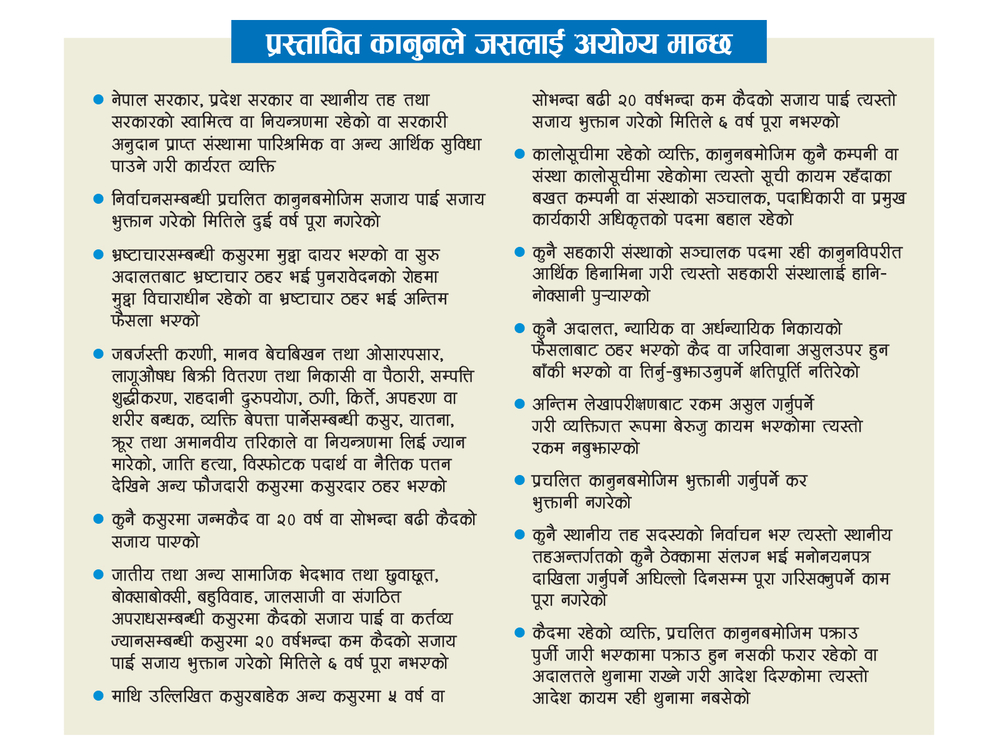
The draft has made a provision that a person who has been sentenced to life imprisonment or 20 years or more in prison for any crime, a person who has been sentenced to imprisonment for a crime related to caste and other social discrimination and untouchability, boxing, polygamy, fraud or organized crime, or a person who has been sentenced to imprisonment for a crime related to duty for less than 20 years and has not completed 6 years from the date of completion of such sentence will not be able to participate in the election. In addition, a provision has been proposed that a person who has been sentenced to imprisonment for a crime related to five years or more but less than 20 years and has not completed 6 years from the date of completion of such sentence will not be able to be a candidate.
The draft also mentions a provision that a person who has not paid the compensation due or has not paid the penalty imposed by a court, judicial or quasi-judicial body will not be able to participate in the election. The draft proposes to ban a person who has not paid the amount due if the amount is found to be personally invalid and has to be recovered from the final audit.
It is proposed that those who have not paid taxes due under the prevailing law, who have been arrested but have not been arrested despite an arrest warrant being issued, or who have been detained despite a court order to detain them but have not been detained despite such an order being in effect, will also be disqualified from running for election.
An Election Commission official commented that a proposal to amend the eligibility criteria for candidates was made after it was observed that people accused of various crimes and convicted of them were getting elected in the past, but the government's failure to submit it to Parliament has hampered reform efforts.
‘We had proposed to amend the provisions related to the qualifications of candidates to end the situation where convicted, absconding and corrupt individuals can also participate in the elections and end the situation where they are suspended after winning and the relevant area becomes without a public representative,’ he said, ‘but the government has not even taken forward the draft bill.’ ‘Even now, the risk of repeating the past shortcomings cannot be ruled out.’
The current law provides that a person who holds a public office or a position of profit or receives remuneration in a grant-receiving organization and has not paid the fine for 2 years from the date of serving a sentence under the prevailing law on elections cannot be a candidate.
Similarly, a person who has been sentenced to life imprisonment or 20 years or more for corruption, rape, human trafficking and smuggling, sale, distribution and export or import of narcotics, property laundering, passport misuse, kidnapping or other criminal offenses involving moral turpitude and whose sentence has become final cannot be a candidate for the House of Representatives.
The Election Act for Members of the House of Representatives prohibits a person who has been sentenced to imprisonment for an organized crime offense or a term of imprisonment of less than 20 years for a crime related to duty and has not completed 6 years from the date of completion of such sentence, and a person who has been sentenced to imprisonment for five years or more for other offenses and has not completed 6 years from the date of completion of such sentence, from contesting elections.
Similarly, there is a legal provision that a person who has been sentenced to imprisonment for an offense related to caste discrimination and untouchability, boxing or polygamy and has not completed three years from the date of completion of such sentence, is blacklisted and is not allowed to be a candidate during the period of imprisonment. There is also a provision that a person who has a permanent residence permit of a foreign country is also ineligible to be a candidate in the election.
There is no practice of the Commission itself investigating the qualifications of a candidate in coordination with the relevant bodies. Section 9 of the Election Commission Act-2073 states that ‘in cases where a nomination has been registered but the election results have not been declared, a complaint received by the Commission through an election officer with evidence regarding the disqualification or disqualification of a candidate shall be investigated and if it is found that the candidate who registered the nomination has fulfilled the qualifications as per the law and is found to be disqualified, such nomination shall be cancelled by the Commission.’ According to this legal provision, the Commission seems to investigate only when a complaint is received. There have been allegations that the Commission is biased in that regard.
Security officials say that since ‘personal conduct’ and qualification details are not mandatory for candidates during the nomination process, people who have been convicted of crimes and are facing court cases easily become candidates.
नेपाल प्रहरीका पूर्वडीआईजी हेमन्त मल्ल मुलुकका सुशासन र समृद्धि अनि ‘रामराज्य’ ल्याउँछु भनेर नथाक्ने दलहरूले नै विभिन्न अपराधका दोषी र अभियुक्तलाई उम्मेदवार बनाएर जिताउने र आम नागरिक तिनै अभियुक्त र दोषीबाटै शासित हुनुपर्ने दुर्भाग्यपूर्ण स्थितिमा रहेको बताउँछन् । ‘समाज नैतिकवान हुनुपर्छ, व्यक्ति इमानदार हुनुपर्छ, राजनीतिक सेवाभावको हुनुपर्छ भन्ने अनि दलहरूले चाहिँ नैतिक पतन देखिने अपराधका दोषी, अभियुक्त र प्रहरीको फरार सूचीमा भएका व्यक्तिलाई उम्मेदवार बनाउने अनि देश त्यस्ता व्यक्तिबाट शासित हुनुपर्ने ?’ उनले कान्तिपुरसँग भने, ‘यो द्वैध चरित्र कायम रहेसम्म दलहरूले सुशासन दिन्छन् भन्ने कल्पना गर्नु बेकार हो ।’
मल्लका अनुसार उम्मेदवारलाई कुनै फौजदारी वा नैतिक पतन देखिने अपराधमा सामेल भए/नभएको, दोषी ठहर भए/नभएको व्यहोरा स्वघोषण गर्न लगाउने तथा प्रहरीको चालचलन रिपोर्ट पनि पेस गर्नुपर्ने व्यवस्था गरिए फरार, दोषी र मुद्दा खेपिरहेका व्यक्ति उम्मेदवार बन्न पाउँदैनन् । ‘आयोगले आगामी निर्वाचनमै उम्मेदवारलाई चालचलन रिपोर्ट पेस गर्न र अपराधमा सामेल रहे/नरहेको स्वघोषणा गर्न लगाउने चलन चाल्नुपर्छ,’ उनी भन्छन् ।
निर्वाचन आयोगका एक अधिकारीले भने प्रस्ताव गरिएको कानुन नआए पनि यस पटक उम्मेदवारको चालचलनलाई आयोगले नजिकबाट नियाल्ने र कतिपय विवरण सरकारसँग माग गर्ने तयारी रहेको बताए ।
‘उम्मेदवारी मनोनयनपछि सम्भव भएसम्म जाँचबुझ गर्ने गरी काम अघि बढाइएको छ, सम्बद्ध निकायमा पत्राचार गरिनेछ,’ उनले भने, ‘सम्पत्ति शुद्धीकरण र भ्रष्टाचारलगायत कसुरमा मुछिएर कालोसूचीमा परेका व्यक्तिको विवरण पनि सरकारसँग माग्ने तयारी गरेका छौं ।’
आयोगका प्रवक्ता नारायणप्रसाद भट्टराईले कानुनी प्रावधान उल्लंघन गरेर उम्मेदवार हुने र निर्वाचनमा विजयी हुने विषयलाई यस पटक गम्भीर रूपमा लिइने बताए । ‘यस विषयलाई निर्वाचन सुरक्षा र कार्ययोजनामै हामीले समेटेका छौं । त्यसका लागि जिल्ला निर्वाचन कार्यालय र प्रहरीसहित फौजदारी अपराधको अनुसन्धान गर्ने निकायसँग पनि समन्वय गर्छौं, गृह मन्त्रालयसँग पनि समन्वय भइरहेको छ,’ उनले भने ।
आयोगका अर्का अधिकारी भने गलत व्यक्ति उम्मेदवार बन्न नपाऊन् भनेर हरसम्भव प्रयास गरिए पनि अहिलेकै कानुन र साधनस्रोतबाट व्यवस्थापन गर्न कठिन हुने बताउँछन् । ‘साढे दुई वर्षअघिको प्रस्तावअनुसार कानुन आइदिएको थियो भने यस प्रश्नको सामना नै गर्नुपर्ने थिएन,’ उनले भने,‘ मौजुदा कानुन उल्लंघन हुने गरी योग्यता निर्धारण गर्न सक्दैनौं ।’
आगामी २१ फागुनमा प्रतिनिधिसभा निर्वाचन हुँदै छ । यसका लागि समानुपातिक उम्मेदवारको बन्द सूची पेस १३ र १४ पुसमा र प्रत्यक्ष निर्वाचनका उम्मेदवारको मनोनयन दर्ता ६ माघमा गर्नुपर्ने कार्यतालिका छ ।

