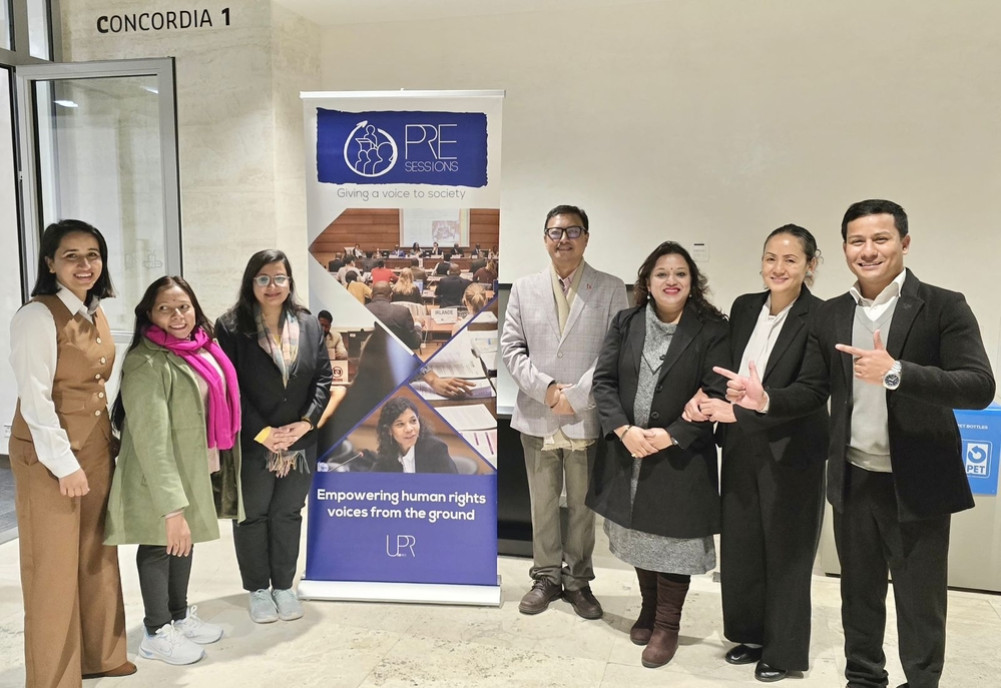
The pre-session discussed sensitive and long-standing issues that still pose challenges in Nepal, such as transitional justice, gender-based violence, the rights of Dalits and indigenous peoples, intersectional discrimination, access to justice, and citizenship through mother's name.
We use Google Cloud Translation Services. Google requires we provide the following disclaimer relating to use of this service:
This service may contain translations powered by Google. Google disclaims all warranties related to the translations, expressed or implied, including any warranties of accuracy, reliability, and any implied warranties of merchantability, fitness for a particular purpose, and noninfringement.
The pre-session organized for the fourth Universal Periodic Review (UPR) of Nepal's overall human rights situation under the United Nations Human Rights Council has been successfully concluded. The pre-session, which was held with the participation of representatives of Nepal's civil society, provided the international community with detailed information on the actual human rights situation, challenges, and priorities for reform in the country.
The pre-sessions particularly highlighted sensitive and long-standing issues such as transitional justice, gender-based violence, women and children's rights, the rights of persons with disabilities, the rights of Dalits and indigenous peoples, intersectional discrimination, access to justice, and citizenship through mother's name. These issues were deeply linked to the protection and promotion of human rights in Nepal, and therefore drew additional attention from the participants.
Representatives from civil society in Nepal — Mandira Sharma, Sabin Shrestha, Laxmi Pokharel, Meena Poudel, Dipesh Shrestha, Karuna Parajuli, Vijay Gautam, Moti Nepali, Pitambar Koirala, Suraj Koirala, Amrita Thebe, Manisha Dhakal, Sarita Burmaska, Roop Sunar, and Pooja Neupane, a representative of the National Human Rights Commission, among others — presented concrete facts, experiences, and suggestions on the current human rights landscape in Nepal. They have credibly highlighted the problems and unfulfilled commitments seen at the national level to the international community.
This pre-session has provided an opportunity to refocus Nepal's human rights issues on a global stage. Civil society presentations are expected to generate both pressure and support for improvements in Nepal's policies and practices.
In the meantime, Nepal's fourth formal periodic review is scheduled to be held in Geneva in January 2026. In the upcoming review, Nepal will face questions and recommendations from member states on its progress to date, remaining challenges, and future strategies. Every four and a half years, UN member states submit a review report on their human rights responsibilities, commitments, and challenges, as well as progress made and initiatives to be taken for improvement.
The fundamental objectives of the UPR include ending all forms of inequality and discrimination, improving the status of human rights for all, creating pressure on member states to comply with their human rights responsibilities and commitments, and building the capacity of states, and supporting coordination and cooperation in the protection and promotion of human rights.
This UPR process is expected to be a significant turning point towards human rights reform for Nepal.