The President's Office has clarified that the new government was formed based on a written recommendation and agreement from the then Prime Minister KP Sharma Oli to provide an appropriate solution in view of the unusual and extraordinary circumstances.
We use Google Cloud Translation Services. Google requires we provide the following disclaimer relating to use of this service:
This service may contain translations powered by Google. Google disclaims all warranties related to the translations, expressed or implied, including any warranties of accuracy, reliability, and any implied warranties of merchantability, fitness for a particular purpose, and noninfringement.
The Office of the President, Sheetal Niwas, has submitted a written response defending the dissolution of the House of Representatives and the government formed under the leadership of former Chief Justice of the Supreme Court, Sushila Karki.
The President's Office has also mentioned in its written reply that 17 writ petitions pending in the Constitutional Bench of the Supreme Court should be dismissed. It has been claimed that the constitutional responsibility to form a government on 27 Bhadra fell on the President after the Genji movement and protests on 23 and 24 Bhadra, and that the government was formed under the leadership of Karki due to the compelling need of the then situation.
The hearing, which was stalled after courts across the country, including the Supreme Court, were burnt down during the Genji movement, was resumed on 28 Asho. After that, 17 writ petitions were filed in the Supreme Court claiming public interest. The Supreme Court, while conducting the first hearing on all those writ petitions, ordered to seek written responses. The filing of these writ petitions has been scheduled for 22 Mangsir. Similarly, the CPN-UML has also filed a writ petition on Wednesday. The first hearing has not been held on it.
Submitting a written response to the writ petitions registered in the past, the President's Office has claimed that there is no need to raise the issue of dissolution of the House of Representatives. ‘Raising the issue of the restoration of the House of Representatives is the current constitutional need of the country, the social and political essence and sentiments, the writ petition filed by the petitioner is liable to be dismissed,’ it said in the written reply.
The claim that the writ petition filed by Advocate Sher Bahadur Rokaya cannot be the action claimed in the writ petition is liable to be dismissed.
‘In Article 61, Clauses (3) and (4) of the Constitution of Nepal, respectively, there is a constitutional provision that the President shall promote the national unity of Nepal and that it shall be the primary duty of the President to uphold and protect the Constitution. On the 23rd and 24th, due to the agitation by the youth, an unusual situation had arisen in the country, and the then Prime Minister KP Sharma Oli had resigned, seeking a way out,’ it said in the written reply. ‘The post of Prime Minister was vacant in the country. In the aftermath of the extraordinary and extraordinary circumstances that have arisen, there was no way for representatives of political parties represented in parliament to come to the forefront and participate in the formation of a government to solve the problem while protecting the country, the people, and democracy.' The written response from the President's Office states that the new government was formed due to the compelling need to immediately resolve the problem as there was no opportunity to even have a general discussion on issues such as submitting claims for government formation and serious problems had arisen in the country's peace, security, order, and governance system.
‘In accordance with the wishes and aspirations expressed by the youth, and based on consultations with political parties and stakeholders, it is imperative to take immediate steps to uphold and protect the Constitution of Nepal and promote the national unity of Nepal by exercising the constitutional powers vested in the President in accordance with the Constitution of Nepal, and to take necessary steps immediately,’ the written reply states, ‘The new government has been formed on the basis of the written recommendation and agreement made by the then Prime Minister KP Sharma Oli to provide an appropriate solution in accordance with the constitutional restrictive provisions of the President, the guardian, protector of the Constitution and the promoter of the national unity of Nepal, in view of the extraordinary and extraordinary circumstances.’
The government has defended itself in the written reply, saying that such a decision was taken to ease the difficult situation in the country with the belief that it would act in the larger interest of the country and the people and in the absence of any other constitutional alternative at the moment.
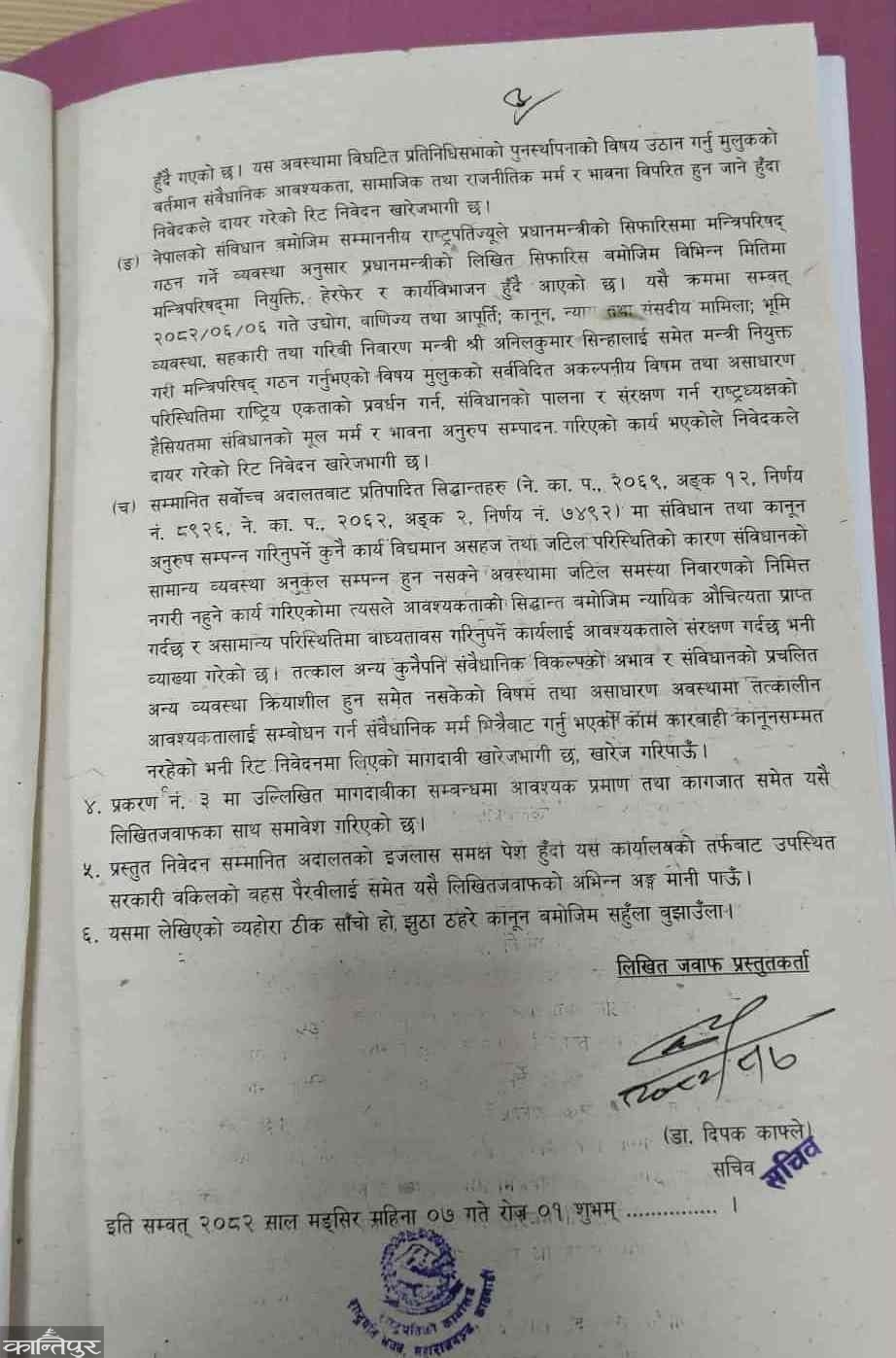
‘The writ petition filed questioning the important role played by the Prime Minister in providing immediate constitutional life to the country in a situation where other prevailing provisions of the Constitution could not even be activated is liable to be dismissed,’ the written reply states, ‘In accordance with the written recommendation made by the Prime Minister on Falgun 21 to dissolve the then House of Representatives in order to hold elections to the House of Representatives, the House of Representatives was dissolved in a situation where there was a compelling need to normalize the unusual and extraordinary situation that had arisen in the country by exercising the functions, duties and powers of the President in accordance with the Constitution of Nepal.’
The written reply claims that the work performed by the Head of State in accordance with the original meaning and spirit of the Constitution to promote national unity in the country’s well-known, unimaginable, unusual and extraordinary situation, to uphold and protect the Constitution, has been carried out in accordance with the original meaning and spirit of the Constitution.
‘When an action that cannot be taken in accordance with the general provisions of the Constitution due to inconvenient and complex circumstances cannot be carried out in accordance with the general provisions of the Constitution, it acquires judicial justification in accordance with the principle of necessity,’ the written reply states. ‘It has been explained that necessity protects actions that must be taken under compulsion in extraordinary circumstances.’
The written reply claims that the constitutional spirit was used to address the immediate need in the absence of any other constitutional alternative and in the exceptional and extraordinary circumstances where other existing provisions of the Constitution could not even be activated.