Despite the government's policy of not providing allowances other than local and dearness allowance, employees of public institutions/bodies have been provided with facilities such as water allowance, account reconciliation allowance, key allowance, tailor allowance, regulation allowance, project allowance, risk (difficult work) allowance, anniversary allowance, productivity allowance, and others.
We use Google Cloud Translation Services. Google requires we provide the following disclaimer relating to use of this service:
This service may contain translations powered by Google. Google disclaims all warranties related to the translations, expressed or implied, including any warranties of accuracy, reliability, and any implied warranties of merchantability, fitness for a particular purpose, and noninfringement.
A study has concluded that public institutions and establishments are exploiting state resources by arbitrarily determining employee benefits. According to a study by the Task Force on Recommendations for Maintaining Uniformity in Remuneration and Benefits, institutions and establishments are providing up to 41 types of allowances to employees.
The task force report states that regulatory bodies, institutions, boards, committees and public corporations funded by the state treasury are providing service facilities to employees contrary to the instructions of the Ministry of Finance, the Commission for the Investigation of Abuse of Authority, various parliamentary committees, etc. The report also points out that there is no uniformity in the service facilities of employees.
According to the report, public institutions/bodies are providing facilities such as water allowance, account reconciliation allowance, key allowance, tailor allowance, regulation allowance, incentive allowance, educational allowance, efficiency allowance, project allowance, risk (difficult work) allowance, clothing allowance, telephone allowance, lunch expenses, transportation allowance, housing allowance, house rent, overtime allowance, anniversary allowance, fund allowance, productivity allowance, business promotion/motivation allowance to employees. While the task force has stated that the government has adopted a policy of not providing allowances other than local and expensive.
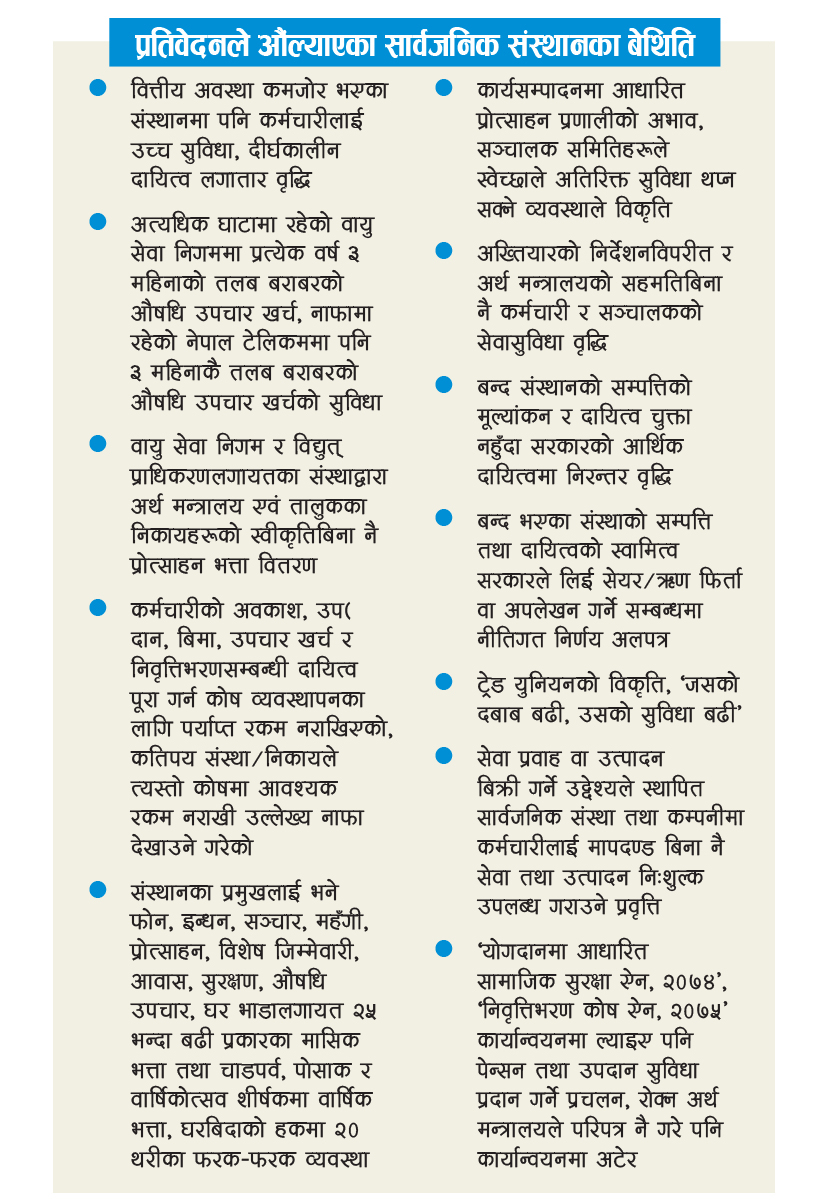
It has also been found that there is a huge disparity in the monetary (salary, allowances, bonuses, gratuities and pensions) and non-monetary benefits provided by corporations to employees. ‘Although there is equality in the leave received by employees, there are different arrangements in the payment of accumulated home leave,’ the report says. ‘There are also different arrangements regarding the determination of salary and allowances, including those determined by the board of directors and those determined by the board of directors with the consent of the Ministry of Finance,’ the report says.
The study found that some corporations provide high benefits to employees despite their weak financial condition. ‘Such activities have led to a continuous increase in their administrative expenses and employee benefits, which has created additional financial liabilities in the state treasury,’ the report says. ‘In some cases, the government has even had to provide support through loans or grants.’
Point no. of the budget statement for the current fiscal year. 374 mentions the formation of a recommendation committee to bring uniformity in the salaries and service facilities of institutions, boards, committees and bodies receiving facilities from the state treasury.
Accordingly, the government had formed a three-member task force three months ago under the coordination of former Deputy Auditor General Ramu Prasad Dotel. The task force members included Ramesh Prasad Siwakoti and Chandi Prasad Ghimire. The task force submitted the report prepared after a comparative study of the rules, regulations and legal provisions of 60 public institutions/bodies to Finance Minister Rameshwor Khanal on 1 Mangshar.
The task force's report mentions that there was no work to manage retirement facilities based on contributions in public institutions/bodies as per the government's policy. 'Institutions have managed retirement facilities in an opaque manner,' the report says, 'It seems that some have set up a fund and provided facilities based on ad hoc decisions, citing the funds as specified. Some have been depositing funds in the names of employees even though they are called employee welfare funds.'
The report states that the Office of the Auditor General has also issued instructions to stop the irregularities in the distribution of services, but the public institution/body has not complied with it. According to the report, the Office of the Auditor General had directed that the remuneration and facilities of the board of directors of the corporation should be determined by the Government of Nepal and that conflict of interest should be eliminated while determining remuneration and facilities. Similarly, it was said that the consent of the Ministry of Finance should be obtained while reviewing remuneration and facilities or on matters of financial liability, and that sufficient funds should be deposited to create a fund for managing long-term liabilities including pension and gratuity.
The task force also stated that the consent of the Ministry of Finance was not obtained for the distribution of services to employees. ‘Although the Ministry of Finance issued a circular to provide service facilities only with the approval of the Ministry of Finance, it was observed that some bodies were determining the facilities without approval and providing different facilities through the Employee Welfare Fund,’ the report says. ‘Although a circular was issued to adopt a contribution-based pension and gratuity system, this arrangement was not implemented in the past.’
While discussing the annual report of the Auditor General, the Public Accounts Committee directed that employee facilities should be reviewed/caused to be reviewed only with the consent of the Government of Nepal, and that allowances should be provided based on performance indicators and implemented, but that too has not been implemented. ‘Although the Public Accounts Committee directed that the Government of Nepal should take ownership of the assets and liabilities of non-existent and closed institutions and return or write off shares/loans, the matter has not been implemented so far,’ the report says.
The task force concludes that the concerned institution/body is not the only one to blame for the uneven service facilities. The main reasons have been pointed out to be the diversity in the acts, rules and regulations governing each institution/body, the implementation of decisions by the board of directors and the board, and the difference in financial capacity and institutional income. Inability to carry out effective regulation and monitoring, and the lack of uniform standards, have also been considered factors. ‘The Ministry of Finance appears to be the central body coordinating the financial affairs of the institution, including salary and benefits. In most cases, the Ministry of Finance is also represented on the board of directors of the institution,’ the report said. ‘The Ministry of Finance has issued a circular and a code of conduct to be followed when representing the director. However, as the regulation and coordination of financial matters by the Ministry of Finance is not effective, the practice of determining benefits voluntarily is increasing in the institutions.’ The task force concluded that inequality in service facilities has hindered the reform of the institution, increased the cost of goods and services, and decreased revenue collection. To solve such problems, the task force has suggested formulating a public institution financial accountability law and making uniform rules and regulations to ensure that no monetary or non-monetary benefits are determined without the consent of the Ministry of Finance. The report also suggests that institutions should be classified into groups (A, B, C and E) based on the complexity of their work, risk, income potential and nature of service delivery and implementing different criteria. The task force has suggested that the government develop a transparent, fair and consistent service facility system to solve the problem of financial irregularities. The task force's report mentions that a bonus or performance-based incentive system should be implemented only on the basis of performance indicators. The report also suggests that 'to increase transparency and accountability in institutions, all institutions should make public their salaries, allowances, facilities, bonuses and rules/regulations of employees, submit an annual report to the Ministry of Finance and control opaque arrangements such as employee welfare or security funds.' ‘Nepal’s weak or closed government corporations are becoming a constant burden on the state,’ the report says. ‘If liabilities are not paid and assets are not transferred on time, losses will increase further, assets will be destroyed, and employee liabilities will increase. Therefore, it is necessary to immediately adopt policy decisions, clear identification, and adjustment measures for the sustainable management, restructuring, or termination of corporations.’
The task force has also suggested an action plan for the immediate (short-term), medium, and long-term work to make employee service facilities in public institutions/bodies reasonable. An official from the Ministry of Finance has also informed that they have started preparing a work schedule for the implementation of the report. ‘The report also contains an action plan for reforms. We are making an action plan to determine what can be done immediately and by when the rest will be done,’ the official said.
Currently, 33 public corporations across the country have been established under the Companies Act, seven special acts, two communications acts, one cooperative act, and one corporations act. It employs 34,951 employees.

