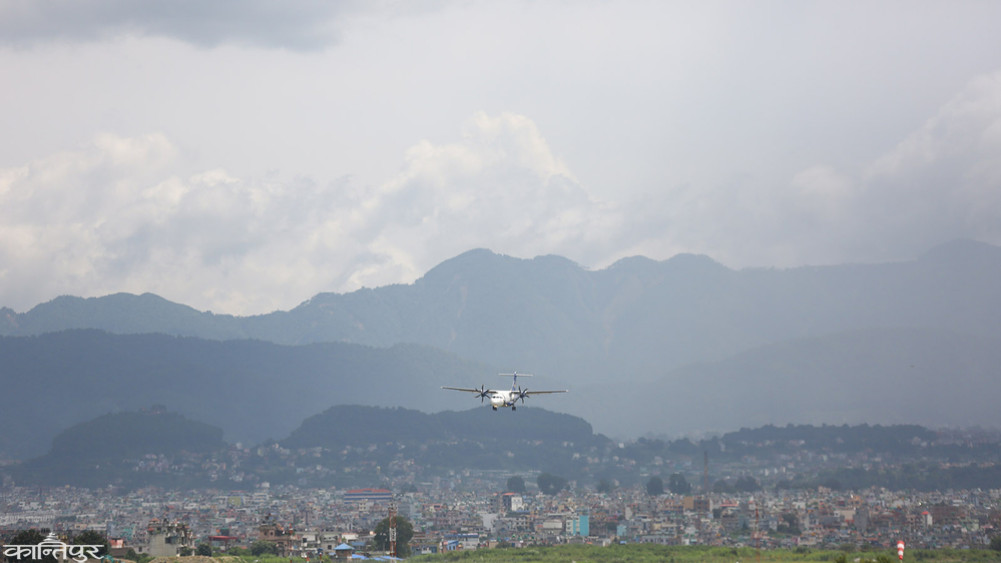
Flights in Nepal have also been affected as volcanic dust particles and sulfur-rich ash spread across international flight routes operating through South Asia and the Gulf region.
We use Google Cloud Translation Services. Google requires we provide the following disclaimer relating to use of this service:
This service may contain translations powered by Google. Google disclaims all warranties related to the translations, expressed or implied, including any warranties of accuracy, reliability, and any implied warranties of merchantability, fitness for a particular purpose, and noninfringement.
The impact of the ash plume generated by the eruption of Ethiopia's Haile Gebi volcano has reached Kathmandu.
Flights in Nepal have also been affected as volcanic dust and sulfur-rich ash spread across international flight routes operating through South Asia and the Gulf region.
According to Tribhuvan International Airport General Manager Hansraj Pandey, flight disruptions at Kathmandu Airport have increased since Tuesday morning after fine dust particles, rock fragments and other solid impurities from the volcanic eruption began to be seen on important westbound flight routes.
He said that flight management has become challenging, especially after ash and sulfur were detected on the routes of aircraft flying to Gulf destinations including India, Qatar, the UAE and Turkey.
The impact of the ash is particularly visible in the Simara sky area. After planes landed at Kathmandu Airport, planes had to be held for hours in the Simara sky due to lack of parking bays. Due to the excessive increase in air traffic, planes had to be held there for a long time. Two wide-body aircraft of Qatar Airways that landed on Tuesday morning have been stopped in Kathmandu. The pilots of those planes have informed the airport that flights on the westbound route are not possible. They argue that the risk of engine damage is high due to the increase in sulfur and dust particles on the flight path. As the impact of the dust decreases, they have indicated that they will return to Doha at night.
As the parking bays at the airport are starting to fill up, ground handling is also under pressure. General Manager Pandey informed that some aircraft have had to be held in the sky for about an hour and a half as flight operations have become complicated.
Some foreign airlines flying west are abandoning their regular routes and adopting alternative routes. But since the alternative route is not completely safe, flights are being operated by changing both altitude and route.
Korean Air has canceled Tuesday's Kathmandu-Seoul flight due to volcanic ash. Other aircraft have also been unable to take off on time, affecting travel. According to Pandey, flight operations are expected to be somewhat easier after midnight as the density of the ash gradually decreases.
Meanwhile, aviation regulatory bodies of various countries have issued safety warnings due to the volcano. The Directorate General of Civil Aviation of India has directed airlines to avoid flying from the affected areas and take alternative routes due to the increasing risk of volcanic ash clouds. Some flights to Gulf countries have been canceled or rerouted. Some flights to Jeddah, Abu Dhabi and Kuwait have been suspended. However, international news agencies have reported that Emirates, Etihad and Flydubai are operating flights almost regularly but are closely monitoring the situation.
Airlines and airports around the world are constantly monitoring the direction, density and risk of ash as volcanic ash spreads at high altitudes, which can directly affect aircraft engines, sensors and visibility. Extra caution has been taken on flights to the west via Kathmandu Airport and officials estimate that it may take some time for the situation to normalize.
According to CBS News, the Haile Gubbi volcano in northeastern Ethiopia erupted for the first time in about 12,000 years. The volcano erupted for a few hours on Sunday. The eruption sent a thick plume of smoke nine miles into the sky. The volcano is located in the Afar region of Ethiopia, about 500 miles northeast of the Ethiopian capital, Addis Ababa, and close to the border with the African country of Eritrea. The volcano rose to a height of about 1,500 feet in the Rift Valley there.