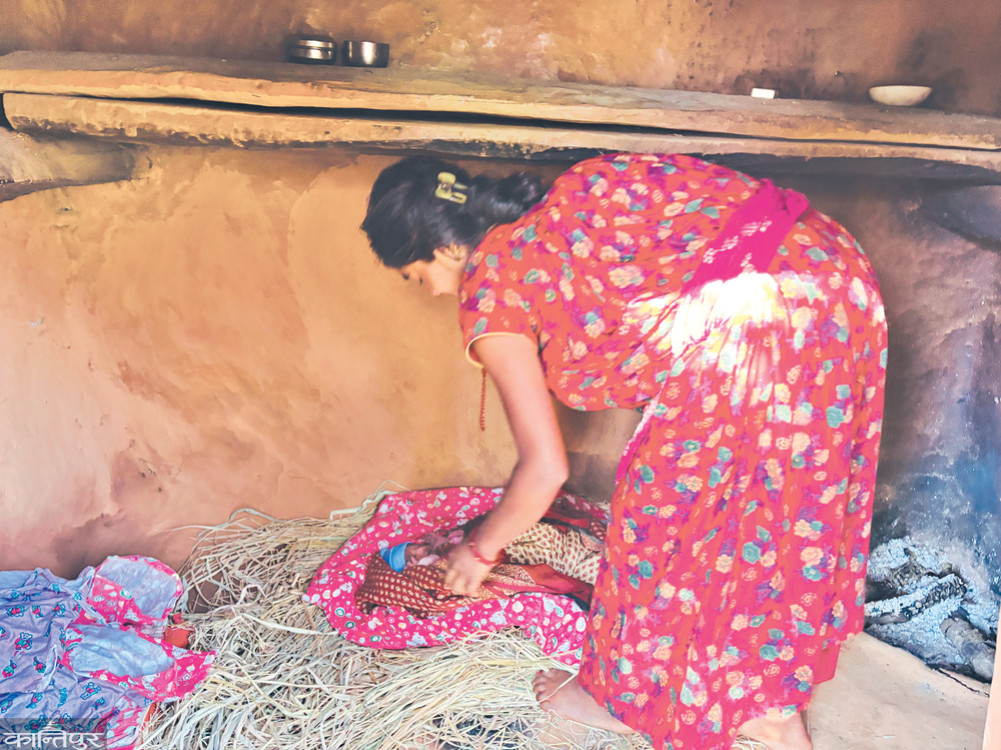
She has to cook her own food in the barn for 10 days after giving birth. Her husband and family members give her ingredients to cook without touching her. When no one is home, she has no choice but to wait for something. A woman who has given birth is treated harshly, even more so than during her period. She is forced to cook and wash her own clothes.
We use Google Cloud Translation Services. Google requires we provide the following disclaimer relating to use of this service:
This service may contain translations powered by Google. Google disclaims all warranties related to the translations, expressed or implied, including any warranties of accuracy, reliability, and any implied warranties of merchantability, fitness for a particular purpose, and noninfringement.
She has kept her clothes in one corner of the narrow hut in front of her house, and there is a stove on the other. Since the hut without windows is smoky, she usually lights a small fire. She has made a sleeping area for herself and her baby by spreading straw on the side and placing some clothes on top of it. Savita Bhandari, 24, of Khimada, Mangalsen Municipality-11, has already spent five nights in the cold with her newborn baby, and she will have to stay like this for another five days.
Savita is a second-time mother. She has to cook her own food in the cowshed for 10 days after giving birth. Her husband and family members give her food to cook without touching her. When no one is home, she has no choice but to wait and wait for something. ‘I have to wash all the clothes and bedding myself. It is also very cold. I have to make do with what I have,’ says Savita. ‘Both of my children were born through normal deliveries. What would have happened if I had to have an operation!’
Although staying in the cowshed in the cold of November is not comfortable, Savita says that society has no choice. ‘I fear that the baby will be uncomfortable if I keep the fire burning. I have to light it to cook food. I stay awake all night to protect my daughter from the cold,’ she said.
For 10 days after giving birth, neither the mother nor the baby are touched by others. The mother is not even allowed to go out into the yard. ‘This is the village rule,’ says Savita. She spent 10 days in the same hut when she gave birth to her first child. When she gave birth to her second child, she was taken back to the hut in the name of tradition.
According to Savita, women are treated harsher during childbirth than during menstruation. ‘I am not the first to suffer this pain, nor will I be the last. This is a common problem for all women in this village,’ she says.
According to health workers, women who have given birth should be given special care. First of all, a new mother needs a warm, clean, and safe room. Since the body becomes weak after childbirth, nutritious food, dals, legumes, milk, eggs, meat, green vegetables, and enough water are essential.
A child needs a clean and warm place, and should be kept away from smoke. Women in Achham, who need a safe place, nutrition, cleanliness, health checkups, and family support, are forced to endure the harsh conditions of a hut during childbirth. Savita cooks food inside the hut when she can. On days when she can't, she asks others to cook for her.
'Even when my body is very weak and bleeding, there is no one to bring me water, take care of my child, or give me medicine,' she says. 'This is not the case in my family's village. I have asked my family to come only after 10 days, thinking that if they see me cooking and eating in the hut like this, my family will feel bad.'
Sita Bhandari, 27, of Mangalsen-11 Khimada, said that families who do not keep their newborns in the hut and do not stay in the hut during their periods are isolated in society. She said that when the campaign to demolish the huts was launched in the district, she and her sister-in-law were ostracized by the family when they stayed at home during their periods. 'Society itself says it is wrong to keep a woman who is menstruating at home instead of keeping her daughter-in-law in the hut. "They say that the customs have been forgotten, the traditions have been spoiled, and the gods are angry," said Sita. "After leaving the chhaugoth and starting to live at home, the family was not invited to festivals, weddings, and weddings. Some even stopped walking and talking on the way home." She said that she started living in the chhaugoth again after the society started to defame her while fighting against the evil. "Like the panchayat, some people in the village decided to separate my family. We also started living in the chhaugoth again because we could not live apart from the society," she said. "Even though the law considers living in a chhaugoth a crime, who dares to remove the boycott in the society? On the contrary, the society defamed us when we fought against the evil." Sarita Bhandari, the chairperson of the Khimada Mothers' Group, says that the situation is becoming complicated because the older generation of women insist on accepting the chhaugoth practice as a custom and the educated women are unable to rebel. "The chhaugoth is in the house of the person who is given the responsibility of making changes. Leaders, teachers, public representatives, and government employees all have huts in their homes. If the leaders themselves do not give up this practice, how will the voice of ordinary women be heard?’
She said that the mother’s group has been conducting several campaigns against the chhaupadi practice, but it has not been effective. ‘We have repeatedly requested that women in labor not be kept in huts, and that they be allowed to stay at home during menstruation. But those who break the tradition are ostracized from society.’ Senior Anami Ratna Sodari of the Jupu Health Post, who delivered Savita, informed that she had sent her sister-in-law Jharana Bhandari to convince her to stay at home. ‘The problem of huts is prevalent in Jupu. After learning that even in Khimada, women are kept in huts during childbirth, I had convinced my sister-in-law,’ she said, ‘No matter how much I say, no one listens. From the point of view of the health of the mother and the child, it is dangerous to keep a woman in a chhaugoth during childbirth.'
Savita's sister-in-law Jharana, who is also a health volunteer, said that she also had to stay in the same chhaugoth when she gave birth five months ago. 'This is the custom of our village. No one listens to me saying that I should not stay in a chhaugoth alone. I stayed in the chhaugoth when all four of my children were born,' she said. 'They say that the gods do not tolerate keeping women in a chhaugoth and a house during childbirth. Our in-laws are ahead of us. We have to obey them. Daughter-in-laws are not allowed to speak loudly.'
Nar Bahadur Bhandari, the ward chairman of Mangalsen-11, claimed that there was no chhaugoth in his ward. 'There is no chhaugoth in my ward. There are 1/2 chhaugoths somewhere. We are gradually removing those too,' he said. 'I have heard that women are not allowed to stay in the house where they gave birth because of the gods. "There are not as many problems now as there were before." He said that he had previously launched a campaign against Chhaugoths and was ready to launch a campaign at the ward level again if problems were identified.