Even after a month and a half since the location of Oli and the writer was set, no official information has been provided nor have they been called for statements. On the very day of his retirement from the IGP, it has been decided to order Khapung not to leave the valley.
We use Google Cloud Translation Services. Google requires we provide the following disclaimer relating to use of this service:
This service may contain translations powered by Google. Google disclaims all warranties related to the translations, expressed or implied, including any warranties of accuracy, reliability, and any implied warranties of merchantability, fitness for a particular purpose, and noninfringement.
The 23-24 Bhadra Incidents Inquiry Commission has been recommending the government to implement the decision by assigning the location of the then Prime Minister and other high-ranking officials one after another. However, no official information has been provided to anyone concerned. The Commission has not even questioned them.
The commission last Thursday recommended to the government to ban outgoing Inspector General of Police Chandrakuber Khapung from traveling abroad and not to allow him to leave the Kathmandu Valley without permission.
The commission decided to place Khapung under house arrest on Thursday, the same day he retired from the post of IGP. The commission stated that the recommendation to place him under house arrest was made as he had to be present at the commission at any time for questioning.
Earlier, on 12 Ashoja, then Prime Minister KP Sharma Oli, then Home Minister Ramesh Lekhak, then Chief of the National Investigation Department Hutraj Thapa, then Home Secretary Gokarnamani Duwadi and then Chief District Officer of Kathmandu Chhabilal Rijal were placed under house arrest. Based on the commission's recommendation, the government immediately decided to ban them from traveling abroad and not allow them to leave the Kathmandu Valley without permission.
Although the commission has been making the decision regarding house arrest public through a press release immediately, the concerned persons have not been officially informed. ‘Shouldn’t we inform about which article of the constitution, which law, and for what justification and for how long the demarcation was made?’, says former Home Minister Lekhak, ‘Should we accept the government’s decision based on what we heard from the media?’
Former Prime Minister Oli’s personal secretary Rajesh Bajracharya also said that no official letter has been received about the demarcation yet. Thapa, the former head of the Investigation Department, and others have also not received a letter from the commission. The commission has allowed Duwadi, the coordinator of the committee formed to assess the damage caused during the protests and prepare a reconstruction plan, to go outside the valley.
He was allowed to go outside the valley to collect details based on Duwadi’s application. The commission has not questioned anyone for a month and a half since the demarcation of the former Prime Minister and five others. The term of the inquiry commission formed on 5 Asoj under the leadership of former judge Gauri Bahadur Karki is now less than a month and a half.
Former High Court judge Lokendra Mallick, who chaired the Kapilvastu incident, Butwal incident, and the Commission for Inquiry and Recommendation on Enforced Disappearances formed by the Supreme Court, says that information should be provided before or after a decision is made against a person. He says that not providing information to the concerned person will also raise public questions. ‘This is also a matter of fundamental rights. If a person is arrested, an arrest warrant is issued. Similarly, the Commission of Inquiry should also provide information if someone is under investigation,’ he said. ‘This is also a person’s right to know. It is not possible to get information only from the media.’
Mallick says that it would be better if the Commission had made the information public by sending a letter first. ‘The work of the Commission of Inquiry is very responsible and serious,’ he said. ‘Many things may have to be kept confidential during the investigation. Otherwise, the person who needs to be investigated may not be able to go out and the Commission may not be able to do its work. Keeping that in mind, the Commission should move forward by informing the concerned person.’
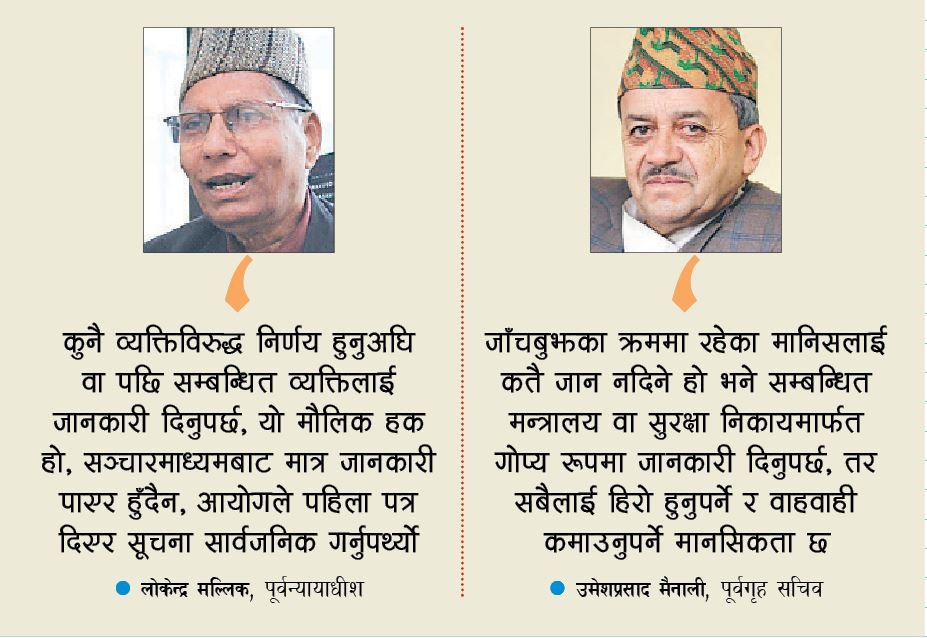
Former Home Secretary Umesh Prasad Mainali says that even though the commission can impose restrictions on the location of people under investigation and investigation and ban them from traveling abroad, it should not be made public.
‘If people under investigation and investigation are not allowed to go anywhere, they should be informed secretly through the relevant ministry or security agency,’ he says. ‘In the context of elections having not yet been announced, circulars issued to people who are already in the leadership should not be made public. But everyone has the mentality of being a hero and earning applause.’
Mainali, who was Home Secretary when the commission was formed to investigate the suppression of the 2062/63 people’s movement, gave an example of a secret recommendation from the commission to ban the travel and movement of various people and it was not made public.
‘The commission used to secretly advise some people not to go abroad. There is an example of the Prime Minister himself coordinating the comings and goings after looking at the situation. The same method can be adopted even now,’ he says. Commission of Inquiry Chairperson Gauri Bahadur Karki and member and spokesperson Vigyanraj Sharma say that the notice made public by the commission is also a letter.
‘We have issued a public notice so that there is no problem in the work of the commission,’ says spokesperson Sharma, ‘It has been advised to send letters to everyone individually as well.’
It is natural for the commission formed to investigate the loss of life and property during the Gen-G movement to question and investigate various people, but the commission officials should not make assumptions, says Mainali.
The commission, which was formed to investigate any matter of public importance, has the power under the Act to take a statement from any person, order the production of documents, examine evidence, and extract any document or its copy from any government or public office or court. Oli, who is also the UML chairman, has already publicly expressed his rejection of the commission.
A writ has also been filed in the Supreme Court against the decision to delimit the area. The Supreme Court has issued an order in the name of the government and the inquiry commission to submit reasons for this. A police officer says that the then IGP Khapung had also expressed his dissatisfaction with Prime Minister Sushila Karki and Home Minister Om Prakash Aryal regarding the commission's work.
Before retiring, while addressing the police headquarters on Wednesday, Khapung had asked, "Who will be held accountable for the attacks on the police and the injuries suffered in the aftermath of every movement?" Khapung was appointed IGP just four days before the Gen-G movement. He retired after 69 days after serving for 30 years.
There are also allegations that competition within the police is being used to influence the investigation of the 23-24 Bhadau incidents. SSP Bishwa Adhikari, who was the Kathmandu police chief during the Gen-G movement, has been promoted to DIG. The officer who was at the top of the ranking is accused of suppressing the Gen-G movement. A police officer said that the promotion committee of the Ministry of Home Affairs may have given the same reason for not promoting the officer.
The commission had sent a letter to the police headquarters to provide details of the police officers deployed on duty during the Gen-G agitation. Khapung was the IGP when the letter was sent. In response to the details requested by the commission, the police headquarters informed that all the police personnel were in the field on both days. After that, the commission, which became angry, asked Khapung for a 24-hour explanation on 19 Kartik, saying, "Why are you not being taken into action?" After that, the police provided the details.
Not only Khapung, but a large section of the police is dissatisfied with the commission's behavior. In the meantime, the commission has also started taking statements from some police personnel. The commission is investigating the police personnel deployed in the field during the Gen-G agitation.
Former Additional Inspector General of Police (AIG) Uttam Raj Subedi, who has been in the inquiry commission in the past, says that the commission should take the statement calling for statements as a matter of course. ‘The commission will call for a statement to understand the truth of the incident. If the commission calls, it will not be found guilty, nor will it be feared,’ he says. Subedi himself had also given a statement to the inquiry commission when he was in the police service.
Former Home Secretary Mainali says that the commission can conduct a detailed investigation but should not act with a bias against anyone. Former Inspector General of Police Khapung argues that no one ordered the firing on 23 Bhadra, but that the incident was caused by circumstances, he says, ‘The Essential Commodities Protection Act states that if firing is necessary to protect something that is intended to be protected, no one should be asked. In such a case, under what circumstances was the firing carried out? Was minimum force used according to the prevailing law? These are the main questions that the commission should find.’
22 people were killed when the police fired during the protest on 23 Bhadra against the government’s ban on some social media platforms and corruption. The next day, angry protesters set fire to and vandalized the offices of the President's Office, the Prime Minister's Residence, the Parliament Building, the Supreme Court, Singha Durbar, and the Commission for the Investigation of Abuse of Authority. Political party offices, leaders' residences, and commercial and private buildings were damaged.

