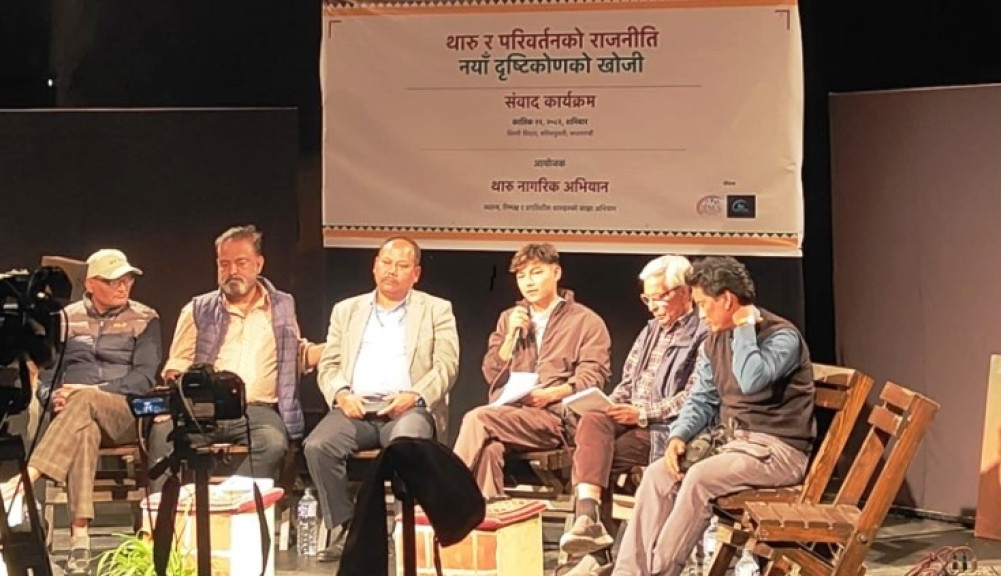
Writer Khagendra Sangraula said, ”The rulers have tried to criminalize the movements of oppressed communities, in which the media also plays a role.”
We use Google Cloud Translation Services. Google requires we provide the following disclaimer relating to use of this service:
This service may contain translations powered by Google. Google disclaims all warranties related to the translations, expressed or implied, including any warranties of accuracy, reliability, and any implied warranties of merchantability, fitness for a particular purpose, and noninfringement.
Stakeholders have criticized the trend of criminalizing the protests by Tharu and oppressed communities.
In an interaction organized by the Tharu Citizens' Campaign, they said that the attempt to criminalize the movement of a community that is engaged in the movement for change is wrong.
Writer Khagendra Sangraula mentioned that the Tharu, Dalit and Madhesi communities made the most sacrifices in the Maoist conflict and said, "The rulers have tried to criminalize the movements of oppressed communities, in which the media also plays a role," he said.
Tharuhat leader Laxman Tharu said that after the movement in Tikapur, everyone is aware of the issues of identity and existence of the Tharu. "The Tharu movement that started after the first Constituent Assembly finally reached Tikapur, but it was suppressed," he said.
He opined that the parties formed with the Tharu issue in mind have weakened the spirit of the movement while negotiating with the government. Demanding the immediate public release of the Lal Commission report, he called for the Tharu Citizens' Campaign to be vigorously carried forward across the country.
Genji Movement leader Rijan Rana Magar said, 'When the oppressed community retaliates, the state begins repression. This is a continuation of historical oppression.' He urged the Tharu people to hold their representatives accountable and boycott leaders who seek power.
Leader Sumana Shrestha said that a comprehensive approach to representation is necessary. She said, 'We should not just look for political leaders, but ensure access to a permanent government. The quota system has provided one level of representation, but without the support of the community, this cannot be long-term.'
Leader Surendra Chaudhary believed that we should understand each other's feelings, create a new narrative, and move forward with alternative politics.