After the issue of double taxation for Ncell reached the Supreme Court of Nepal and the International Tribunal at The Hague, it was decided that capital gains tax would be imposed. At that time, Rameshwor Khanal, who was also the former Finance Secretary, was at the forefront of the social pressure to impose the tax. However, it was decided to grant tax exemption to Dolma Impact when Khanal was the Finance Minister.
We use Google Cloud Translation Services. Google requires we provide the following disclaimer relating to use of this service:
This service may contain translations powered by Google. Google disclaims all warranties related to the translations, expressed or implied, including any warranties of accuracy, reliability, and any implied warranties of merchantability, fitness for a particular purpose, and noninfringement.
The interim government, formed with the original mandate of holding elections within six months, has taken a controversial decision to grant income tax exemption to companies that have invested in Nepal through a ‘shell company’ in the ‘tax haven country’ Mauritius. The government has resorted to a treaty with Mauritius to grant tax exemption to the Dolma Impact Fund, which has invested in 16 companies in Nepal. However, along with the decision to grant tax exemption to Dolma, the government has also revoked the treaty.
In countries like Mauritius, where there is no specific inquiry into the transparency of the source of investment and the identity of the investor, it is common to open a company and invest in various countries through it. Therefore, investors from different countries open 'shell companies' in countries like Mauritius, Panama, British Virgin Islands, Cayman Islands, and Bahamas and invest in various countries through them as direct foreign investment. For this, shell companies are registered in such countries.
On August 3, 1999, the government explained that since there is a Double Taxation Avoidance Agreement (DTAA) between Nepal and Mauritius, investment from there will not be taxed. Tax authorities have not been able to make such a decision so far, saying that no treaty should be interpreted to exempt income earned from using Nepal's resources from tax. Tax administrators were hesitant to give such an exemption, saying that the investment coming through Dolma was not from Mauritius but from a third country.
According to the agreement (which Nepal considers a treaty), even if a Mauritian company claims to be tax exempt in Nepal, it must have at least 50 percent investment from Mauritius. Mauritius' investment in Dolma Management, which is registered with an office in Mayawa Tower, Cyber City, Mauritius, is only 0.75 percent. 99.25 percent of the investment was taken from various countries to the Mauritian company and brought to Nepal. The government has decided to provide such a facility as per the 'lobbying' of Dolma, which has invested in various companies in Nepal, to get a 25 percent tax exemption on its income here.
As per the Income Tax Act of Nepal, 2058, Dolma had been 'lobbying' during the previous government to get exemption from the 25 percent capital gains tax. Along with political pressure, discussions had been going on between the Internal Revenue Office and the Ministry of Finance for a long time. However, the decision could not be taken after the tax administrators warned Dolma not to give such an exemption, citing the background and precedent of the failed attempt to give tax exemption to Ncell's income in the past.
The issue of double taxation of Ncell had reached the international court, but Ncell's tax was fixed according to the decision of the Supreme Court of Nepal and the international 'Tribunal Hague'. Rameshwor Khanal, who is also the former Finance Secretary, was at the forefront of the social pressure to thwart the attempt to grant tax exemption to Ncell. The decision to grant tax exemption to Dolma was made when Khanal was the Finance Minister.
Before making this decision, Finance Minister Khanal had also sought the opinion of retired officials and tax administrators from the Ministry of Finance and the Inland Revenue Department. The officials who came in contact with Kantipur said, 'We had warned them that Dolma had received investment through a Mauritius cell company and that this issue was similar to Ncell's tax dispute. Based on the Ncell example, tax is levied as per the Income Tax Act, and if not done, Nepal will lose a large amount of tax, so we suggested not to make such a decision, saying that it would become a political, social and legal issue,' they said, 'but we are surprised to learn that such a decision has been made.'
Tax experts had suggested to Finance Minister Khanal to decide that in the event that Dolma has to withdraw her investment or income, a 25 percent capital gains tax should be levied as per Nepal's Income Tax Act. The Finance Ministry had sought a legal opinion from the Attorney General's Office on this issue. However, even the officials of the Attorney General's Office were divided on the matter.
'The Attorney General's Office had initially prepared an opinion stating that only a company from a country with more than 50 percent shareholding in Nepal would be eligible for the benefits under the double taxation agreement,' the official said, 'However, the Mauritius investor has only a total of 0.75 percent investment in this company. Since 99.25 percent of the investment was from another country (outside Mauritius), it was concluded that Dolma would be taxed as per Nepal's Income Tax Act. But later a different letter was sent.' Kantipur has a draft of the letter prepared by the Attorney General's Office.
Dolma Impact Fund has brought investments in Nepal in various phases. Phase 1 brought 36.6 million (about 5 billion) and Phase 2 brought 71.96 million US dollars (about 10 billion). 'This investment is to generate profit. If the shares of those companies are sold at a higher price than before, capital gains tax should be levied. But capital gains tax has been made not to be levied by showing the treaty,' tax experts say. According to the Ministry of Finance, it has been decided to exempt Dolma from tax, and immediately after that, the Council of Ministers meeting held last Wednesday (October 12) also decided to revoke the double taxation exemption agreement with Mauritius.
An example of how Dolma is trying to get rid of capital gains tax is Makar Jitumaya Suri Hydropower Company, from which Dolma is going to sell its shares. Dolma Impact Fund has invested 26 lakh 5 thousand 900 shares in this hydro company. This is a share purchased at 100 rupees per share.
On Tuesday, the shares of this company were traded at 5 hundred and fifty-two rupees per share on the secondary market NEPSE. Thus, by selling the shares purchased for 26 crores now, Dolma will earn a profit of about 1 billion 177.866 thousand 800 rupees. According to Nepali law, foreign investors are subject to capital gains tax at the rate of 25 percent on the profit received from the sale of shares. Accordingly, the company will be subject to capital gains tax of 294.466 thousand 700 rupees. However, since the government has already decided to provide tax exemption, now the company will get all the mentioned amounts tax exempted.
Not only Makar Jitumaya, but also Dolma will get tax exemption in other companies if it sells shares for another 6 months, says Finance Minister Khanal. ‘Even if the treaty with Mauritius is revoked, the same arrangement will be applicable for 6 months. What happens after that will be according to the new arrangement,’ he said.
Shabd Gyawali, Investment Director of Dolma Advisors, said that they have not received a formal letter regarding the government’s decision to grant tax exemption. The company has been advising Dolma Impact Fund. ‘Dolma has not taken the benefit of tax exemption from the government so far, except for dividends,’ Gyawali said, ‘We have not received a letter regarding the government’s additional decision.’
Tax administration expert and former minister Bidyadhar Mallik says that the government cannot grant tax exemption to Dolma Impact Fund on the basis of a treaty or bilateral agreement. ‘I also read the treaty with Mauritius. It does not say anywhere that capital gains tax exemption will be granted. Therefore, according to the provisions of both the treaty and the current Income Tax Act, Dolma Impact Fund is subject to tax, the government cannot give exemption,' he told Kantipur, 'If the Mauritius company is not satisfied, it can go to court for legal redress, it is allowed to go. However, the government cannot give it tax exemption and it is not possible according to the law.'
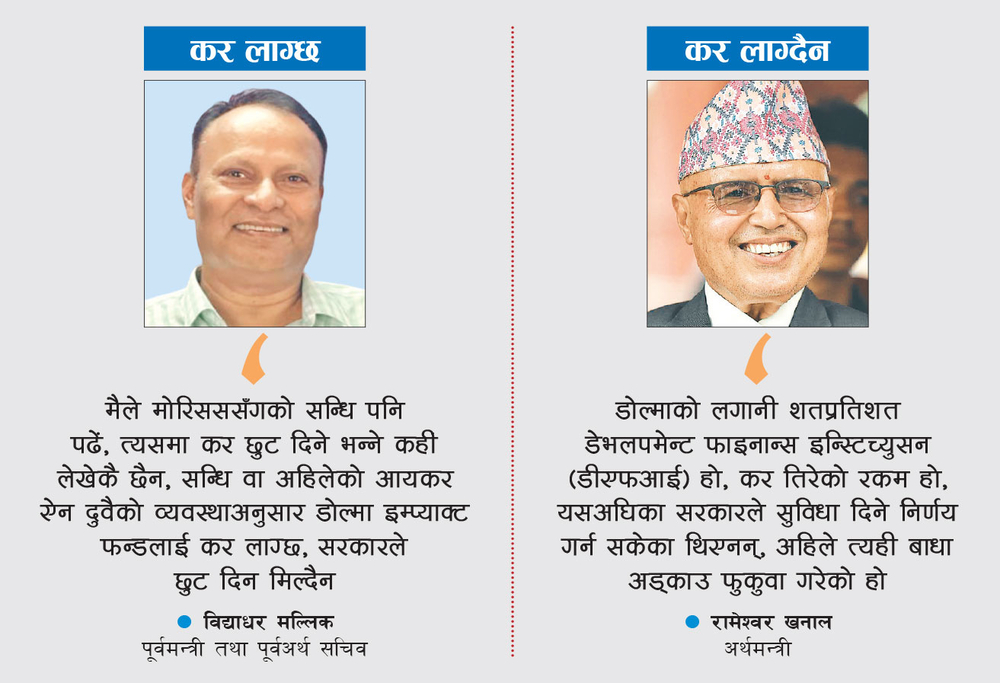
Mallik also revealed that a few years ago, a representative of Dolma Impact Fund asked him to explain the non-taxation. He also said that since Dolma is subject to tax regardless of the treaty or law, he could not explain as requested and suggested that he go to court if he was not satisfied. 'Investing in that company, earning profits in Nepal, receiving dividends but not taxed on income? The law cannot be misinterpreted like that,' he says, 'Dolma is subject to tax regardless of the treaty and the Income Tax Act. Therefore, the government's decision to give tax exemption is not right.'
He says that the government should make tax-related decisions according to the provisions of the Income Tax Act. ‘The Income Tax Act, 2058 is the basic tax law of Nepal. It also covers treaties and agreements made before the promulgation of the Income Tax Act, 2058, and no one has the right to go beyond it,’ says Mallik.
Confirming that the double taxation agreement has been revoked, but a decision has been made to provide tax exemption facilities to Dolma Impact Fund as per the same agreement, Finance Minister Khanal has defended the government’s decision. ‘We have already revoked the double taxation agreement. Now, new investors will not get the tax exemption facility. Dolma gets tax exemption on old investments. Because even if we give notice of the termination of the agreement now, it will be valid for the next 6 months,’ he told Kantipur.
Finance Minister Khanal claims that the decision regarding the tax exemption facility was not made under anyone’s pressure or influence, but rather it is the state’s responsibility to provide such facilities. ‘Dolma’s investment is 100 percent Development Finance Institution (DFI). DFI is a sovereign wealth fund of foreign countries. This is the amount of tax paid. There is no private investment in Dolma at all. It has brought investment from all the developed countries that have relations with Nepal,' he said, 'There is investment from countries including Swiss funds, Japan, UK, Netherlands, America.'
When asked by Kantipur why it was not private but a transparent investment that paid taxes, why would it have brought investment by going to a 'tax haven' country like Mauritius, Finance Minister Khanal said, 'Any investor would expect to get tax exemption. If private investment had come like that, there would have been room for doubt. There is no need to doubt this investment.'
Finance Minister Khanal claims that foreign ambassadors had also asked previous governments to grant income tax exemption to Dolma and that they were confused by not making such a decision.
'Since it is an investment from developed countries, ambassadors from countries including Switzerland, Japan, UK, America have been running here and there for tax exemption for Nepal since last year. The previous government could neither decide to provide tax exemption nor did it revoke the treaty,' he said. 'The previous government had a situation where it did not decide even if it said so. That is why further investment by DFIs coming to Nepal has been stopped. Other DFIs are also trying to invest in our hydropower projects.'
Now that the treaty has been revoked, as Finance Minister Khanal said, the question of how DFI will come has also arisen. Finance Minister Khanal said that the government is revoking the treaty and amending the act to avoid confusion among investors in the coming days. 'The new act will include a provision for tax exemption for DFIs but not a provision for tax exemption in DTA, and a new DTA model has been prepared so that what is earned here will be taxed there and what is earned here will be taxed here,' he said.
Dolma had written a series of letters to all government bodies in Nepal to get the exemption facility. Dolma wrote a letter to CDS and Clearing on Ashad 23, 2082, stating that there should be a tax exemption on the sale of shares of Makar Jitumaya Suri Hydropower Company. On the basis of the same letter, CDS wrote a letter to the Inland Revenue Department on Ashad 24, asking for the tax to be determined.
On Shrawan 5, the Inland Revenue Department also sought the opinion of the Nepal Stock Exchange (NEPSE) on whether or not tax would be levied on the sale of Dolma's shares in Makar Jitumaya Suri Hydropower Company Limited. Then on Shrawan 15, NEPSE wrote to the department asking for the percentage of capital gains tax levied on the company.
Meanwhile, the Inland Revenue Office had sought an opinion from the Ministry of Finance on whether or not to grant tax exemption to Dolma as per the treaty. The Ministry of Finance sought a legal opinion from the Attorney General on Ashad 24, 2082. The Ministry of Finance had sought its opinion on the grounds that Section 73, Sub-section 5 of the Income Tax Act, 2058, does not provide tax exemptions as the investment of the country (investors from Mauritius) is less than 50 percent, and the treaty does provide tax exemptions. However, since Nepal did not inform Mauritius of the arrangement made in 2058, the Ministry of Finance was concerned that it might be forced to provide tax exemptions.
‘In Article 5 of the agreement between Nepal and Mauritius, the authorities were required to inform each other of the changes made in their respective tax laws. However, it appears that the Inland Revenue Department did not inform the authorities of Mauritius about the double taxation provision of Section 73, Sub-section 5 of the Income Tax Act, 2058,’ the Ministry of Finance said in a letter to the Attorney General’s Office. ‘In Article 9, Sub-section (1) of the Nepal Treaty Act, 2047, if the provisions of any treaty conflict with the prevailing law, the provisions of that treaty shall be applicable as per Nepal law. In this regard, the Attorney General will provide a legal opinion on whether the provisions of the double taxation relief agreement between Nepal and Mauritius and the Income Tax Act will apply if there is a conflict between them.’
There was also a difference of opinion among the officials of the Attorney General’s Office regarding the opinion sought by the ministry. However, another letter was prepared and sent stating that the provisions of the treaty will apply. ‘Since the Government of Nepal is a party to the said agreement, it falls under the Nepal Treaty Act, 2047 and it is clear. It seems that there is a clear legal provision that if the provisions of a treaty conflict with the prevailing law, the prevailing law will be invalid to the extent of the conflict for the purpose of that treaty and the provisions of the treaty will be applicable in Nepal in that regard,’ the letter states.
Deputy Attorney General Sanjeev Raj Regmi said that the opinion was given on that basis because the ministry did not ask them whether dolma is taxable or not, but asked them which of the provisions of the agreement and the provisions of the Income Tax Act would apply. ‘In that, the Attorney General’s Office has only given an opinion that the provisions of the treaty are applicable as per Section 9 of the Nepal Treaty Act, 2047 BS and that there are many judgments of the Supreme Court in it,’ he said, ‘The matter of tax levy/non-levy is a matter for the Internal Revenue Department to determine and we were not even asked about it.’
Dolma’s logo and CEO Tim Gochar.
Dolma has invested in Worldlink, Century Masala, Sasto Deal, Foodmandu, Cloud Factory Holdings, Fusion Machines, Upaya City Cargo in Nepal. Similarly, Dolma also has investments in Setikhola Hydropower, Shweta Ganga Hydropower and Construction, Makar Jitumaya Suri Hydropower, Solar Farm, National Path Labs, Nidan Hospital, Chirayu Hospital, Rhododendron Biotech Pvt. Ltd.
It is also understood from the audited accounts that Dolma has now withdrawn its investment, which will generate significant income. The company has made the best profit from hydropower projects. It has received a capital gain of Rs 1.17 billion in Makar Jitumaya Suri Hydropower. Similarly, the fair value (potential fair value) of Dolma's shares, which invested $ 3.5 million in Shweta Ganga Hydropower, has now reached $ 1.24 million (about Rs 1.76 billion at the current exchange rate). With an investment of $ 3.4 million in Setikhola Hydropower, the assets have reached Rs 7.2 million (Rs 1.24 billion). In the solar farm, Dolma had invested $ 2.2 million, in which the value of the assets has now been limited to Rs 1.5 million (Rs 213 million).
Dolma had invested $ 5.45 million in fuse machines, now the 'fair value' has reached Rs 5.9 million (Rs 837.8 million). Dolma had invested $5.45 million in Cloud Factory Holdings. The ‘fair value’ of the shares is now $4.1 million (582.2 million).
Dolma’s investment in the health sector is also disappointing. Dolma, who invested $1.34 million in Nidan Hospital, has seen its share ‘fair value’ drop to $350,000 (497 million). Similarly, Dolma’s investment in Chirayu Hospital has also suffered losses. It had invested $4.2 million in this hospital, the potential value of which has been limited to $2.5 million (355 million). Dolma’s property value in National Path Labs and Research Center is $3.9 million (553.8 million). Rhododendron Biotech’s investment and ‘fair value’ are not mentioned in the report published by Dolma. The 'fair value' of Dolma's shares, which invested 1.83 million in DOS Pharmaceuticals, is now 1.5 million dollars (213 million).
Dolma had also invested in Upaya City Cargo. The investment of 3.6 million dollars has now reached 4 million dollars (568 million). Dolma had invested 2.7 million dollars in Sasto Deal, but the e-commerce company Sasto Deal, which was established in 2011, is no longer in operation. Dolma had also invested 3.8 million dollars in Foodmandu, but now only 1.9 million (269 million) remains.
Dolma's shares, which invested 6.9 million dollars in Worldlink, have reached 8 million (1.136 billion) according to the company's own statement. Dolma has also invested in Century Masala, which has a potential value of 5.6 million dollars (795.2 million). Despite relatively small investments incurring losses, Dolma's Nepal investment is remarkably encouraging, with returns from large and hydroelectric companies.

