Flood-affected locals in border areas fear that problems will increase year after year
We use Google Cloud Translation Services. Google requires we provide the following disclaimer relating to use of this service:
This service may contain translations powered by Google. Google disclaims all warranties related to the translations, expressed or implied, including any warranties of accuracy, reliability, and any implied warranties of merchantability, fitness for a particular purpose, and noninfringement.
Nepali villages have been inundated due to the border road built by the Indian government near the Nepal-India border. The floods that occurred after continuous heavy rains in the third week of Asoj last year submerged Shedhwa-Chhanki, Hathiual and Laxmipur villages of Wards No. 1, 2 and 3 of Balra Municipality in Sarlahi district for about 36 hours. Water entered houses. Flood water is still present in the fields.
Locals blame the high-rise road built by India near the border for this. Farmers on the Nepal side have been affected by the waterlogging. At least one thousand families have been affected. Hundreds of bighas of paddy fields have been damaged.
Farmers who suffered due to drought this year had planted 100,000 paddy. The flood submerged them, causing great damage to the paddy crop. Some houses made of mud and straw have been damaged. Some farmers have even lost their livestock. Binodananda Mishra of Laxmipur, Balra-3, has lost his house due to the flood.
He has reached a point where he cannot even recover the investment he made in paddy planting when the paddy planted in 10 kathas is submerged in water. He has reached the district headquarters Malangwa, 30 kilometers away, and has filed an application with the district administration, hoping to get relief for rebuilding his house. He has also visited his municipality. However, he complains that he has not been able to get relief from anywhere to rebuild his house.
He is currently temporarily living in a tent. He has lost both his house and his shelter. ‘I would have thought more if there had been shelter first. I have been hearing on the radio that the government would help in the reconstruction. I myself came with a police report and submitted a petition, but so far there has been no hearing,’ he said, ‘10 quintals of paddy are produced from 10 kathas. That would have been enough rice for about a year. But, look at the fields, they are still submerged.’

He says that those belonging to the small farmer group or the lower class group have been hit hard. The plight of Bharosi Mishra from this village is no less painful. He lost his recently calved milch buffalo in the flood. He used to help him make ends meet by selling milk. He says that the buffalo died due to a disease caused by the flood. ‘There was water everywhere, the house was submerged. The buffalo that was born could not be provided with the necessary services. The buffalo was lost 2-3 days after the flood,’ he said, ‘Never mind farming. Everyone is suffering from it. I feel like crying when I look at the rice I planted. There is nothing left. On top of that, I lost the buffalo.’
The villages that are now submerged were also submerged in the flood that occurred on 10 Asoj last year. However, locals say that there is more water this year than the previous time. This year, the flood occurred on 19 Asoj. The Bagmati River is nearby. Previously, the flood water drained away immediately during the rains, but the inundation has been going on for a long time for the past two years, says local farmer Kapildev Ram.
‘The road built by India is very high, we are on the border. That road is near the border. Not only is it high, it is also strong,’ he said, ‘it stops the natural flow of water. When the floodwaters receded, there was water in everyone’s houses for not just one or two hours, but for two days. Only a few exceptional houses may not have had water. But their courtyards were also submerged.’
He says that the farmers suffered the most due to the lack of drainage for a long period. ‘The paddy fields were submerged. The harvesting time was approaching, and the farmers have been badly affected by the flooding that occurred at this time,’ he said, ‘The production of the paddy I planted in 14 kathas has reached zero.’ He said that the paddy crop was rotting and rotting when the fields were submerged, as the paddy yield was up to one quintal per katha.’
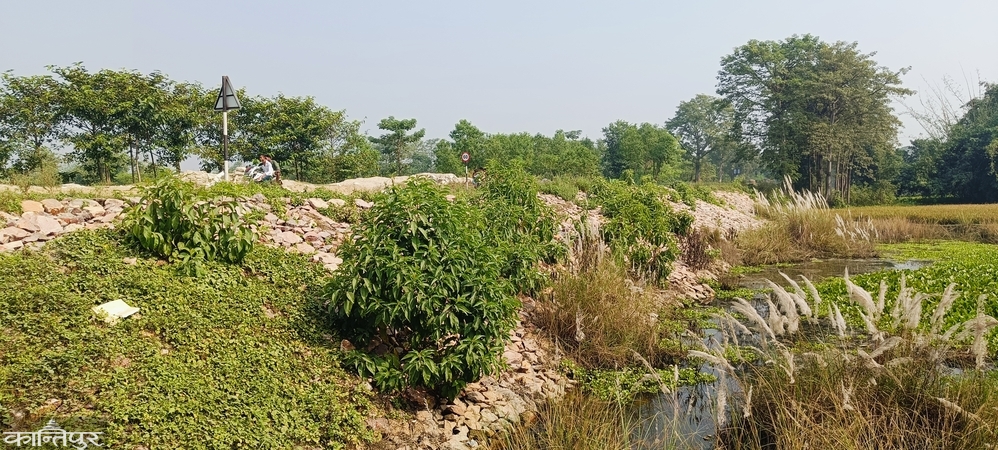
India has built a border road around 200 meters from the Dashgaja border separating the two countries. It is also called a military road. India has started building a road from east to west near the border with Nepal to make it easier for the Indian Sashastra Seema Bal (SSB) deployed on the border with Nepal to patrol in any weather. Some construction has been completed. Some are in the process of being completed.
The road is being built in the areas connected to the Nepal-India international border in the states of Bihar, Uttar Pradesh and Uttarakhand. It was started in 2010.
Kaushal Kishore Singh, Chairman of the District Coordination Committee Sarlahi, says that almost the entire Indian border road has been built on the Indian border with Sarlahi. He said that this has increased the problem of flooding and inundation since last year. He himself is a resident of Hathiyol, which is severely affected by the floods. He mentioned that in the long term, it has created a big problem in the flood-affected areas of the entire district.
He said that the district headquarters, Malangwa, has also started to suffer from it. This year, when the flow of water stopped, abnormal water was seen in the border area near the district headquarters. The international border at the district headquarters remained blocked for several days due to the problem in the drainage of water, he said, "The drainage of floods in the Bagmati, Manushmara, Lakhandehi or Jhim rivers has been stopped. This has led to the problem of flooding increasing further."
He said that the area affected by the Bagmati has returned to the situation it was three decades ago. In the past, there was no embankment on the Bagmati banks on the Nepal side. Floods would easily occur. The embankment built near the border by the Bagmati River Control Project in India would stop the water. The western villages of the district would get flooded. It was a problem every year. In 2050 BS, the devastating flood in the Bagmati River had broken the Indian embankment in places. It had also caused huge loss of life and property in the villages across the border. The embankment that was broken by the flood had not been built for three decades. It had facilitated the drainage of water. On the other hand, with the help of the Indian government, embankments were built on the banks of the Bagmati in both Rautahat and Sarlahi to control the river.
‘The construction of the embankment from Karmaiya in Sarlahi to the Indian border in the south had been completed a decade ago. That had helped control the flood. On the other hand, even when the flood occurred, there was no problem in the drainage of water as the embankment across the border had broken,’ Singh said, ‘Now the situation has changed. India has built a strong and high embankment on the border in the name of military or border roads. The drainage of water has been controlled by gates at a few places. Indian security personnel open the gates only when they want.''
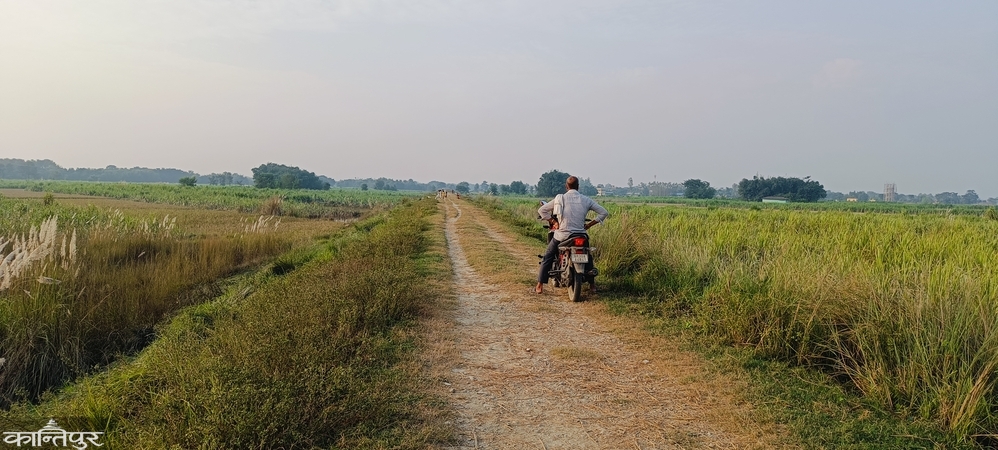
After India built an embankment to control the Bagmati in 1975, these areas used to remain submerged for the next 18 years. Now, the same old situation is starting to repeat itself, said Shashibhushan Kushwaha of Mirzapur. He expressed his dissatisfaction that India is irresponsible towards its citizens for not listening to the Nepal government's strong objections to it for so many years while it is building an embankment near the border, contrary to international norms.
The United Nations' International Rules on the Use of Rivers and Waters prohibit any country from building structures including embankments within its borders or in border areas that harm another state. Such an embankment is considered a violation of international law if it changes the course of a river, prevents flooding in settlements or fields in neighboring countries, or prevents water from flowing. There is an international rule that neighboring countries must be informed and consulted before such construction.
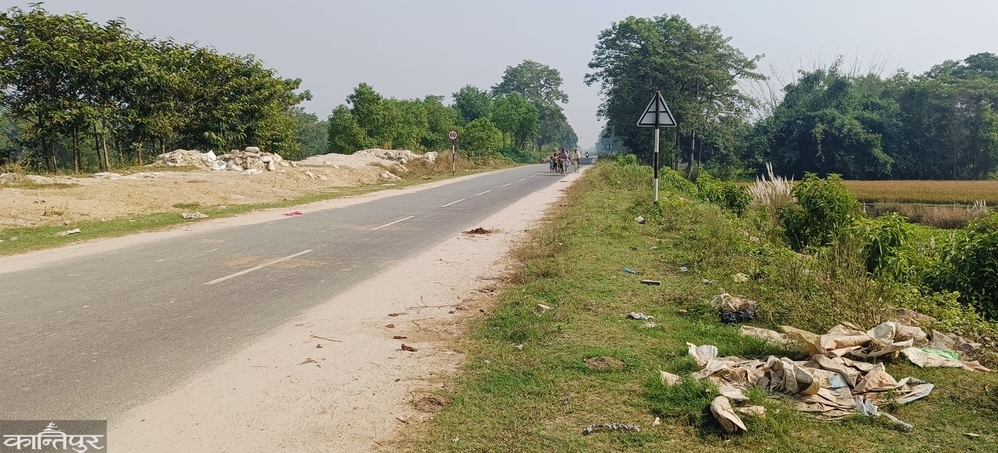
The border road built by India, known by locals as the Military Road, is high and wide. It has been blacktopped. Although this road passing through the border provides ease of movement from one place to another, the locals are terrified of the destruction it brings to Nepal every year. It has been flooded for two consecutive years. If a solution is not found, many people are afraid that there will be a situation of displacement.
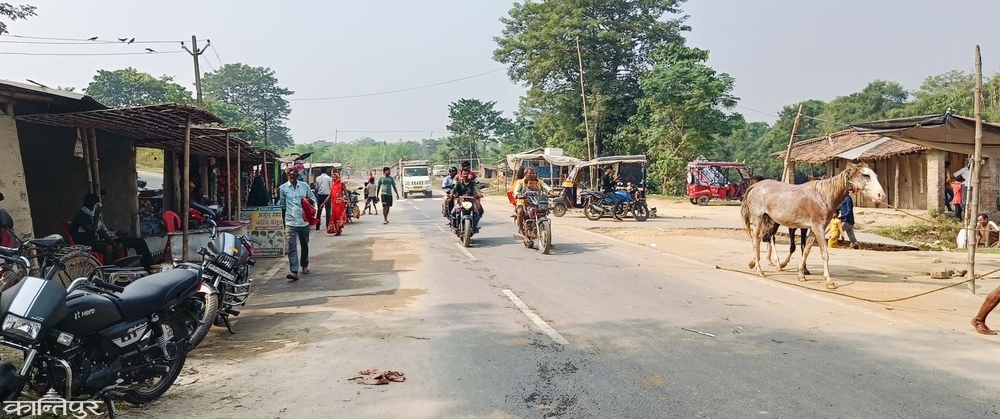
District Coordination Committee Chairman Singh says that an embankment has been built from the Chure area to the Indian border to control the Bagmati River on the Nepal side. However, since there is no embankment for 3 kilometers on Indian land from the Dashgaja area where the embankment on the Nepal side has been completed, Singh said that floods are entering Nepali land through the Indian villages of Rusulpur and Nankar. Local Harihar Mishra said that water has started coming from the Jamala Tol of the Indian village of Rusulpur in the opposite direction.
He mentioned that the problem increased when the flood was stopped by the border road built by India. He suggested that the embankment built to control the Bagmati River on the Nepal side should be connected to the previously built embankment by ten yards and that the Nepal government should urge India for that. He mentioned that Nepal also needs to take serious initiatives with the Indian government regarding the issue of water flow being stopped due to the road built near the other border.
If a neighbor builds a unilateral structure in the border area that affects another neighbor, Nepal can object to it as a unilateral step according to international law. Although the problem of flooding caused by structures built in the border area on the Indian side has been on the agenda of bilateral meetings, no result-oriented discussions have been held on it. Former Nepali Ambassador to India Nilambar Acharya says that despite discussions on the issue of floods and inundation in every meeting between Kathmandu and Delhi, no solution-oriented conclusions have been reached.
‘Bilateral mechanisms at various levels have also been formed.’ There are also discussions at the political level. Our concern is the structures built in the border area and the flooding they cause in Nepal. They emphasize the issue of Nepal releasing water into the river,' he said, 'and mechanisms are also given the responsibility to find a solution. But a solution never comes.'
He says that India's strategic construction of structures near the border is a violation of international law. He says that the Nepal government should work in the interests of the safety of its people and the people and farmers in the flood-affected areas along the border. 'It is not just that the structures built by India caused flooding, what is the Nepal government doing for its people? What efforts has it made? What plans have it made to keep them safe? That is an important aspect,' he said, 'It is a matter of keeping its word with India. Apart from that, the responsibility of keeping its people safe is the responsibility of the Nepal government. Planned work should be done. Or it can be left to chance, saying it is because of India.'


