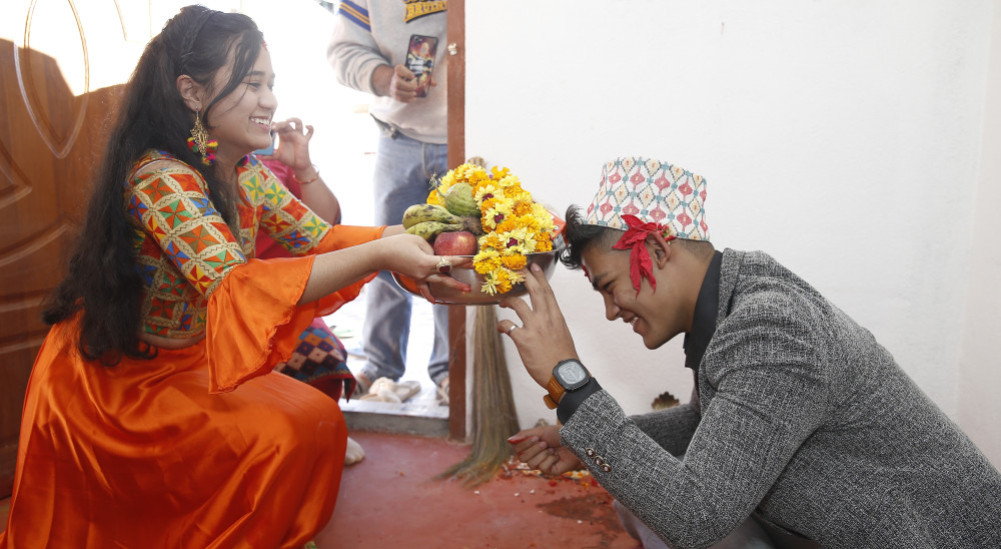
Nepalis living in countries like Japan, Korea, Australia, America, and the UK express their love for home by giving glimpses of Tihar through social media every year.
We use Google Cloud Translation Services. Google requires we provide the following disclaimer relating to use of this service:
This service may contain translations powered by Google. Google disclaims all warranties related to the translations, expressed or implied, including any warranties of accuracy, reliability, and any implied warranties of merchantability, fitness for a particular purpose, and noninfringement.
Tihar is the second biggest festival of Nepalis. A festival of colors, lights, and intimacy. The main attraction of Tihar is Bhaitika, which is especially dedicated to the relationship between brothers and sisters. But for Nepalis living abroad, this festival becomes a day full of memories.
Thousands of Nepalis living abroad are very emotional about their childhood, family and loved ones during Tihar. For them, the joy of Tihar is not that easy.
Nepalis living in countries like Japan, Korea, Australia, America, and Britain are expressing their love for home by giving a glimpse of Tihar every year through social media. The melody of Deusi-Bhailo, the beauty of Sayapatri and velvet garlands, the fun with brothers and that moment of Tika like at home are limited to imagination abroad.
Diksha Shrestha, who is living in Japan, says that she feels lonely when celebrating festivals abroad. She says, ‘Since I came to Japan, I have not had a chance to celebrate Bhai Tika.’ Although most of the Tihar materials are available in Japan, Sayapatri garlands are not easily available. However, she has been carrying out the tradition of offering Tika to her brothers and sisters through video calls every year on Bhai Tika.
She feels even more sad when Tihar comes abroad. ‘I feel sad as soon as Tihar comes, but I remind myself that I will celebrate it with great pomp when I return next year,’ she says. She recalls the moments of having fun playing cards with her brothers and receiving dakshina from them, and says that the lack is felt deeply abroad.
Nepalis living abroad are now celebrating Tihar through video calls and digital platforms. Diksha says, ‘Since the day I came to Japan, I have not been able to give tika in person to my brothers. I have been doing tika through video calls. I like to spend that day at work because when I am busy with work, I don’t remember.’
In Nepal, the tradition of giving tika and dakshina abroad is completed by sending gifts online. Some send money or materials to their relatives, while others are limited to remembering.
Diksha said that the possibility of taking a day off on tika is also low. ‘I spend that day at work so that the memories of the festival don’t make me emotional,’ she added, ‘It seems like when we get close, we don’t understand its importance, we only realize it when we get far away.’
She says that it is difficult to make special time for Nepali festivals because of the busy lifestyle abroad. She said that since there is not a large presence of Nepalis in Japan, there are no group programs like Deusi-Bhailo.
She tries to celebrate Tihar at home by lighting twinkling lights and cooking sweet dishes. ‘I really like lighting, so I try to create that atmosphere by lighting lights on Tihar,’ she said.
Amika Chhetri has been living in the UK for many years. For her, Tihar has now become ‘more of a day of remembrance than a festival.’ ‘I celebrate Tihar abroad, but my heart is always in Nepal,’ she says, ‘I don’t get a day off at work, my brother is in Nepal.’ That's why the enthusiasm of Tihar is not like in Nepal.'
But in that sense, Tihar has not disappeared for her. She makes her own bread, buys garlands, and worships Lakshmi in the evening. She fasts all day and lights a lamp in the evening. This light reminds her of Nepal's hundred-patri and velvet flowers, the garlands she sews in the courtyard, and the Deusi-Bhailo that resonates in the villages. Since her brother is in Nepal, she does not celebrate Bhai Tika. She seeks blessings over video calls.
Munmun Pandey, who lives in Sydney, Australia, also makes her house sparkle during Tihar. Lamps, steps, garlands. She prepares everything herself. 'When I was in Nepal, I used to make steps and light lamps all over the house. Even now, I have not given up that habit,' she says.
She says that as the Nepali community has grown, it has become a tradition to celebrate festivals together abroad. She has been living in Sydney since 2006. Since her brother lives in Australia, they celebrate Bhai Tika together. ‘We order tika and garlands from Nepal. All the materials are available here too. When I apply tika to my brother, I feel like I am in the atmosphere of Nepal,’ she says.
For Munmun, Tihar is not just a tradition, it is a mixture of emotions. ‘Seven-color tika, garlands, blessings and a sense of unity. In that one moment, all the love comes together,’ but she feels an incompleteness, ‘My sister is in Nepal. It would have been more fun if she were also with me.’ There are no Deusi-Bhailo, Sayapatri and Velvet flowers, and the twinkling of houses like in Nepal. But for Nepalis living abroad, Tihar is not just a festival, but a renaissance of belonging and memories.
When Tihar comes abroad, everyone is happy, but sadness also comes with it. Because everyone from home is far away. They don't get holidays from work. That's why they say that the fun atmosphere like in Nepal is not found here.
When Tihar comes in Nepal, there is a festive atmosphere throughout the country. Houses and courtyards are decorated, the streets sparkle with twinkling lights, but for Nepalis living abroad, that time is a little different.
Deepa Karki came to Australia from Nepal two years ago. For the past two years, she has had the opportunity to apply Bhai Tika to her brother. She says, 'I have celebrated Bhai Tika twice since coming to Australia. The first year, I went to my brother's house and applied tika.' But this time, it is difficult to arrange due to time and work, so we have agreed to go and come back every year.' Although her brother is also in Australia, he lives in a different state, so the flight will take about two hours.
Deepa, who misses her brother a lot when she is in Nepal, says that she feels 'blessed' now. Because even though she is abroad, she has the opportunity to meet her brother and get tika.