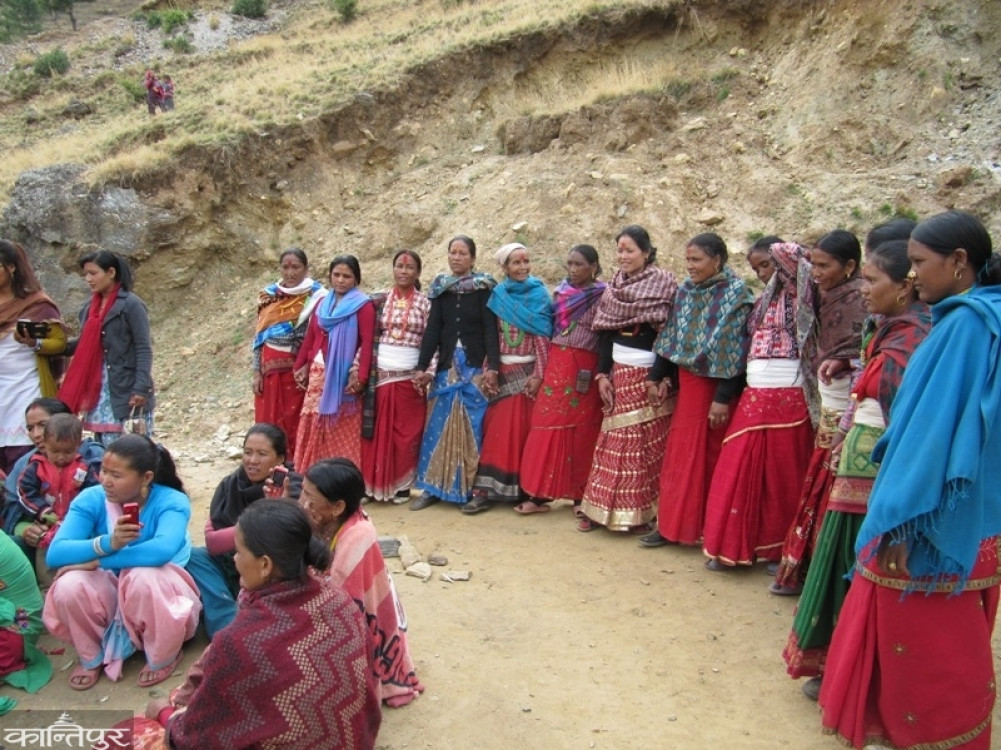
The tradition of Puse Bhaili is still practiced in villages in the mountainous districts of Jumla, Kalikot, Mugu, and Lower Humla in Karnali.
We use Google Cloud Translation Services. Google requires we provide the following disclaimer relating to use of this service:
This service may contain translations powered by Google. Google disclaims all warranties related to the translations, expressed or implied, including any warranties of accuracy, reliability, and any implied warranties of merchantability, fitness for a particular purpose, and noninfringement.
Sushila Rawal of Soru Rural Municipality-3 in Mugu is currently in a hurry to bring in Marsidhan. “We are busy storing the crops throughout the village,” she said. “After bringing in the rice and planting the barley, we celebrate Bhaili only around the middle of the month.”
According to her, in settlements such as Mundu, Kotila, Bhi, Jhyari, Narthapu, Bam, and others, the tradition of Puse Bhaili is more prevalent than Tihar. She says that in the month of Pus, from Purnima to Aunsi, people go from house to house to play Bhaili and collect rice, money, oil, salt, and pulses, and go to a forest feast.
Her neighbor Naurata Budha is also busy preparing for Puse Bhaili after finishing her farm work. ‘Puse is the best time to celebrate Tihar in the Himalayas,’ she said. ‘During the winter season, we have fun by singing and dancing with our neighbors and relatives, which also helps to beat the cold.’
The tradition of Puse Bhaili is still prevalent in the villages of Jumla, Kalikot, Mugu, and Lower Humla, the mountainous districts of Karnali. ‘Locals, government employees and army and police who have returned from India to the headquarters have brought the atmosphere of Tihar, but no one plays Bhaili on Tihar in the villages,’ said Dharma Bahadur Shahi, chairman of Soru Rural Municipality. ‘The tradition of Bhai Tika is common during Tihar, while Deusi is played during Puse Bhaili.’ According to him, baja is not used during Puse Bhaili. While playing this Bhaili, women wear a cotton dhoti as a dhoti and carry it on their backs. Men have a tradition of wearing a daurasuruwal on their sides and spinning takhu in their hands.’
According to Ramananda Acharya, a cultural expert from Jumla, Tihar had no importance until the district of Kalikot and others were separated from Jumla in 2032 BS. ‘Until then, the tradition of wearing a tika made of curd and rice was observed on Bhai Tika,’ he said. ‘The practice of wearing a tika made of seven colours has only started in the last 10-12 years.’ He said that now, Deusi Bhailo has started playing in the district headquarters and various sweet dishes including roti have started to be prepared.’
Most of the festivals and fairs in the mountainous districts of Karnali are centered on Purnima. There are monasteries (mashts) of deities in most settlements. To please these mashts, fairs and festivals are held on every Purnima. ‘Masht Puja is a bigger festival for us than Dashain-Tihar,’ said Purna Bahadur Shahi, leader of Pachaljharana Rural Municipality in Kalikot. ‘Some fair and festival are held on all 12 Purnimas throughout the year, one of which is Bhailo on Puse Purnima.’
Now, residents of Jumla, Mugu and Humla who have migrated to cities including Kathmandu, Nepalgunj, Surkhet and others play Puse Bhaili. Local expert Rajusharan Neupane said that the custom of playing Puse (large) Bhaili has been going on in Jumla since the time of the Kalyal kingdom. ‘After the Jumlis living in Kathmandu started playing Puse Bhaili towards Kathmandu, Puse Bhaili has started spreading across the country,’ he said, ‘The Bhaili played during Tihar is not the history of Karnali, but the culture of Karnali.’ According to him, Bhaili is played from the full moon of Pus to Aunsi. After the grain harvest in Karnali is full, Puse (large) Bhaili is played as a fun way to relieve fatigue.
He informed that due to heavy snowfall in the villages, the locals also play Puse Bhaili as a fun melo to beat the cold.
In Dolpa, the locals also celebrate Chora Tihar. On the day of Pus Shukla Dwitiya, it is customary for sons to apply tika from their mothers. ‘Just as brothers and sisters apply tika on Bhai Tika, on Chora Tihar, it is customary for mothers to give their sons Akshata on their foreheads, garlands around their necks, and homemade dishes like Selroti, Finiroti, and Chiniroti as sagun,’ said Ramananda Upadhyay, leader of Tripurasundari Municipality-1. ‘Along with the tika, blessings are given to the sons, wishing them long life and progress.’ He said that it is customary for sons to give their mothers cash and various clothes as gifts. He said that it is customary for the youth to gather and play Bhailo after applying tika from their mothers.