The use of electric traps has begun to control pests that regularly eat tea leaves, especially butterflies and other insects of that class.
We use Google Cloud Translation Services. Google requires we provide the following disclaimer relating to use of this service:
This service may contain translations powered by Google. Google disclaims all warranties related to the translations, expressed or implied, including any warranties of accuracy, reliability, and any implied warranties of merchantability, fitness for a particular purpose, and noninfringement.
Pest infestations are increasing in tea gardens. Most gardens are using chemical pesticides to control pests. Some gardens have used new methods to kill pests instead of pesticides.
Mechinagar's Kalika Tea Estate, Haldiwari Tea Estate and other tea gardens have used 'electric traps' to kill tea-eating insects. Kalika Tea Estate has installed such traps at about 150 locations throughout the garden.
After dusk, traps are set overnight, targeting insects that come to eat tea. Water is kept in a vessel, in which a small amount of pesticide is mixed. Two electric torches are lit over the water. The torches, which are connected directly to a nearby electric pole, remain lit overnight. Insects that fly towards the water are attracted to the light and drown in the pesticide-mixed water.
According to Shilakanta Chaudhary, manager of Kalika Tea Estate, this method, which was started as a trial, has been found to be very effective. He says, ‘With the reduction in pest infestation, there has also been a reduction in diseases, which has improved tea production.’
The use of electric traps has started to control pests that always eat tea leaves, especially butterflies and other insects of that class. According to Santosh Pahan, a worker working in Kalika, earlier the pests were very active at night. Now, lights are turned on throughout the garden all night, the insects get caught in the light and die in the traps.
According to him, the garden watchmen destroy the insects that have been submerged in pesticide-mixed water all night in the morning. And then they prepare the traps again for the next night. Gopal Giri, a tea farmer from Haldibari, says, ‘After we started controlling pests by turning on lights all night, the incidence of diseases in plants has reduced.’
The problem of diseases like looper caused by insects has increased in tea production areas including Jhapa. Such diseases adversely affect tea production. Farmers have now started adopting alternative technologies instead of traditional pesticides.
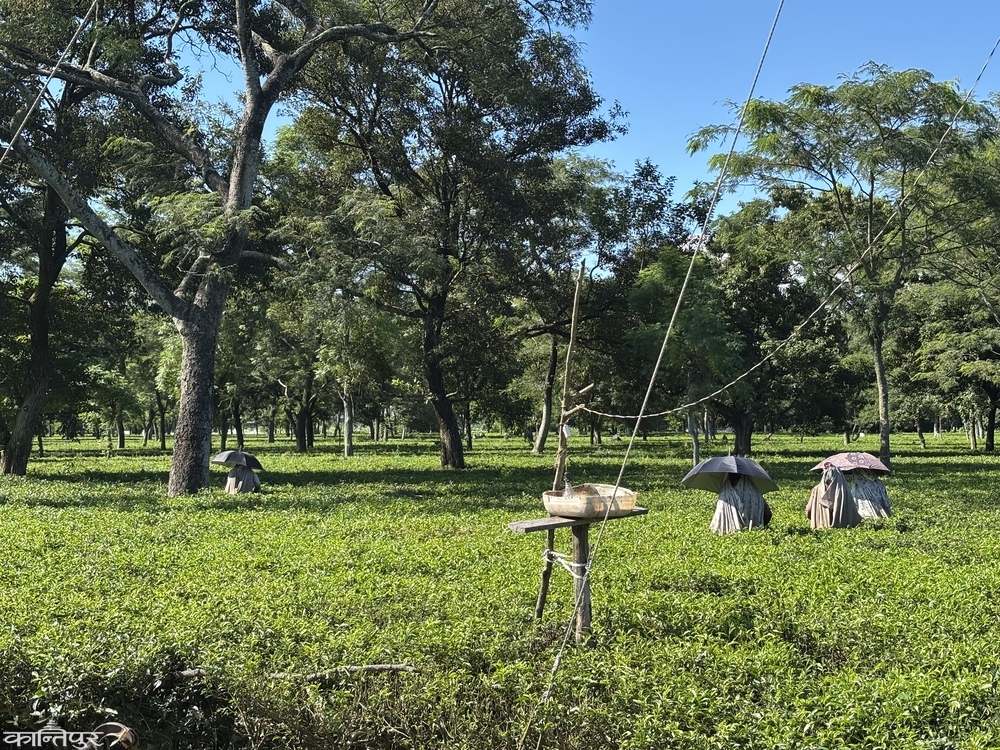
According to Indra Adhikari, head of the National Tea and Coffee Development Board, Jhapa, the problem of pests in tea gardens is increasing day by day. With the increase in the use of pesticides to kill pests, problems have been seen in the environment and production. Due to which farmers have started looking for new and alternative methods.
‘This initiative of farmers towards an environmentally friendly and sustainable solution instead of pesticides in tea farming is welcome,’ said Adhikari. ‘If this technology could be adopted everywhere, the use of pesticides in tea would have decreased and the quality would have also increased.’
The insect called ‘tea mosquito’ is active in both dry and wet weather. It attacks the new shoots of tea. Which gradually increases the disease in tea. According to experts, symptoms such as drying and cracking of the tea leaves appear after the transplant. There may be a huge drop in production.
Another pest that infects tea is the red spider. It leaves wrinkled and brown spots like blood on the upper surface of the leaves. The leaves become thin. This hinders the photosynthesis of tea. Its outbreak is fatal in hot and dry weather.
The looper caterpillar is another pest that causes great damage to tea. It has been seen as a plague in Jhapa for the last decade. It eats young tea leaves. It gradually strips the leaves bare. A team from the Pesticide Inspection Laboratory, Sunsari Jhumpa, recently monitored the tea gardens of Jhapa and found that the use of pesticides was excessive and suggested reducing it.
‘The looper has become more aggressive as farmers use pesticides indiscriminately,’ said the chief official of the Tea and Coffee Development Board, ‘It seems likely to cause even more damage in the future.’

