Constituent commissions to confirm justification in 10 years: Most of the commissions are dominated by Bahun and Chhetri, very few appointed from Madheshi, tribal, Dalit and other marginalized communities. Among those who get opportunities from the tribal and Madhesi communities are those who have been in positions of profit for a long time and are close to the ruling political party. Independent experts have not got a chance except those who have offended the ruling political party.
We use Google Cloud Translation Services. Google requires we provide the following disclaimer relating to use of this service:
This service may contain translations powered by Google. Google disclaims all warranties related to the translations, expressed or implied, including any warranties of accuracy, reliability, and any implied warranties of merchantability, fitness for a particular purpose, and noninfringement.
On December 5, 2077, Prime Minister KP Sharma Oli issued an ordinance related to the Constitutional Council a few days before the dissolution of the House of Representatives. In which he made a provision that he could hold a council meeting as per his convenience. Accordingly, the then Chief Justice Cholendrashamsher Jabara and National Assembly Speaker Ganesh Prasad Timilsina recommended appointment to several constitutional commissions.
Because the House of Representatives was dissolved, they were appointed without a parliamentary hearing. At the same time, he also recruited people he liked in the National Human Rights Commission. This style of appointment has raised questions nationally and internationally over the 26-year history of the Human Rights Commission. Whereas, before this, the independence and autonomy of the commission had never been expressed by the national and international community.
The United Nations Human Rights Office wrote a letter to the government questioning the political participation in the commission. Various other international human rights bodies have also questioned the Commission's autonomy. The Human Rights Commission of Nepal was in the 'A' category and it was recommended to downgrade to 'B'.
The Geneva-based International Network of National Human Rights Organizations (GANRI) recommended that Nepal be downgraded from 'A' category to 'B' category. After the government's many diplomatic initiatives and the commission's commitment to work in accordance with the Paris Principles, and the government's passage of the commission's law in parliament, it remained in the 'A' category in November 2080.
As a result of the controversial appointments made during the Oli government, the Commission was never presented strongly against the government. The last time on 23 August, the government used brutal force on the youths who were involved in the movement of Gen-Ji. Shot in the head and chest. But the Human Rights Commission limited itself to general monitoring. Not once did he criticize the government's use of force.
On 6 Baisakh 2076, Dinesh Kumar Thapalia, secretary of the Ministry of Federal Affairs and General Administration, was recommended to be the chief commissioner of the Election Commission without retiring. He also got the appointment. Due to the appointment made during Oli's time, he also remained generous towards Oli.
Oli created a favorable situation for himself by getting Thapalia's support in the then CPN dispute. The commission had benefited Oli by holding the decision on authority in the CPN dispute for a long time. Due to this, Oli's position as president remained intact despite the controversy, minority and action. Oli made many decisions in favor of him under the guise of Thapalia.
The Human Rights Commission and the Election Commission are two examples, which show how the constitutional commissions, which are supposed to play the role of 'watchdog' given by the constitution, are becoming weak due to the fact that they have been created as party recruitment centers.
There are 13 constitutional commissions in the constitution. Seven of these are rights-based. The remaining 6 commissions are of permanent nature. Like – Women, Dalits, Tribals, Muslims, Madhesi, Tharu and Inclusion Commissions are commissions focused on rights. Human Rights, Abuse of Authority Investigation, Elections, Public Service, Language Commissions are permanent nature commissions.
It is stated in the constitution that the seven commissions are to be reviewed every 10 years to see what they have achieved and what they were meant to do for the community. For proportional inclusion and mainstreaming of marginal classes, the constitution has provided for such commissions in part 27 of the constitution. But most of those commissions have become recruiting grounds for political leaders. In some cases, appointments are not made on time, while in others, questions are always raised about those who have been appointed.
For 10 years, experts say that the specific justification of those commissions has not been confirmed and on the contrary, they have become a place to consume political leaders. Provision has also been made for the appointment of qualified persons from the Constitutional Council in the said commission. But by issuing an ordinance related to the Constitutional Council, Prem Rai was appointed to the Dalit Bhagbanda.
At the time of appointment, Rai fell under the quota of UML while another commissioner Jai Bahadur Chand fell under the quota of Nepali Congress. Cholendra Shamsher Jabara, who attended the Constitutional Council meeting as the Chief Justice, chose Kishore Silwal. The rest of the members were also divided in the same way.
Rai, who was appointed in this way, was questioned by the special court in the widebody case. He raised the question that he had done 'selective' research in the case of those who have got the right to investigate. Even before this, most of the appointments to the authority were controversial. The controversial appointment of Lokmansingh Karki, Rajnarayan Pathak, Deep Basnet has not been resolved even after the constitution of 2072.
Not only the authority, but also the appointment of the Chairman of the Muslim Commission from the Inclusion Commission was in dispute. When appointing, instead of looking for qualified people, workers and people who are suitable for them are selected. There was a lot of discussion when Ramakrishna Timalsina, the former registrar of the Supreme Court, was appointed as the chairman of the Inclusion Commission in June 2078 under the guise of an ordinance.
The situation was created that Samim Mian Ansari, a controversial character, was appointed as the chairman of the Muslim Commission without a decision by the parliamentary hearing. He managed to get the appointment even though he was controversial because of the then Prime Minister Chairman KP Sharma Oli.
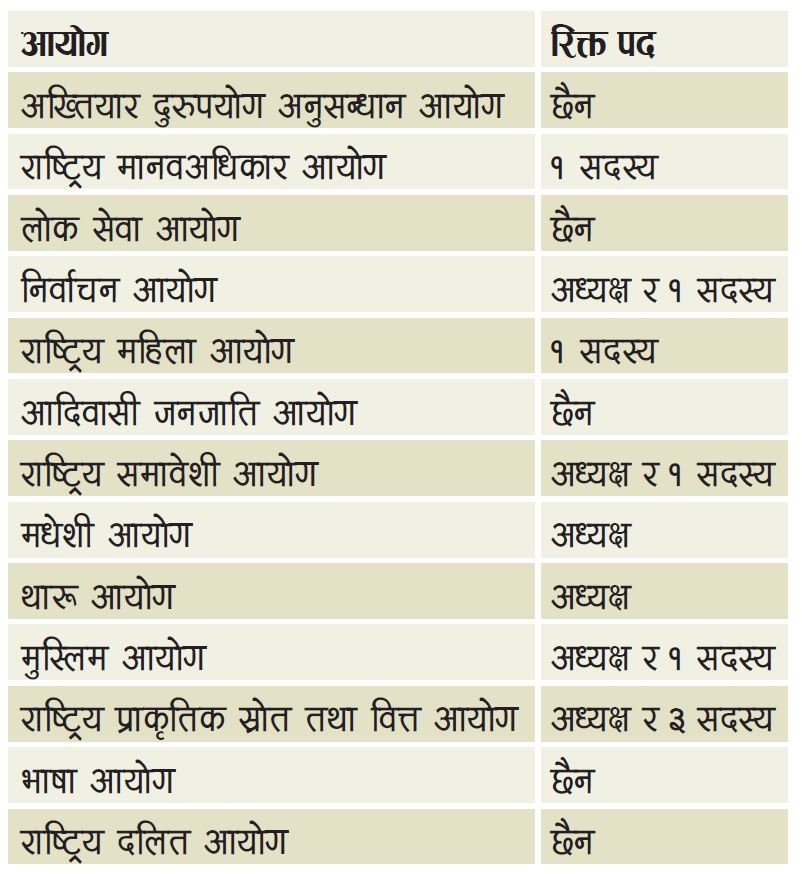
On the other hand, the Dalit Commission did not get an official for three and a half years. The Dalit community was deprived of services as the Commission was without an officer for a long time. It was only on 13 February 2081 that the appointment of officials in the Dalit Commission was recommended. The National Natural Resources and Finance Commission, which has a role in allocating resources and budgets and revenues from the local level to the federal and state levels, is running under the guidance of two members. Chairman Balanand Paudel has not been recommended after his retirement.
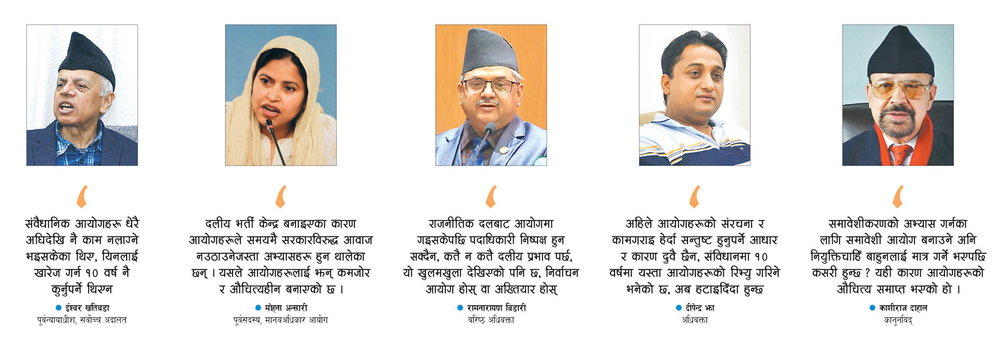
In this way, instead of creating an environment for the creation of good working conditions, the commissions, entrusted with intensive responsibilities by the constitution, have "settled" the workers, so now the justification of the commissions has been raised. Senior advocate Ram Narayan Bidari says that he was forced to conclude that such commissions are not necessary.
former chairman of National Inclusion Commission Dr. Ramakrishna Timalsina claims that the constitutional commissions are discredited because the government's view of them is negative. Bidari says that commissions are problematic when political parties appoint only those who they say are officials. "After going from a political party to the commission, officials cannot be impartial," Bidari said, "somewhere there is party influence." It has also been openly seen. Be it election commission or authority.'
Legalist Kashiraj Dahal also likes to say that commissions have become recruiting centers for relatives of the political leadership. This is the reason why he believes that these commissions have expired in these 10 years. "How will it happen when an inclusion commission is formed to practice inclusion in the country and the appointment will be made only to Bahun?" And what will be achieved by taking the people who were responsible in the past to such commissions?'
Advocate Dipendra Jha is also not completely satisfied with the functioning of the commissions. Looking at the structure and functioning of the commissions now, there is no basis or reason to be satisfied. In the constitution, it is said that such commissions will be reviewed in 10 years. Now it will be removed," Jha said, "as the Inclusion Commission has said. However, seeing that, the Khas-Arya Commission was formed. In this way, there is no need to create a commission by focusing only on one category.'' He is not in favor of keeping these commissions. The representatives of the commission themselves accept that the constitutional commissions established with the aim of mainstreaming the marginalized communities through inclusive participation in every state body are not working as intended.
They say that those commissions have become ineffective due to non-cooperation of the government and political partisanship. The complaints of the commissions have increased because the government has not even implemented the report recommended by the commission. The heads of the commissions have been complaining and drawing attention to the fact that the government has practically not given statutory recognition to the constitutional commissions. However, the government never paid attention to making the constitutional commission effective.
Violation of inclusiveness
The constitution envisages the country as an inclusive state. A certain percentage of reservation has been arranged for some communities. It has been said that every appointment in the constitutional bodies and commissions should be made on the basis of inclusive principles.
But such appointments are not inclusive. The best example of this is the appointment to the Inclusion Commission. The constitution has provided this commission with more than 20 functions, duties and powers. The main task of this commission was to suggest the government to practically implement the inclusion policy embraced by the constitution.
The commission, which had the mandate to make the overall structure of the country inclusive, should have been fully inclusive. In the commission, a chairman and one of the four members was appointed as a female member and all five members, including the chairman, were from the Khas-Arya group. No appointment was received from tribal, Madhesi, Dalit communities in the commission. Currently, the commission is without a chairman and there are only three members. The same is the case with appointments in other commissions with a
inclusive approach. Most of the commissions are dominated by Bahun and Chhetri, with a very small number of appointees from Madheshi, tribal, Dalit and other marginalized communities. Among the opportunists from the tribal and Madhesi communities are those who have held positions of profit for a long time and are close to the ruling political party. Independent experts have not got a chance, except those who have offended the ruling political party.
Premkumar Rai, chief commissioner of the Abuse of Authority Investigation Commission, belongs to the tribal community. But he is a long-time civil servant. Sumitra Shrestha is a member of the Commission. The other three members are Kishore Kumar Silwal, Jai Bahadur Chand and Hari Paudel.
It is natural for women to be appointed to the Women's Commission. In the commission, Vidyakumari Sinha is one of the Madhesi community, while all others belong to the Khas Arya group. President Kamala Parajuli and three members are Krishna Kumari Poudel Khatiwada and Savitri Kumari Sharma. There is no presence of women from marginalized communities including tribals and Dalits in the commission.
The Election Commission is without a chairman. Apart from the Chairman, there are four members, three men and one woman. The female member, Janakikumari Tuladhar, is from the Newar community. Among the other two members, Ramprasad Bhandari and Sagunshamsher Jabara both belong to upper castes.
The National Human Rights Commission led by Top Bahadur Magar has a team including Madhesi and women. Lily Thapa is female and Mohir Thakur is Madhesi.
Mohana Ansari, a former member of the National Human Rights Commission, sees the commissions as becoming party recruitment centers rather than making them independent and capable, rather than justifying them. She said that experts should study it and decide whether to keep it or not. She said that the impact of Tharu, Muslim, Madhesi, Dalit commissions on the community should be studied. He is of the opinion that people from marginalized communities should pay attention to the appointment while forming the
commission. He insists that commissions should not be made into 'vacation clubs'.
'Due to non-implementation of the instructions of the commissions and the establishment of party recruitment centers, practices such as commissions not raising voice against the government in time have started. These practices have made the commissions more weak and unreasonable," Ansari said. "Constitutional commissions are the bodies that stand up for the people and speak out when their rights are violated. It is not a body that protects the government. But now the commissions have become mute spectators and bodies that do not speak to the government or wait for instructions.
Former judge of the Supreme Court, Ishwar Khatiwada, says that the necessity and justification of constitutional commissions have ended long ago. He believes that the review of the constitution itself has been delayed. "Constitutional commissions were no longer functional long ago," he said, "there was no need to wait 10 years to abolish them." What achievements did the commission that was placed in the constitution in this period? After evaluating it, if it is not necessary, it should be discarded immediately," he said. "If it is necessary, it should be allowed to work independently. If not, why spend the resources of the state to raise it?'

