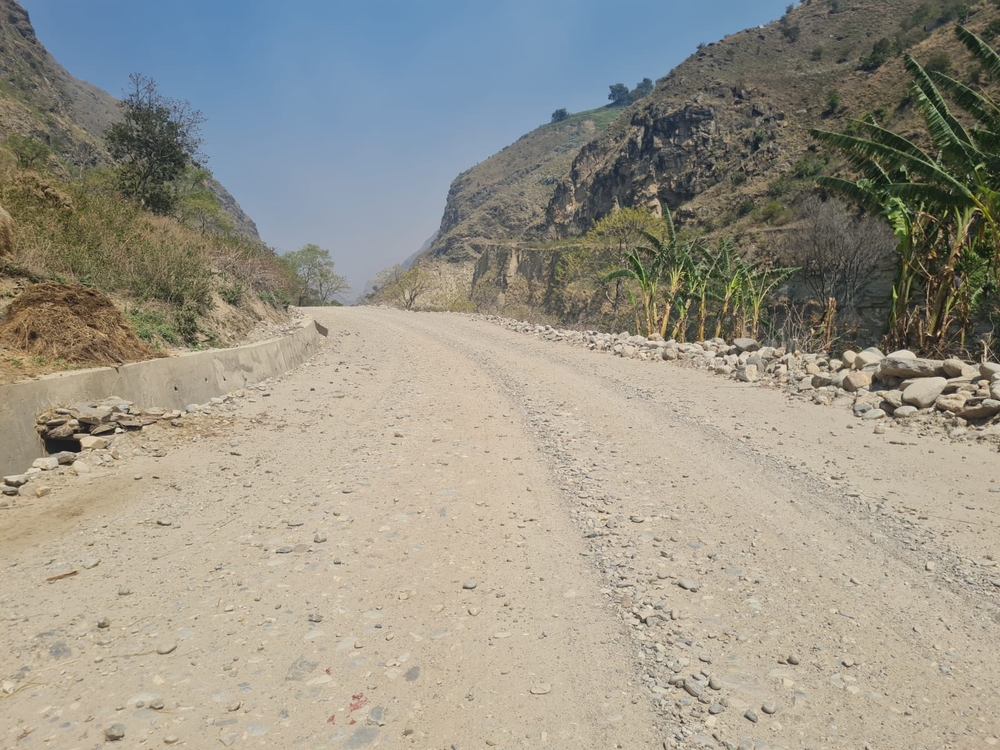
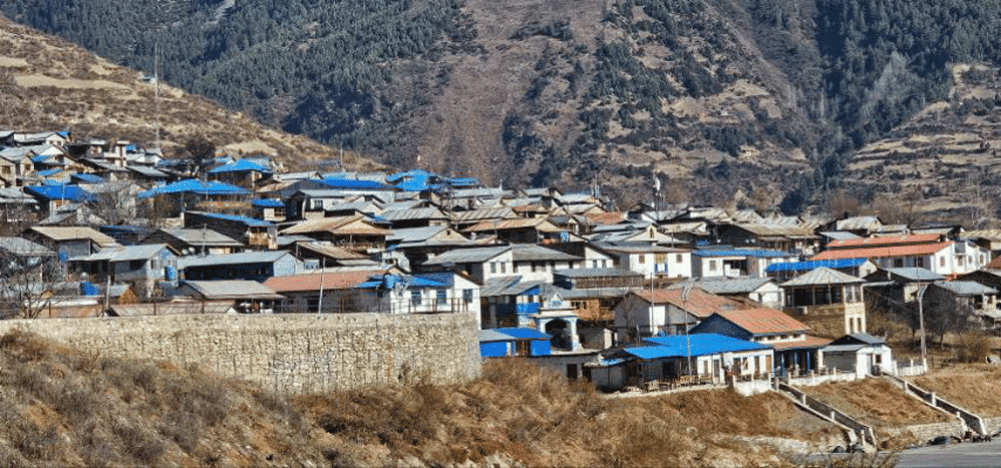
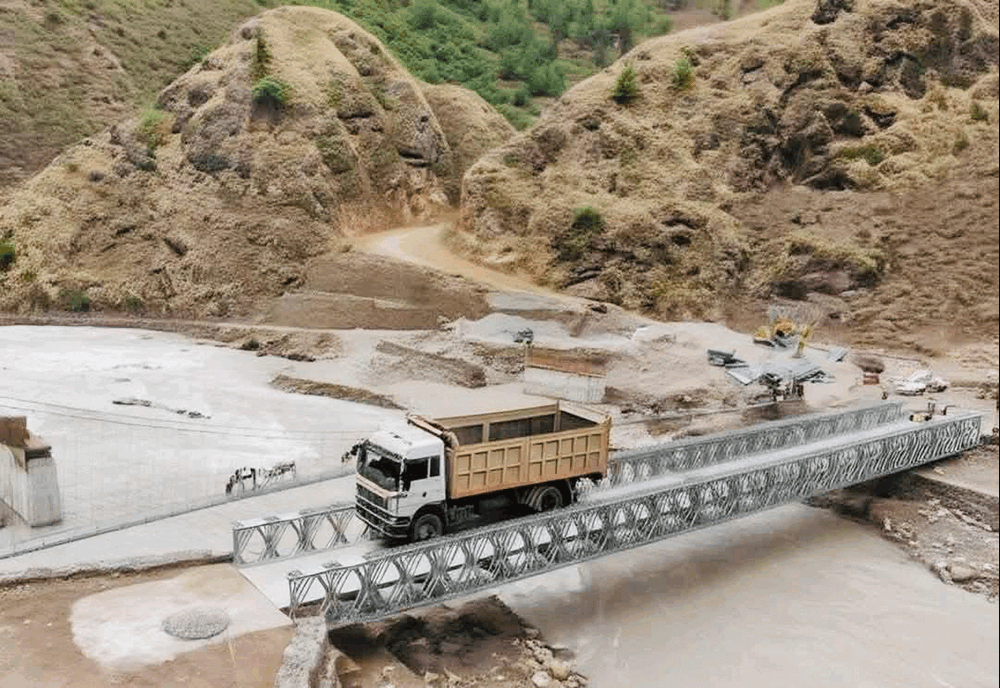
Humla has been connected to the national road network after the construction of a belay bridge on the Karnali River at Chuwakhola in Kharpunath Rural Municipality-5 on June 22. Traders say that with the arrival of the vehicle, the price of consumer goods has halved due to cheap transportation.
We use Google Cloud Translation Services. Google requires we provide the following disclaimer relating to use of this service:
This service may contain translations powered by Google. Google disclaims all warranties related to the translations, expressed or implied, including any warranties of accuracy, reliability, and any implied warranties of merchantability, fitness for a particular purpose, and noninfringement.
Until a year ago, Padam Bahadur Rokaya of Simkot rural municipality-7 in Humla had to stand in line all day at the Food Supply and Trading Company Limited for 5 kg of rice. "We can't buy expensive rice in the market, we have to stand in line all day for food and sometimes we have to return empty-handed," he said.
According to him, due to the lack of road facilities, before this, he had to pay 125 rupees per kg for transportation of food grains.
Raghuveer Budha of Simkot-7 bought rice for 250 rupees per kg on Dasain two years ago. Currently, a 30 kg bag of milled rice is available at Rs 2,500 in the headquarters Simkot. "Nowadays, cars deliver food at home, cooking has become cheaper with the arrival of roads," he said, "Poverty is also decreasing after the decrease in prices." He informed that the price of coarse rice is selling at 70 to 80 rupees per kg in the market. According to him, the price of coarse rice was between Rs 120 to Rs 150 per kg till noon.
Humla has been connected to the national road network after the construction of a belay bridge on the Karnali River at Chuwakhola, Kharpunath Rural Municipality-5 under the Karnali Corridor on June 22. Traders say that with the arrival of the road, the price of consumer goods has halved due to cheap transportation.
According to Sundar Lama, a businessman from Simkot, now the price of food grains has decreased by at least 80 to 100 rupees per kg. "Where is the shipping fee of 125 rupees per kg for the ship, where is the transportation fee of 20 to 25 rupees per kg for the vehicle?" He said, "Now all the goods found in Nepalgunj and Surkhet are available here, and that too with the addition of 20/30 rupees for the freight and profit."
According to Sundar, the price of food was very expensive because it could not be transported on the ship when it was told. He informed that now flour is available at 90 rupees per kg, sugar at 130 rupees and chiura at 100 rupees. Until a year ago, the prices of all these food grains were above Rs 200 per kg. According to him, the prices of daily consumables including rice, pulses, oil, sugar, LP gas have decreased by at least 40 percent after the transportation was started. According to him, now goods are being transported by vehicle for Rs 30 to Rs 45 per kg.
According to another businessman, Jhalak Budha, the price of cooking oil has also decreased by 60 to 80 rupees. Edible oil, which used to cost Rs 230 per half liter, is now available at Rs 160. He informed that until a year ago, a new gas cylinder was available for Rs 7,000, but now it is Rs 4,500 and a filled cylinder is available for Rs 5,000, but it has dropped to Rs 2,700. "After gas became cheaper, most people have started to stop using firewood in the kitchen," he said, "with the construction of roads, smokeless kitchens are also increasing."
According to Budha, after reaching the road, the villages of Humla have started turning into small markets. After other municipalities are connected with the headquarter through the road network, horse and cart business people have started buying tractors, buses, minitrucks and farmers have started investing in hotels, transport business, shops etc. "The road has removed the cost, brought convenience," he said.
At present, there are about 7,000 quintals of food grains in the warehouses and depots of the food management and trading company. Krishna Bahadur Pun Magar, head of Humla branch of the company, said that the sale of food rice is decreasing. "Now rice has become cheaper in the market, everyone has started eating rice from the market," he said, "the food godown that used to be busy all day until noon became deserted." According to him, until last year at this time, 500 to 800 people used to take rice from food every day. In the last fiscal year 2082/83, about 14,000 quintals of food grains worth 13 million rupees were sold from the office.
Being a very cold place, the grain produced by the residents of Humla is barely enough to eat for 3 months. Therefore, the residents of Humla consume food from outside. Herbs, animal husbandry and fruit business are the basis of livelihood of the local residents. Humla has a good yield of herbs like Katuki, Chiraito, Volte, Panchaule.
Local residents save their expenses by going to the nearby community forest to collect herbs. Herbalist Guru Lama said that locally produced herbs are sold at 200 to 1000 rupees per kg. According to him, the transportation of herbs by road has also become easier.
'Now we transport herbs to Surkhet and Nepalgunj for 20 to 50 rupees per kilogram,' he said, 'Earlier we had to send herbs by ship for 150 rupees per kilogram, when the ship refused to carry them, half of the herbs would rot here.' After the arrival of the
vehicle, the organic products such as beans, apples, marci, potatoes, lice and rice, which are being produced in Humla, have started to find market easily, said Vijay Bhandari, Chairman of Simkot Rural Municipality. "Now the produce of Humla, including apples, is going to the city in trucks carrying food and consumables," he said. According to Hem Rawat, a farmer of Simkot, beans are going out at Rs 150 per kg, potatoes at Rs 50 to Rs 70, lice at Rs 150, and sugarcane at Rs 160. "This year Humli apple has gone out commercially for the first time," he said.
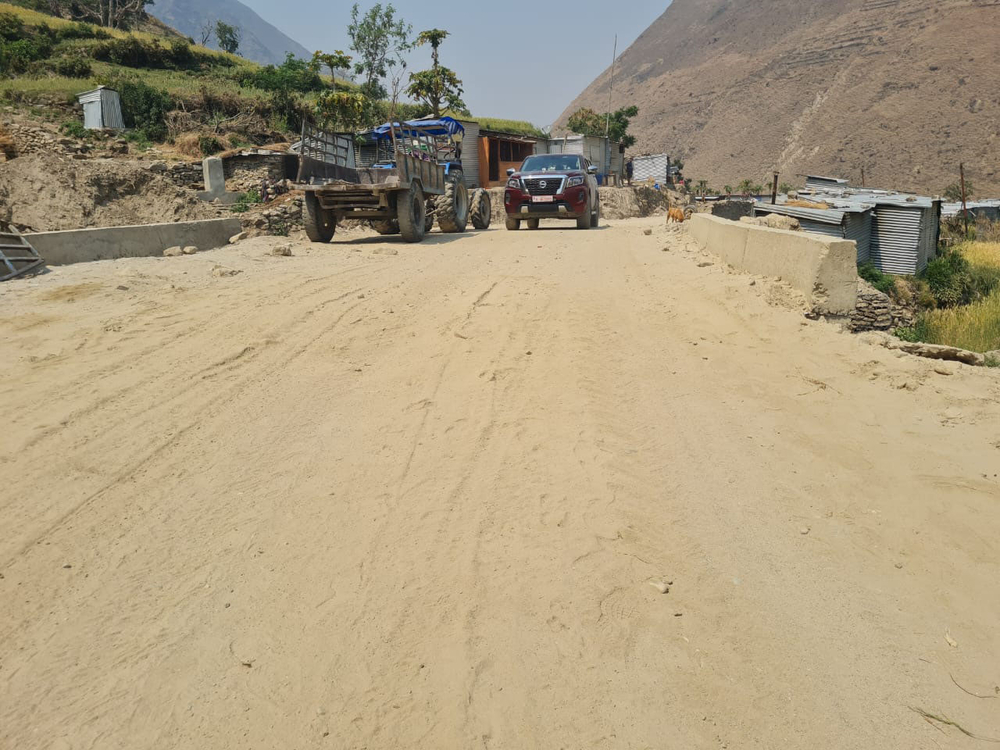
After reaching the road, construction materials are also easily available in Humla, said Ram Bahadur Bhandari, president of the Chamber of Commerce and Industry. According to him, a bag of cement used to cost 8 and a half thousand rupees, but now it has come down to 2 thousand rupees. Similarly, kilakata which cost 350 rupees 170 per kg, Gabin net worth 300 rupees has dropped to 140 rupees. He informed that iron rods costing 280 per kg fell to 122 and zinc sheets costing 22,000 per bundle fell to 13,500 rupees.
According to him, with the decrease in the price of construction materials, the locals have started building concrete houses in the capital city and nearby business centers. He said that diesel is being sold at Rs 400 per liter now at Rs 165 per liter and petrol at Rs 500 per liter at Rs 250 per liter. "After the cheapening of construction materials, the way to build large infrastructures has opened up, development has started to be felt in the district within 1/2 months," he said, "locals are getting jobs in the villages due to the development and construction, and economic transactions have increased due to the increase in business." Last year, Humla was connected to the national road network after the Nepali Army opened a 286 km road track from Khulalu in Kalikot. This road, which was started in 2057, connects Kalikot, Bajura and Humla.