There are 24,000 cases in the Supreme Court, for which about 150 cases have to be disposed of every day, but the current human resources of the Supreme Court can only dispose of an average of 70 cases, more than half of the cases are pending.
We use Google Cloud Translation Services. Google requires we provide the following disclaimer relating to use of this service:
This service may contain translations powered by Google. Google disclaims all warranties related to the translations, expressed or implied, including any warranties of accuracy, reliability, and any implied warranties of merchantability, fitness for a particular purpose, and noninfringement.
75-year-old Hariram Ahir was found in the courtyard of the Supreme Court at 4 pm on Sunday. He from Tilottama municipality-14 Tikligarh in Rupandehi has been going to court for 17 years to save his 6 katta land and house.
In 2046, the government distributed land to the squatters through the Forest Clearance Commission. In 2065, the Malpot Office filed a case against 5 families, including Ahir, who got the land at that time, saying that they had signed the government seal. The district court ruled that Van Maser was living on the said land and had taken government papers. We are simple people, we don't know why this happened,'' said Ahir, 'the court said that the correct sakkali and red parts of the head of the shipping office were found to be fake.'
High Court Butwal also came to the Supreme Court after ruling against them. "We have filed an appeal, we have taken the date for the fourth time till today," he said, "Now the date has been set again after two months. It may take four to five years for the verdict.'' Ahir said that his neighbors Harishankar Kasiyar, Shriram Kasiyar and Umashankar Kasiyar have died fighting the same case. Ahir's son Vijay said that a complaint was registered against them after documents were burnt in a fire at the commission's office.
000
Rajendra Mahato Koiri from Dhanusha was also found in the Supreme Court on Sunday. He is fighting four cases against Raghuveer Mahaseth since 17 December 2075. His case is forgery and forgery. Koiri claims that zamindar Mahaseth has usurped his land. "The landlord got all the land in his name by bowing down to us." We became squatters. It has been 20 years since the district, higher and the Supreme Court started running," he said. On Sunday, his case was in the bench of judges Saranga Subedi and Shantisingh Thapa.
'There was a debate today. The husband ordered to get all the files,'' he said happily, 'after seven years in the Supreme Court, there is hope of getting justice.' Five years old cases are heard on priority basis in the Abhiyan area.
Ahir and Koiri are the only two representative characters found in the Supreme Court, who have been waiting for their cases to be resolved for years. There are currently 24,000 cases and writs pending in the Supreme Court. But on an average only 60-80 cases are heard every day. Out of that, most of the Supreme Court's time is spent in the hearing of writs, PILs (Public Concerns), so it is difficult for the people's cases to get their turn. Last Sunday, 414 PCs were fixed in the Supreme Court. Out of them, 72 cases i.e. 5.75 percent were heard and 342 cases were moved due to various reasons. Out of those that were heard, 10 were cases and 62 were writs. It is clear that the Supreme Court spends more time in hearing writ petitions than people's cases.
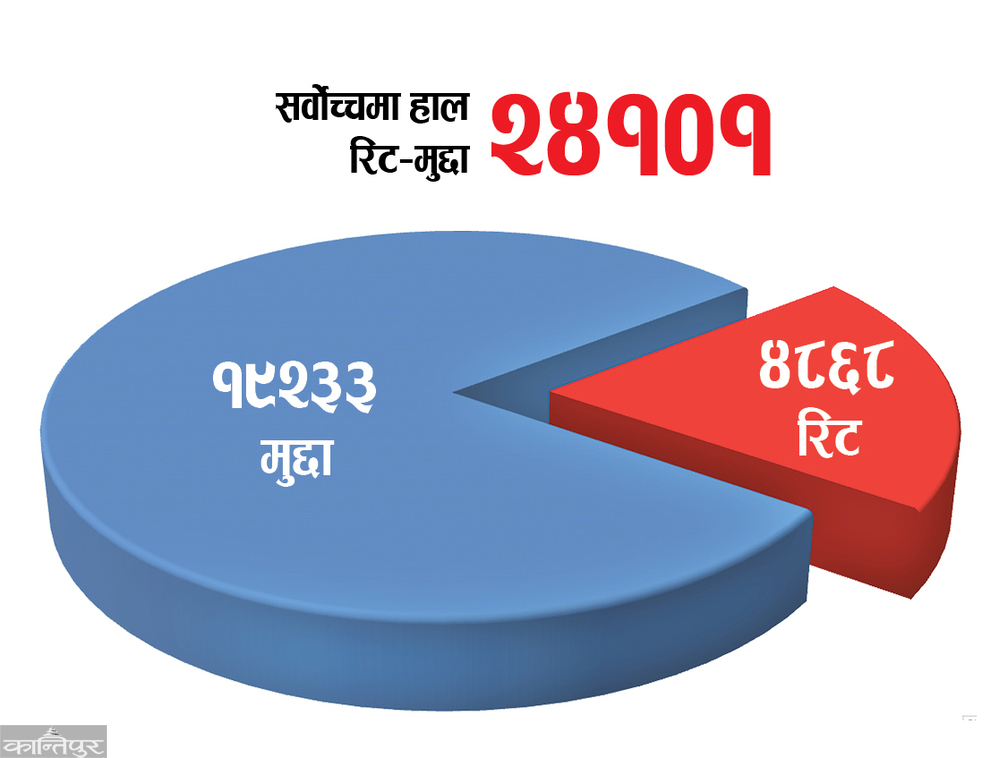
Similarly, currently 24 thousand 101 cases are pending in the Supreme Court, of which 4 thousand 868 are writs and there are 19 thousand 233 cases. In the last 10 years, 95 cases out of 210,400 have been filed in the Supreme Court. Among them, 44 thousand 415 writs were registered and 166 thousand 80 cases were filed. But the case clearance rate is lower in the Supreme Court than in the District and High Courts. In the district and high courts, the case clearance rate is above 65 percent, while in the Supreme Court, it barely reaches 40 percent. In the financial year 2080/81, only 37.67 percent of cases were dismissed by the Supreme Court. There is a constitutional system of 21 judges including the Chief Justice in the Supreme Court. Up to 10 benches are being formed daily.
The judges of the Supreme Court say that there are three reasons why the verdict of the Supreme Court is less. First, the lack of judges, secondly, the court's time spent on public concerns and political cases, and thirdly, procedural hassles.
The cases registered in the constitutional bench, such as the dissolution of the House of Representatives, the formation of the government of the provinces, and the writs claiming public concern against the decisions taken by the government at various times, have to be heard and decided continuously, and when these cases are debated for weeks, there is a problem that the people's cases do not get their turn. Similarly, due to the practice of bringing writs directly to the Supreme Court against judgments from special courts and other judicial bodies, people's cases have not been prioritized.
Gopalkrishna Ghimire, the former president of Nepal Bar Association, comments that the problem of people's cases not being heard is related to the judicial leadership and the efficiency of the courts. "The cases have been stuck for years due to the lack of practice of appointing judges on time and fast-tracking cases, getting missiles on time and coordinating between one court and another," he said. Those who sit outside will fight the case slowly. What will happen if he is acquitted after being imprisoned for years? Chief Justice Prakashmansingh Raut himself expresses his displeasure that people's cases are not heard quickly. However, the old backlog has reduced considerably. Still the court needs to pay attention to it. I am focused on this," he said.
A 10-member study committee was formed under the coordination of Judge Harikrishna Karki on 30th July 2077 to correct the corruption of the courts. The current Chief Justice Prakashman Singh Raut was also a member of the committee. The committee admitted that the hearing of people's cases was not a priority or it was difficult to hear them. The report stated that the reason for this is lack of manpower in the Supreme Court, registration of many cases in PIL (Public Concern) and writ jurisdiction and spending a lot of time on it.
A judge of the Supreme Court said that the trial going on in the 4th and 10th bench of the Supreme Court since last Thursday shows how the court's time is being wasted. In court 4, the hearing is ongoing in the case filed that there was corruption in the construction of Babai Bridge, while in court number 10, the case of Nepal Electricity Authority's transformer scam is going on. More than 20 lawyers have signed up for debate in both these cases. In court number 10, 50 lawyers are in the line of debate. After the debate was left on Sunday, it was put on hold for Monday. The judge said that during this period, about 10 people's cases can be cleared daily by two benches.
Similarly, in the internal study conducted by the Supreme Court in 2078, it is mentioned that some petitioners register PIL only for intellectual luxury. According to the study report, it has become difficult to get a turn due to cases that have reached the Supreme Court through the district court and serious cases such as the detention of prisoners. Courts have to waste their additional means, resources and time for hearing such petitions. In order to discourage such applications, consideration should be given at the time of registration of the application," said the report.
But senior advocate Prakashmani Sharma, who has been practicing in many public interest writs, is not ready to accept this argument. He contends that PIL does not allow the government to be arbitrariness from going down an unconstitutional path. "Most of the PILs have been filed focusing on the interests of the collective and the nation," said Sharma, "PILs have not consumed time." He claimed that the importance and dignity of PILs are different and that they are all people's issues. Former judge Anand Mohan Bhattarai says that the PIL cannot be dropped completely. The court should speak on matters affecting good governance. So there is no need to close the door for PILs. But the trend of filing writs without study should be stopped," he said. Bhattarai said that to reduce the pressure of writs and cases in the Supreme Court, more powers should be given to the Supreme Court. "If there is a dispute at the local level or the province, it will be done at the highest level," he said.
Supreme Court spokesperson Arjun Koirala says that it cannot be said that the Supreme Court has not tried. He claims that the Supreme Court has made significant progress since the access to justice by setting up a campaign platform to clear the backlog of old cases. Koirala said that while there were cases of 10 to 12 years in the Supreme Court, now the cases of 8 years ago have been reduced to zero. He also informed that 24,000 pending cases have been kept at a cost of around 40,000. In the case of cases exceeding five years, about 6,000 such cases have been dismissed, three-fourths of which are still 1,400 with the Supreme Court. Spokesperson Koirala said that the target is to dispose of all cases that are more than five years old by the end of June 2083. "It takes time to resolve many pending cases, complex land disputes or writs that require constitutional interpretation," he said, "We are working for this in a planned manner, the court also has a campaign to give speedy justice." It makes the administration of justice legitimate and fair. Clause 3 of Article 133 of the Constitution mentions such a writ under the exclusive jurisdiction of the Supreme Court. The Constitution has given jurisdiction to the Supreme Court to hear five types of writs. The Supreme Court has the authority to issue writs of writs of writs of inquiry, remand, injunction, prohibition, and detention. In the case of the district court, the district court has the right to interdict and injunction in the writ, while the high court has the jurisdiction to issue appropriate orders such as remand, injunction, remand, interdict, writ petition. But most of these disputes come to the Supreme Court. Similarly, another writ area to be filed in the Supreme Court is the Constitutional Bench. In the Constitutional Bench, writs of a political nature and disputes over the rights of provinces and local levels are registered.
cases are of two types, civil and criminal. Any act prohibited by law is punishable by imprisonment for at least one day or a fine of at least one rupee, which is a criminal case. Criminal cases are also of two types, secularist and governmental criminal cases. It is a governmental criminal case where the government takes the case to the court as the plaintiff and the government itself defends the victim through the government lawyer.
A secular criminal case is a case of a civil nature, where compensation is to be paid. A civil case is a case related to one's position, property or family relationship. For example, cases related to inheritance, apostasy, transaction, contract, divorce, relationship maintenance, torts come under civil. Both criminal and civil cases start in the District Court and end with the Supreme Court.
000
'Separate bench necessary for PIL'
- Ramesh Badal, Attorney General
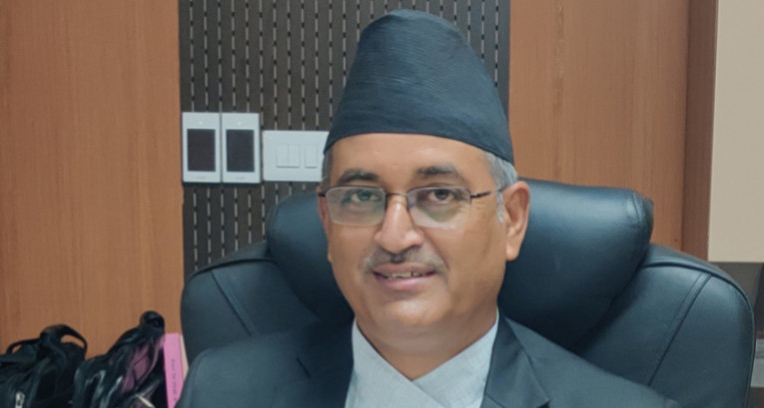
Why are common people's cases not getting their turn?
is not a problem, especially in the district and high courts. The percentage in which district and higher courts have disposed of the cases is not seen in the case of the Supreme Court. Cases have piled up in the Supreme Court. Supreme Court has writ, PIL and district level cases. The Supreme Court is the last court of justice and the place where the people come with their last hope. But as the case has piled up, the verdict or the trial has not been done.
It seems that the writ and PIL in the Supreme Court took time?
This is true to an extent. A PIL may take at least a week of continuous arguments to reach a verdict. During this period only 60 cases of common people are dismissed at the rate of 10 cases every day. It does not mean that PIL should not be brought. PIL helps to prevent arbitrary activities from serious constitutional interpretation. But it is necessary to stop the writs that are immature and come with someone's selfishness. Such writs have neither helped the people nor the state. Just wasted the court's time.
How to prioritize people's issues?
People are running from district, higher to the highest. They take years to reach the top. Just as the Supreme Court has conducted a campaign to pursue old cases, people's cases should also be prioritized. A dedicated bench may be created for PILs and writs. PILs and writs are heard there. People's cases are heard in regular court. It does not affect either.
How much discussion is there between the attorney general's office and the court to solve the court's problems?
We don't have such a discussion mechanism yet. There is a fear of public speaking. So this problem is yours. It should be started by the court itself. The executive cannot speak on this matter. Instructions cannot be added to. Because the concept of an independent court is in the constitution. It is free to formulate your justice. The judicial leadership should begin. Once a year, many problems can be found to be a source of mechanisms that the cases of the people should not be heard that the issue of the people should not be heard.

