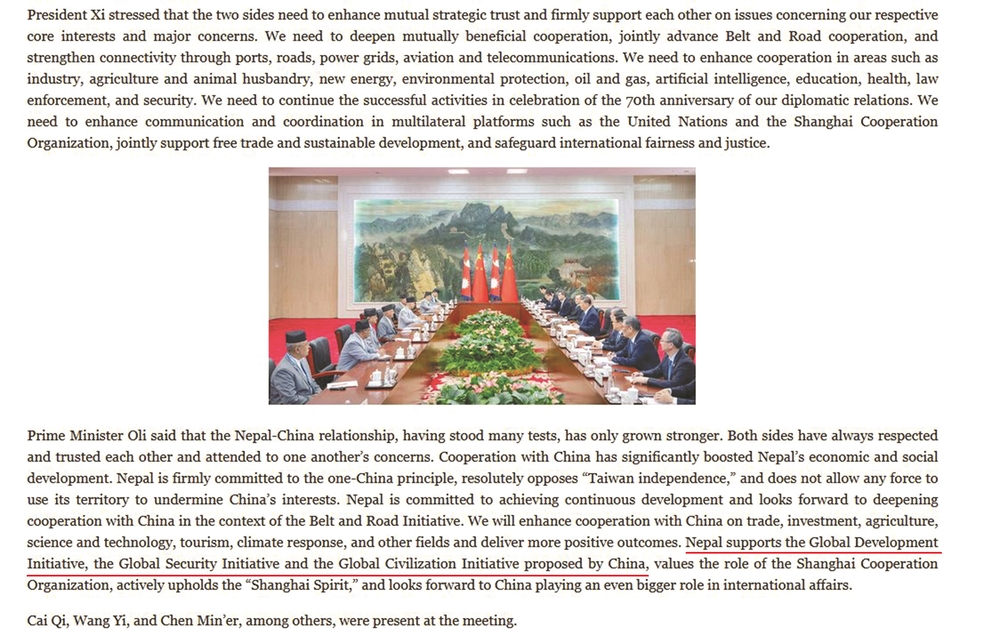
The statement released by the Chinese Foreign Ministry does not mention the Lipulek incident, but it is claimed that Nepal supports other concepts of China including the GSI.
We use Google Cloud Translation Services. Google requires we provide the following disclaimer relating to use of this service:
This service may contain translations powered by Google. Google disclaims all warranties related to the translations, expressed or implied, including any warranties of accuracy, reliability, and any implied warranties of merchantability, fitness for a particular purpose, and noninfringement.
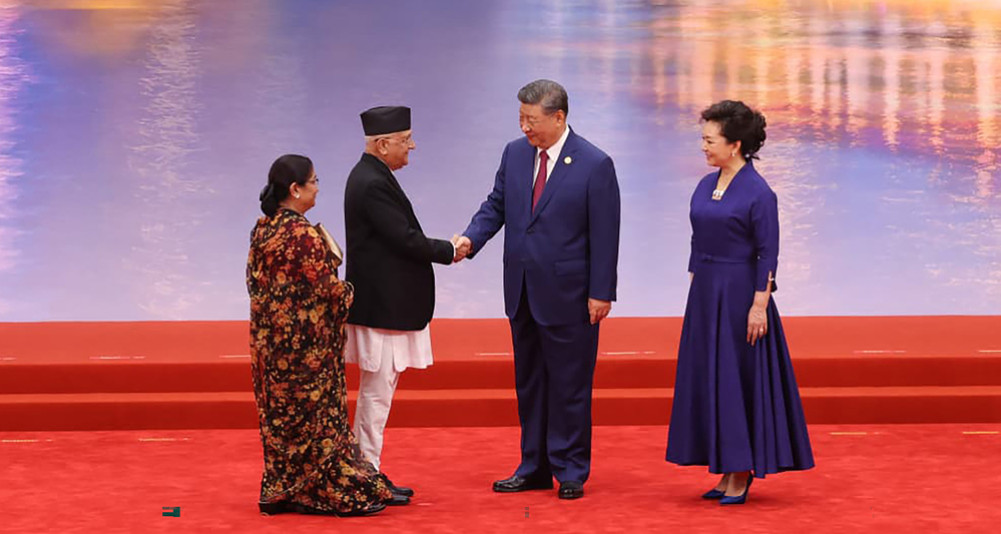
The news of Nepal's support for China's strategic concept Global Security Initiative (GSI) has sparked protests in Nepal. After talks between Prime Minister KP Sharma Oli and Chinese President Xi Jinping in Tianjin on Saturday, a statement issued by China claimed that Nepal supported the GSI.
Article 51 of the Constitution of Nepal clearly states that Nepal's foreign policy will be guided by the principles of non-alignment and Panchsheel. Nepal cannot become a partner or supporter of any security strategy based on policies unrelated to Nepal's constitution and foreign policy.
Nepal has been living separately from strategic concepts like America's Indo-Pacific Strategy (IPS) and China's Global Security Initiative (GSI). But China has mentioned in the statement that Nepal supports GSI. The delegation including Prime Minister Oli is still in China, but the Nepal government has not yet given a diplomatic response to China's statement.
Prime Minister Oli is visiting China to participate in the 25th Summit of the Shanghai Cooperation Organization (SCO). The heads of government of SCO members and non-member countries are participating in the conference. Nepal is a 'dialogue partner' of SCO.
After landing in Tianjin on Saturday, Prime Minister Oli had a meeting with President Xi Jinping. According to Foreign Secretary Amrit Bahadur Rai, Prime Minister Oli raised issues including the agreement made by China and India to resume trade through Nepali land Lipulek. "In the meeting with the Chinese President, Prime Minister Oli raised the issue of the recent agreement between the two neighbors of Nepal and asked to recognize Lipulek as part of Nepali territory," said Rai.
The statement issued by the Chinese Foreign Ministry does not mention the issue of Lipulek, rather it is claimed that Nepal supports other concepts of China including GSI. Nepal supports Global Development Initiatives (GDI), Global Security Initiative (GSI) and Global Civilization Initiatives (GCI) proposed by China. According to the values and spirit of the Shanghai Cooperation Organization, China expects an even greater role in international affairs," the Chinese Foreign Ministry said in a statement.
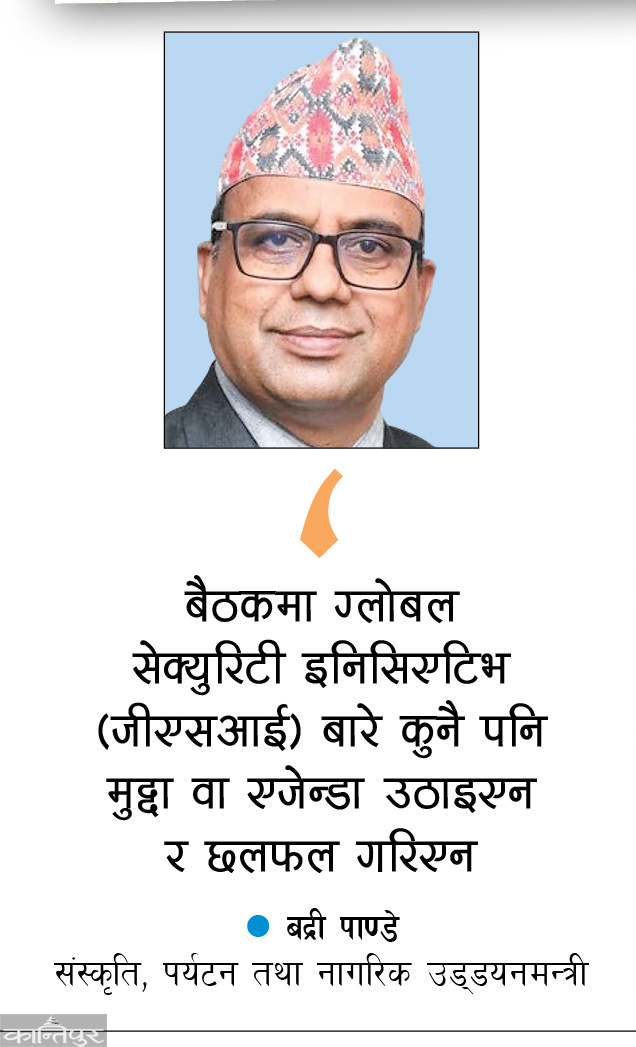
Ministers, senior officials and aides in the Prime Minister's visiting team have rejected the claims of the Chinese Foreign Ministry. "No such issue or agenda was raised or discussed in the meeting," Culture, Tourism and Civil Aviation Minister Badri Pandey told Kantipur from Beijing.
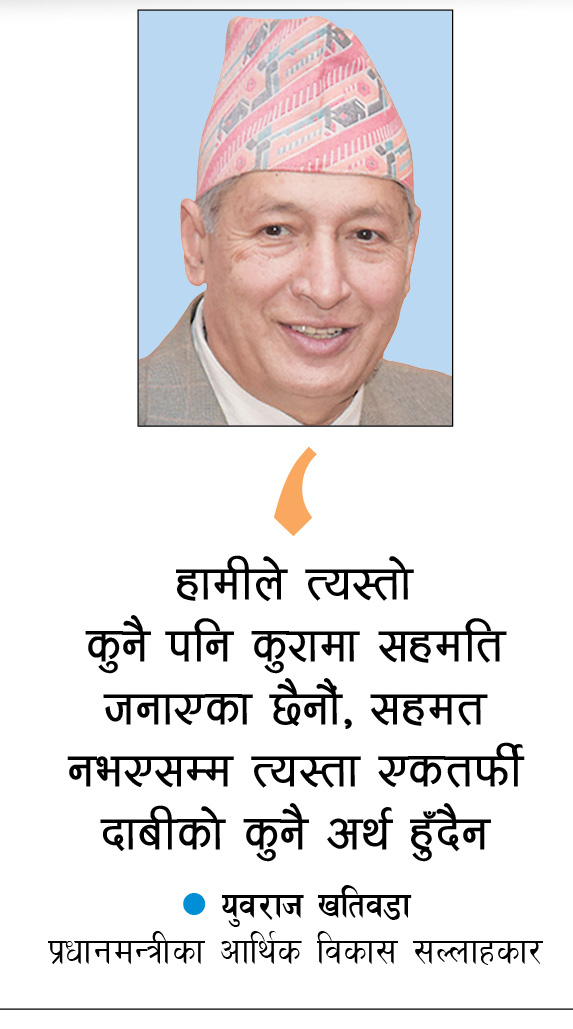
 Similarly, Prime Minister's economic development advisor and former finance minister Yuvraj Khatiwada, who is in Beijing, also commented that the Chinese claim is meaningless. "We have not agreed to anything like that. Unilateral claims have no meaning unless we agree,” said Khatiwada. "The news that Nepal has supported GSI is wrong," Nepali Ambassador to China Krishna Prasad Oli told Kantipur on the phone, "That is a false news. The Prime Minister's visit is going very well and we have not made any such agreement or support," said Oli.
The GSI is considered a Chinese security strategic concept. However, China calls it a concept promoted for world development, prosperity and peace. Although China has repeatedly requested Nepal to support this, Nepal has been keeping itself apart. "We have clearly told the Chinese leaders and officials that we cannot be a part of the GSI for various reasons," says Bishnupukar Shrestha, the former ambassador to China, "We rejected the GSI." Likewise, on 31 August 2075, Nepal refused to allow the Nepali Army to participate in the joint military exercise between the member states of the Bay of Bengal Initiative for Multilateral Technical and Economic Cooperation (BIMSTEC) in Pune, India. BIMSTEC includes India, Bhutan, Bangladesh, Sri Lanka, Myanmar and Thailand along with Nepal. But Nepal has been keeping itself apart from the strategic partnership program. Experts in diplomacy and security affairs say that the government should come out with an official statement on the Chinese claim that Nepal supports the GSI.
Deviram Sharma, an expert on security matters and former head of the National Investigation Department, says that even though the Chinese side has been lobbying for Nepal's participation in the GSI, it is serious for the Chinese side to bring out the issue that the Prime Minister's visit has been agreed upon.
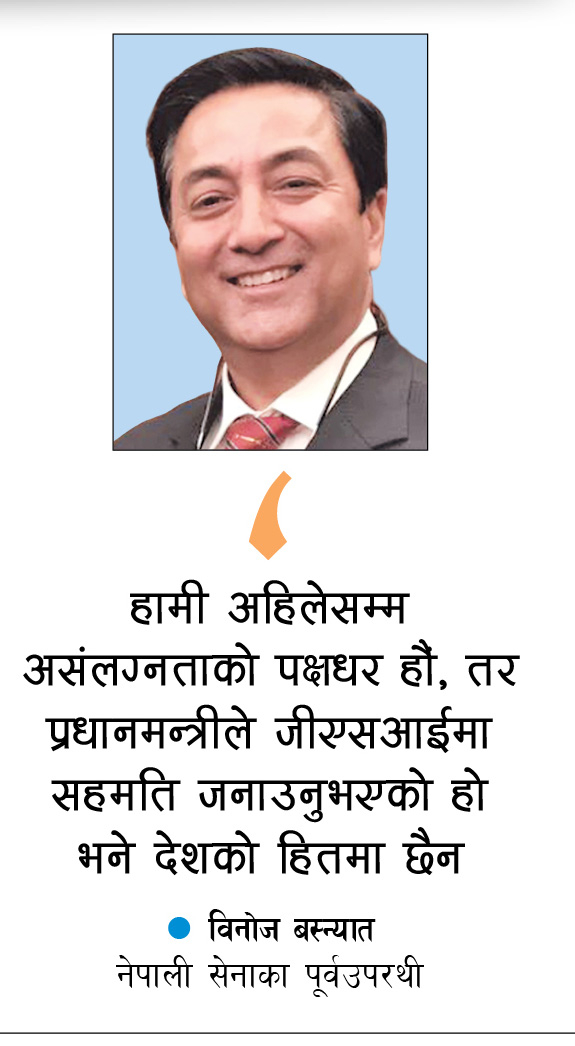
"The prime minister has neither told the House of Nepal that the issue of GSI will be discussed, nor has he discussed it in the cabinet. I am surprised how a topic that has not been raised has reached China and become an agenda," Sharma said. Vinoj Basnyat says, "Currently, the world is divided into three poles in terms of the interests of powerful nations, one is America, the other is China and the third is non-aligned." We are in third so far. But if the Prime Minister agreed on GSI, it is not in the interest of the country.
Basnyat says that if he went to China and supported GSI without even discussing it within the country, it would be wrong. The topic has come up that Nepal has expressed support for GSI, what is the government's opinion on this? That should come out," he says. "If the Prime Minister has agreed, is it according to national-foreign policy? Or have you agreed to support the party participating in the government? Or did he refer to himself? That should also be clear information. If the Prime Minister agrees to this according to the government or his party's line, he commented that the risk of Nepal falling into the 'strategic trap of powerful nations' is imminent.
 During his speech at the Boao Forum for Asia annual event held in April 2022, Chinese President Xi proposed the Global Security Initiative (GSI). At that time, he questioned the validity of America's Indo-Pacific Strategy (IPS) and Quad (America, Japan, Australia and India) and proposed GSI as an alternative.
In the Chinese Communist Party (CPC) high-level dialogue with world political parties held on March 15, 2023, President Xi also offered to participate in the GSI. Although China has repeatedly tried to add Nepal to the GSI, which is said to have been supported by more than 100 countries, Nepal has been sticking to its commitment.
Liu Jinsong, director general of the Asia Affairs Department under the Ministry of Foreign Affairs of China, requested Nepal to participate in the GSI in a meeting with Shrestha, the then Ambassador of Nepal to China, on 14 December 2079. The day after the meeting, the Chinese Ministry of Foreign Affairs issued a statement stating that it wants to advance the implementation of the Belt and Road Initiative (BRI), Global Development Initiative (GDI) and Global Security Initiative (GSI) with joint promotion and common concepts.
Similarly, during the visit of the then Speaker of the National Assembly, Ganesh Timalsina, to China on 29th June 2080, the Chairman of the Chinese National People's Congress, Chao Lachi, requested Nepal to participate in the GSI.
With the acceptance of the US international development program MCC by the government of Nepal, some have argued against it saying that Nepal has entered into its 'Indo-Pacific Strategy' (IPS). But Nepal has not participated in IPS. In December 2018, the issue of IPS was discussed during the visit of Nepal's Foreign Minister Pradeep Gyawali to America. The subject discussed in the meeting between Gyawali and his American counterpart Mike Pompeo was made public by the US State Department.
 Nepal was heavily criticized on this issue and the then Oli-led government decided not to participate in IPS. After that, the government under the leadership of Sher Bahadur Deuba decided not to participate in the American program State Partnership Program (SPP) under IPS on 6 June 2079.
President Bidya Devi Bhandari participated in a virtual conference on GSI in October 2079 when there was a government led by Prime Minister Sher Bahadur Deuba. She also delivered a video address at an event organized by the Chinese People's Association for Peace and Disarmament (CPSPD). In the context of the International Peace Day, which has been celebrated by the United Nations since 1981, it was held in Beijing under the title of 'Global Security Initiative to maintain peace and stability in the world'. At that time, President Bhandari was criticized in the country because of his speech in a program on security strategy.